Last updated 2026-07-11
TL;DR
At a property tax appeal board, you can question the assessor's appraiser about methodology, comparable sales, condition adjustments, and data errors on your record card. The strongest cross-examination asks the appraiser to confirm facts that contradict the assessed value, then lets the board draw its own conclusion. You don't need a lawyer. You need a numbered list of targeted questions and your own comp evidence.
What actually happens when the assessor testifies at a board hearing?
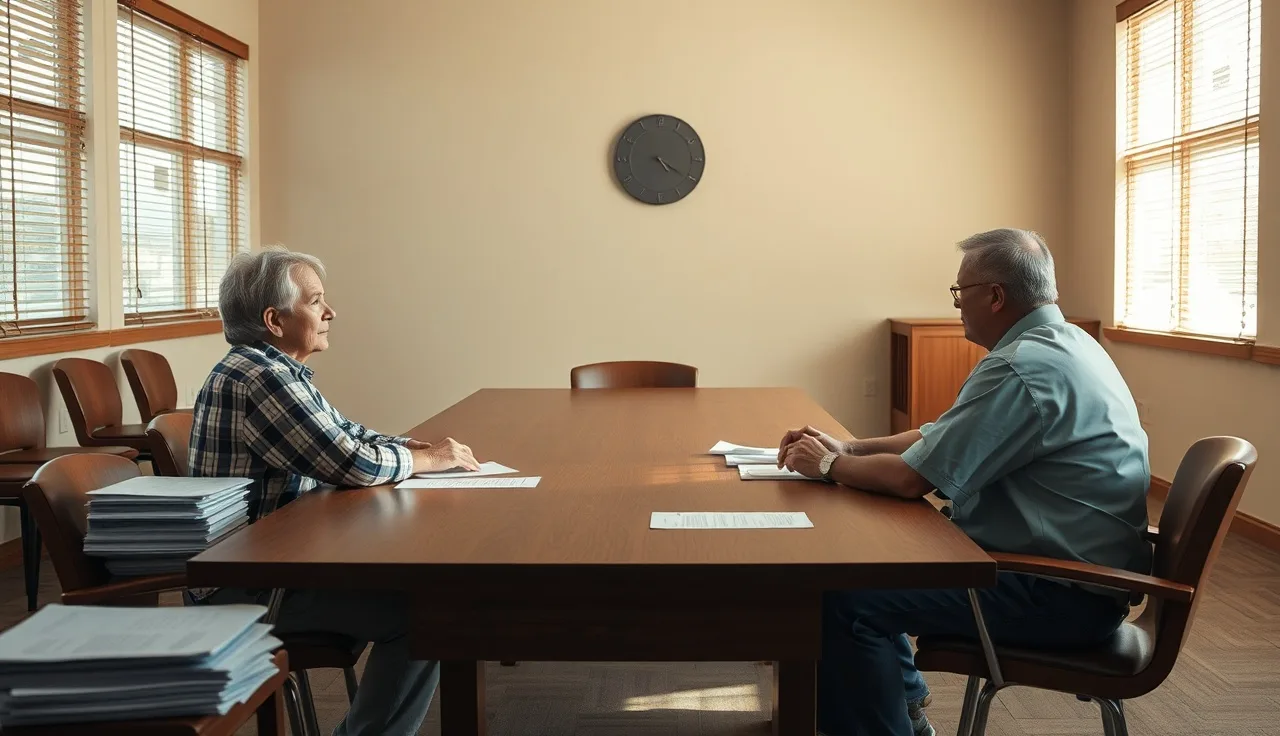
Most homeowners picture a courtroom. What they get is a conference room. Three or five board members sit behind a folding table, a clock ticks on the wall, and a county appraiser reads from a one-page summary of why your assessment is correct.
That appraiser is the assessor's witness. They may be the analyst who set your value, a supervisor, or a staff appraiser pulled in to defend the number. In most jurisdictions the appraiser is not under oath in the criminal-perjury sense, but affirming a valuation before a quasi-judicial board still carries professional weight for a licensed appraiser [1].
Here is how a typical hearing runs. The board chair opens the file and asks you to go first, because the burden of proof usually rests with the taxpayer [2]. You present your evidence, make your argument, and sit down. Then the assessor's representative speaks, often five minutes or less. After that, the board asks questions. So do you. That window, asking questions of the assessor's witness, is cross-examination.
Some boards call it rebuttal. Some call it cross. Some don't label it at all. Call it whatever the board calls it. The opportunity is there regardless of the name.
Do you have a legal right to cross-examine the assessor's appraiser?
In most states, yes. Administrative due-process principles give you the right to confront adverse witnesses in quasi-judicial proceedings, and several state statutes spell it out.
New York requires boards of assessment review to conduct hearings at which the complainant or a representative may appear, be heard, and present and examine evidence [3]. Illinois provides that at the Property Tax Appeal Board each party has the right to present evidence, examine and cross-examine witnesses, and make arguments [4]. Ohio's County Board of Revision rules mirror this.
Even where statute is silent, boards operating under general administrative law must let you question adverse testimony. If a chair tries to cut you off, say it plainly: "I believe I'm entitled to question the appraiser on the evidence they've presented. May I proceed?" Almost every chair will let you continue. You rarely need to cite a statute by number. Asking the question calmly is usually enough.
One caution. Some small boards, especially in rural counties, run informal hearings with no clear procedural rule. Ask before your hearing date whether cross-examination of the assessor's representative is permitted. Get that answer in writing if you can.
What is the assessor's appraiser actually trying to prove?
The appraiser has one job at that hearing: support the assessment as of the lien date with appraisal evidence. They lean on one or more of three things.
Comparable sales come first. They'll name three to six sales in your neighborhood that they say justify your value. Second is the mass appraisal model, which is the statistical regression or cost schedule the county uses to value everything at once. Third is the presumption of correctness, meaning they'll remind the board that the assessment is legally presumed valid until you overcome it [2].
Know what they're defending and you know exactly where to probe. Your cross-examination should be surgical, not scattered. You are not trying to win a debate. You are trying to put three or four specific facts in front of the board that the appraiser cannot honestly dispute, facts that point to a lower value.
How do you prepare cross-examination questions before the hearing?
Start with your evidence file. Pull the county's assessment card, which you should already have requested under your state's public records law. Pull the assessor's comparables if you got them in advance (many boards require a pre-hearing exchange). Read the appraiser's written summary or report if one exists.
For each comparable the assessor will cite, write down the sale date, gross living area, condition at sale, lot size, bedroom and bathroom count, and price per square foot. Then set those facts next to your property. Every meaningful gap is a possible question.
Sort your questions into three buckets.
Bucket one is foundation. What did the appraiser actually do, what data did they use, when did they last inspect your property, and what method did they apply? These aren't aggressive. They're factual setup.
Bucket two is adjustments. Did the appraiser make proper adjustments for condition, size, location, or the time gap between the comparable sale and the assessment date?
Bucket three is your evidence. Ask the appraiser to confirm facts your comps or your condition documents support. For example: "If my property has 1,400 square feet of finished space rather than the 1,620 on the assessment card, would that affect value?" A licensed appraiser cannot honestly say no.
Write the questions on paper. Number them. Keep the supporting document in hand for each one. The board watches you do this and sees that you came ready. That matters.
If you want a ready-made framework organized by valuation method and property type, the TaxFightBack DIY appeal kit includes a printable cross-examination worksheet built around these three buckets.
What are the most effective cross-examination questions to ask an assessor's appraiser?
Below is a table of high-yield question categories, the purpose of each, and a sample phrasing. Adapt them to your facts.
| Category | Purpose | Sample question |
|---|---|---|
| Last inspection | Establish whether the appraiser has firsthand knowledge | "When did someone from the assessor's office last physically inspect this property?" |
| Assessment card data | Expose data errors | "The card shows 3 bathrooms. The property has 2. Is that correct?" |
| Comp sale date | Challenge the time lag | "This sale closed 22 months before the assessment date. Did you apply a time adjustment?" |
| Comp condition | Challenge like-for-like | "That comparable sold in good condition after a full renovation. What condition adjustment did you make for my property?" |
| Comp location | Challenge the neighborhood match | "That comparable is on a cul-de-sac. Mine backs to a commercial parking lot. Was a location adjustment made?" |
| Price per square foot | Anchor the math | "Your comparables average $185 per square foot. My property is assessed at $214. Can you explain that difference?" |
| Mass appraisal model | Challenge blind reliance | "Was an individual appraisal of this property done, or was the value generated by the mass appraisal model?" |
| Equity argument | Raise uniformity | "Are you aware that similar homes on my street are assessed 12% lower per square foot?" |
| Depreciation | Challenge condition scoring | "My roof is 24 years old and needs replacement. How was that factored into the physical depreciation estimate?" |
| Listing price | Undercut the ceiling | "The property was listed for sale at $X for six months before the lien date with no offers. Were you aware of that?" |
A few principles govern how you ask.
Keep them short. One fact per question. Long compound questions let the appraiser dodge or redirect. "Did you adjust for condition, and if so, how, and did you compare that to the market?" is three questions and hands away your control.
Ask questions you already know the answer to. If you're not sure what the appraiser will say, don't ask. Every question on your list should have a yes, a no, or a specific number as its expected answer.
Never argue. When the appraiser says something you disagree with, nod, write it down, and move on. Your chance to address it comes in closing. Arguing with a witness looks bad to the board and almost never helps.
How do you challenge the comparables the assessor selected?
Comparable selection is where most assessor defenses are weakest, because mass appraisal systems often pull comps by zip code and price range with no property-level adjustments. Here's how to attack that.
Map the comparables. Literally. If a comp sits across a major road, in a different school attendance zone, or in a subdivision with different amenities, that geographic mismatch is your opening.
Check gross living area next. A 400-square-foot gap between a comp and your home matters. At $150 per square foot that's $60,000 in unadjusted value. Ask the appraiser whether that adjustment was made and by how much.
Check the sale conditions. A distress sale, a bank REO, or a related-party transfer may not reflect market value. Ask: "Was this sale arm's-length?" A careful appraiser will have verified this. A mass appraisal system often doesn't.
Count the adjustments. If a comp needed large gross adjustments (over 25% of sale price) or large net adjustments (over 15%), it is generally treated as unreliable under Uniform Standards of Professional Appraisal Practice (USPAP) guidance [5]. Ask: "What was the total gross adjustment on that comparable?" Most assessor witnesses will not have the number memorized, which tells the board something.
Then offer your own comps. You should have already submitted them with your evidence package. Ask the appraiser: "Were you aware of the sale at [address] on [date] for $[amount]?" If they weren't, ask why it was left out. If it was left out on purpose, ask on what basis. The board hears this exchange, and it often lands harder than your opening statement.
What do you do when the appraiser claims the assessment has a legal presumption of correctness?
This is the most common defensive move, and it throws a lot of homeowners. The presumption of correctness means the assessment is treated as valid until you produce enough evidence to overcome it. Some jurisdictions set this in statute. Others draw it from case law.
The presumption does not mean you lose. It sets the burden of proof, not the result. Your job is to produce evidence that creates a reasonable doubt about the assessment's accuracy. In most states that means comparable sales or an independent appraisal.
When the appraiser invokes it, acknowledge and pivot: "I understand the assessment carries a presumption of correctness. I'd like to ask about the data underlying it." Then go back to your list. The presumption is a procedural argument. Cross-examination is a substantive one. Don't let the appraiser use one to skip the other.
In Illinois, the Property Tax Appeal Board's procedural rules state that the presumption may be rebutted by a preponderance of the evidence [4]. That's a low bar. Three or four solid comps that sell below your assessed value, presented clearly, usually clear it.
How do you handle a dismissive or evasive appraiser?
Some appraisers are curt. Some give vague non-answers. Some say "the model accounts for that" and stop. Here's how to handle the three most common dodges.
The vague answer. "Our methodology accounts for all relevant factors." Your response: "Can you tell the board the specific adjustment applied for the deferred maintenance items I've documented?" If they can't name a number, that silence speaks.
The credential appeal. "I have 15 years of appraisal experience." Your response: nothing. You don't need to engage with credentials. Ask your next question.
The redirect to policy. "That's how the mass appraisal model works county-wide." Your response: "I understand. But the standard is the market value of this specific property. Does the model produce an accurate individual value in every case?" They'll say no, or they'll hedge. Either answer helps you.
If an appraiser turns hostile or flatly refuses to answer, turn to the chair: "I'm having difficulty getting a direct answer. Could the board ask the appraiser to address [specific question]?" Boards dislike witnesses who seem evasive, even their own. That mild request shifts the room without a fight.
Can you object to the assessor's evidence or testimony?
Technically yes, but the formal rules of evidence don't apply to most administrative boards, so objections work differently than in court.
You can object if the assessor submits evidence that was never shared with you before the hearing, in a jurisdiction that requires pre-hearing exchange. Say: "I haven't seen this document. My understanding is that evidence must be exchanged at least [X] days before the hearing per [board rule]." Rules vary. Check yours in advance.
You can object if the appraiser testifies to hearsay about your property, such as a neighbor's description of its condition, without personal knowledge. Frame it as a question: "Did you personally observe that condition, or is that from a secondary source?"
You can object to comps that don't qualify as arm's-length sales. Most states maintain an arm's-length affidavit database through the state department of revenue or treasury [6].
What you should skip is raising formal legal objections in legal jargon. Most boards have no authority to rule on them, and it makes you look like you're playing games. Substance beats procedure at these hearings almost every time.
What should your closing statement cover after cross-examination?
After you've cross-examined the appraiser, the board usually gives you a short chance to sum up. Two minutes is typical. Spend it well.
Connect the dots. "The appraiser confirmed that no one from the assessor's office has physically inspected this property in seven years. The assessment card shows 1,620 square feet; my permit records show 1,400 finished square feet. And the three comparables I submitted, all within a quarter mile, sold between $X and $Y, which points to a market value of $Z."
Then state your number. Be specific. Not "lower" but "$287,000, which reflects the comparable sales I've submitted." Boards give bigger reductions to taxpayers who name a number and back it with evidence.
Don't recap everything. Pick the two or three strongest points from cross-examination and tie them to your requested reduction. Less is more at this stage.
If your board issues written decisions, you can often request its reasoning in writing. That matters if you decide to push the case up to your state's tax tribunal or circuit court.
What happens after the board hearing, and can you appeal the board's decision?
Most boards issue their decision the same day or by written notice within a few weeks. In a large county like Cook County, Illinois or Los Angeles County, the board may take months to clear a backlog.
If you win a reduction, ask the board clerk whether it applies to the current tax year only or rolls forward.
If you lose, you almost always have a further appeal right. In most states the next step is a state-level tribunal, such as the Illinois Property Tax Appeal Board [4], New York's Small Claims Assessment Review (SCAR) [3], or a state tax court. After that comes the circuit or superior court system.
Deadlines to appeal a board decision are short, often 30 to 90 days from the decision date. Miss that window and you wait for the next assessment cycle. Write the deadline down the day you get your decision.
Rules differ sharply by place. Homeowners in Cook County, Bexar County, and Gwinnett County each face different procedures at both the board and tribunal level, so read your local specifics before you decide to keep fighting.
One more thing. Even a partial win is worth money. A $30,000 reduction on a property taxed at 1.5% saves $450 a year, compounding forward until the next reassessment. Boards rarely grant everything you ask for. Take the partial win, lock in the savings, and decide whether the remaining gap justifies the cost and effort of another round.
The TaxFightBack appeal kit includes a post-hearing checklist that lists next-step deadlines state by state, so the appeal window doesn't close while you're waiting to hear back.
Are there situations where you should skip cross-examination entirely?
Honest answer: sometimes, yes.
If the assessor's appraiser submitted no written comparables or testimony before the hearing and you have solid evidence, you may be better off presenting your case and letting your evidence carry it. Cross-examining nothing leaves nothing to undercut.
If your only goal is a small reduction, say $10,000 to $15,000 on a home, and the board already seems to buy your evidence, cross-examination can add time without adding value. Read the room.
If you feel shaky on a line of questioning, skip it. A fumbled cross-examination looks worse than none at all. Stick to the questions you've rehearsed and know the likely answers to.
The goal is not to win every exchange. The goal is to leave the board with a clear picture of why your property is worth less than the assessment says. Sometimes your evidence alone does that better than any question you could ask.
Frequently asked questions
Do I need a lawyer to cross-examine the assessor's appraiser at a board hearing?
No. Most state boards of equalization and review are built for unrepresented homeowners, with simplified procedures. You do need to prepare: know your comparables, know the data errors on your assessment card, and have specific questions ready. A lawyer earns their fee in complex commercial cases or when large sums are at stake. For a typical residential appeal, preparation beats legal credentials.
Can the assessor's appraiser refuse to answer my questions at the hearing?
They can give vague answers, but in most jurisdictions they cannot flatly refuse. If an appraiser stonewalls, ask the board chair to direct them to respond. Board members dislike evasion from their own assessor's staff. Persistent non-answers often hurt the assessor's credibility more than any single answer would have. Document what they refused to address and reference it in your closing statement.
What is the legal presumption of correctness, and how do I overcome it?
The presumption of correctness means the assessment is assumed to reflect market value unless you prove otherwise. In most states you overcome it with a preponderance of evidence: comparable sales, an independent appraisal, or documented data errors pointing to a lower value. Three to four well-chosen comps that price below your assessed value typically meet the standard at the board level. The presumption sets the burden; it doesn't decide the outcome.
How do I get the assessor's comparables before the hearing so I can prepare cross-examination?
Request them in writing as early as you can. Many boards require pre-hearing evidence exchange, often 10 to 15 days before the hearing, though this varies by county. If your board doesn't require it, file a public records request with the assessor's office for the appraisal workfile or evidence packet for your parcel. Most states require this disclosure under open records law. Get it before the hearing. Don't wait to see it for the first time in the room.
What if the assessor's appraiser never actually inspected my property?
This is more common than most homeowners realize. Mass appraisal systems value hundreds of thousands of properties using statistical models and field data that may be years old. Ask directly: when was the property last physically inspected? If the answer is five, seven, or ten years ago, that's useful testimony for the board. Then walk through documented condition issues, deferred maintenance, or structural problems a physical inspection would have caught, and ask whether those were reflected in the assessment.
Can I cross-examine the assessor's appraiser about errors on the property record card?
Yes, and it's often the most productive line of questioning. The assessment card is the foundation of your value. If it overstates square footage, lists bathrooms that don't exist, or misclassifies the quality grade, those errors go straight to the assessment's accuracy. Bring the card, bring your correcting evidence (photos, permits, a floor plan sketch), and walk the appraiser through each discrepancy. Boards respond well to concrete, documentable factual errors.
What USPAP rules govern what the assessor's appraiser can say at the hearing?
Licensed appraisers must comply with the Uniform Standards of Professional Appraisal Practice (USPAP), which requires opinions supported by market evidence, adjustments that are market-derived, and no advocacy for a value beyond what the evidence supports. USPAP's Standard 6 covers mass appraisal. If the appraiser's testimony contradicts their written workfile or lacks support, that's a USPAP issue. You can note it to the board without citing the standard by name.
How long does a typical board hearing last, and how much time do I have to cross-examine?
Most residential board hearings run five to fifteen minutes total. Cross-examination time is rarely stated separately; it comes out of the overall clock. In practice you may have two to five minutes of actual question-and-answer with the appraiser. That means you cannot ask every question on this page. Prioritize your three strongest lines: a data error, a comparable mismatch, and an adjustment question. Arrive knowing which three matter most and lead with those.
What if the assessor's appraiser brings new evidence the day of the hearing that I haven't seen?
Object right away, and politely. Say: "This evidence was not shared with me before the hearing. I'd ask that the board not consider it, or that my hearing be continued so I have a fair chance to respond." Most boards that require pre-hearing exchange will sustain this or grant a continuance. Boards that don't require exchange are trickier. In that case, ask for a brief recess to review the new material before you cross-examine on it.
Does cross-examining the assessor's witness actually change board outcomes?
Nobody has rigorous experimental data on this. Practitioner experience and board member accounts consistently suggest it helps in specific ways: it puts facts on the record the board might otherwise miss, it shows preparation, and it sometimes gets the appraiser to admit weaknesses in the assessment, on the record, that the board can't ignore. The strongest cross-examinations don't argue. They surface facts and let the board draw the conclusion.
Should I ask the appraiser about sales from after the assessment lien date?
Generally no, but check your state's rules. Most jurisdictions value property as of a specific lien or assessment date, and sales after that date aren't legally relevant to that year's value. If post-lien sales support your argument and your state allows them as secondary evidence of market trends, they can still persuade. Ask your board clerk in advance whether post-lien-date sales are admissible. The rules vary a lot by state.
What is the difference between a board of equalization and a board of assessment review?
The names vary by state, but the function is the same: both are administrative bodies that hear taxpayer challenges to assessed value before a case reaches court. Some states use "board of equalization" (common in California, Colorado, and Washington), some use "board of assessment review" (New York), and others use "board of revision" (Ohio). Procedural rules, deadlines, and evidence standards differ by state, so confirm which body handles your appeal and read that body's rules.
If I win at the board, does the reduction automatically apply to future years?
In most states, a board reduction applies only to the tax year under appeal, not to future assessments. You may need to re-appeal each cycle if values are reassessed annually or every few years. Some states, notably New York under the SCAR process, may lock in a value for multiple years under certain conditions. Ask the board clerk at your hearing whether the reduction carries forward, and get the answer in writing or noted in the transcript.
Sources
- Appraisal Foundation, USPAP 2024-2025 Edition: Licensed appraisers providing testimony before quasi-judicial bodies are bound by USPAP ethical and competency obligations, including Standards Rule 6 governing mass appraisal.
- International Association of Assessing Officers (IAAO), Standard on Assessment Appeals: In most U.S. jurisdictions the burden of proof in a property tax appeal rests with the taxpayer, and the assessment carries a presumption of correctness that the taxpayer must overcome with evidence.
- New York State Department of Taxation and Finance, Assessment Review Procedures: New York requires boards of assessment review to allow complainants to appear, be heard, and present and examine evidence at assessment review hearings.
- Illinois Property Tax Appeal Board, Official Rules and Procedures: Illinois provides that at the Property Tax Appeal Board each party has the right to present evidence, examine and cross-examine witnesses, and make arguments, and that the presumption of correctness may be rebutted by a preponderance of the evidence.
- Appraisal Foundation, USPAP Advisory Opinion 1 and Standard 1: Under USPAP guidelines, comparables with total gross adjustments exceeding approximately 25% of sale price or net adjustments exceeding approximately 15% are generally considered less reliable indicators of value.
- Michigan Department of Treasury, Property Tax and Transfer of Ownership Guidance: Michigan and most other states maintain arm's-length affidavit and property transfer records through the state department of treasury or revenue, which can be used to verify whether a comparable sale qualifies as an arm's-length transaction.
- California State Board of Equalization, Property Tax Rules (Rule 321 and Rule 325): California BOE rules governing local assessment appeals boards require that hearings be conducted so taxpayers have a reasonable opportunity to present evidence and question the assessor's evidence.
- Texas Comptroller of Public Accounts, Property Tax Protest and Appeal Procedures: Texas Tax Code Chapter 41 provides that at appraisal review board hearings, both the property owner and the appraisal district have the right to present evidence, examine witnesses, and argue their case.
- Lincoln Institute of Land Policy, Improving the Administration of the Property Tax: Research from the Lincoln Institute of Land Policy documents that mass appraisal systems routinely produce assessment-to-sale-price ratios that vary significantly at the individual parcel level, creating systematic over-assessment for some properties.
- New York State Department of Taxation and Finance, Residential Assessment Ratio Study: New York publishes annual residential assessment ratio studies by municipality, showing median ratios taxpayers can use to evaluate whether their property is assessed above or below the local equalization rate.
- Cook County Assessor's Office, Appeals Process Overview: Cook County processes tens of thousands of residential and commercial assessment appeals annually and publishes its comparable selection criteria and adjustment schedules online for taxpayer review.