Property Tax Appeal for Unfinished Construction: Assessment Before Completion
TL;DR
If your home was assessed before construction was complete, the assessment may reflect the finished value rather than the actual state of the property. You should not pay taxes on a finished home if drywall is not up, fixtures are not installed, or systems are not operational. Document the completion stage with dated photos, get a construction progress certification from your builder, and present the actual percentage complete as evidence for a proportional reduction.
Property Tax Appeal for Unfinished Construction: Assessment Before Completion is one of those subjects where specifics count. Assessors may value a partially built home at its projected finished value because:.
If you cannot find enough sales in your immediate area, expand your search radius gradually. Start within half a mile, then one mile. Explain to the review board why each comparable is relevant to your property, especially if it is not on the same street.
When This Happens
Assessors may value a partially built home at its projected finished value because:
- The assessment date fell during construction
- A building permit triggered an automatic value increase
- The assessor assumed construction was further along than it actually was
Deadlines in property tax are not flexible. Miss the filing window by even one day and you lose your right to appeal for the entire year. That is another 12 months of overpaying with no recourse. As soon as you receive your assessment notice, find the deadline and mark it on your calendar with a reminder set for two weeks before.
If your deadline has already passed, check whether your state has a secondary appeal window. Some states allow filing with a higher court or board after the initial deadline. If no secondary option exists, start preparing now for next year's appeal so you are ready the moment your next notice arrives.
How to Appeal
Document the Construction Stage
Take dated photos showing the actual state of construction on the assessment date. Interior framing, unfinished electrical, missing fixtures, incomplete landscaping - all of it.
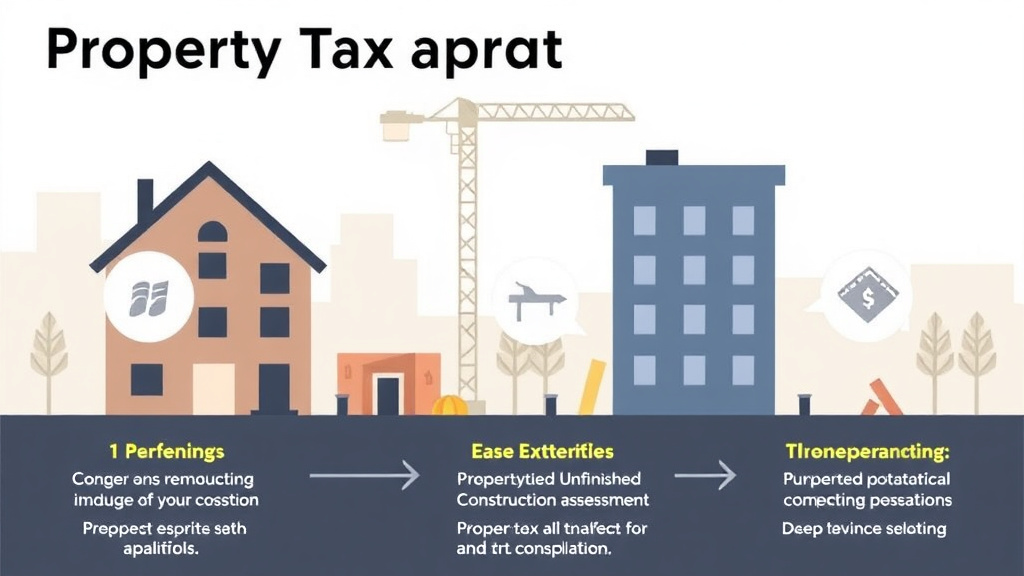
Get Builder Documentation
Ask your builder for a written statement of the completion percentage as of the assessment date, along with the remaining work and estimated cost to complete.
Request Proportional Assessment
If the home was 60% complete on the assessment date, the assessment should reflect approximately 60% of the finished value plus the full land value. Present this calculation to the board.
Appeal the Supplemental Bill
In states that issue supplemental tax bills for new construction, appeal the supplemental bill separately if the value it uses is too high.
Your Next Steps
Do not let this information sit. Take action this week:
- Review your most recent assessment notice. Pull it out and check every line. Look for errors in square footage, lot size, bedroom count, and property features. Mistakes here are more common than most homeowners realize.
- Pull comparable sales data. Find 3 to 5 similar properties near you that sold recently. If they sold for less than your assessed value, you have the foundation of a strong appeal.
- Check your exemption status. Contact your county assessor's office and confirm which exemptions are currently applied to your property. Many homeowners qualify for exemptions they have never filed for.
- Set a deadline reminder. Find your appeal deadline and put it on your calendar with a 2-week advance warning. Missing the deadline costs you a full year of potential savings.
Why Most Homeowners Overpay
Studies consistently show that a large percentage of residential properties are over-assessed. The Lincoln Institute of Land Policy found that roughly 40% of assessments are off by more than 10%. That is not a rounding error. On a $350,000 home, a 10% overvaluation means you are paying taxes on $35,000 of value that does not exist.
The reason is simple: assessors use mass appraisal models to value thousands of properties at once. They cannot inspect every home individually. The models rely on averages, which means homes that are below average in condition, location, or desirability often get assessed too high. If your home has any characteristics that reduce its value compared to the average home in your area, your assessment may be inflated.
The only way to fix this is to check your assessment yourself. Compare it to actual sales of similar properties. If the numbers do not match, file an appeal. The process exists for exactly this purpose, and homeowners who use it save an average of $1,000 to $3,000 per year.
Appealing does not increase your assessment. In most jurisdictions, the review board can only lower your value or leave it unchanged. There is no downside to filing a well-prepared appeal.
Protecting Your Property Tax Savings Long-Term
Winning an appeal or securing an exemption is the first step. Keeping those savings requires ongoing attention. Here is what to do after you succeed.
Monitor your assessment every year. Even after a successful appeal, the assessor can raise your value in subsequent years. Check each new assessment notice and compare it to recent sales. If the value jumps back up without corresponding changes in the market, you may need to appeal again.
Renew exemptions on time. Some exemptions are permanent once filed, but others require annual renewal. Income-based programs are especially common re-application requirements. Missing a renewal deadline means losing the exemption for the entire year.
Keep records. Save copies of your appeal evidence, the board's decision, exemption applications, and each year's assessment notice and tax bill. This documentation makes future appeals easier and protects you if there is ever a dispute about your property's history.
Stay informed about changes. Property tax laws, exemption thresholds, and assessment methods change. Your county assessor's office and your state's department of revenue are the best sources for current information. Check their websites at least once a year, ideally when your assessment notice arrives.
Why Timing Matters
Property tax appeals have strict deadlines, and procrastination is the number one reason homeowners miss their chance to save. Once the filing window closes, there is no extension and no second chance until next year. That is another 12 months of overpaying.
The homeowners who save the most money treat their assessment notice as a call to action. They review it immediately, check for errors, pull comparable sales within the first week, and file their appeal well before the deadline. This approach leaves time to gather additional evidence if needed and avoids the last-minute scramble that leads to weak cases.
If your deadline has already passed for this year, do not wait until next year's notice arrives to start preparing. Begin gathering comparable sales data now. When your next notice arrives, you will be ready to file immediately with strong evidence already in hand.
Try our free tools
Frequently Asked Questions
How does unfinished construction affect my property tax assessment?
If your home was assessed before construction was complete, the assessment may reflect the finished value rather than the actual state of the property. You should not pay taxes on a finished home if drywall is not up, fixtures are not installed, or similar.
When This Happens?
Assessors may value a partially built home at its projected finished value because the assessment date fell during construction or a building permit triggered an automatic value increase. The assessor may have also assumed construction was further along than it actually was.
How to Appeal?
Take dated photos showing the actual state of construction on the assessment date, including interior framing, unfinished electrical, missing fixtures, and incomplete landscaping. Get a written statement from your builder detailing the completion percentage and submit this documentation when appealing the assessment.
Get Your Evidence Packet
Our $79 Evidence Packet can establish the market value of comparable completed homes, giving you the benchmark for your proportional assessment argument.