Last updated 2026-07-11
TL;DR
Assessors split your home into above-grade and below-grade square footage because buyers pay less for a finished basement than for main-floor space. Most jurisdictions value below-grade finished area at 20 to 50 cents on the dollar. If your record has the wrong square footage in either category, you're probably overtaxed, and you can appeal with a tape measure and free public records.
What does above grade vs below grade mean in a property tax assessment?
Grade is the finished ground level outside your home. Above grade is every square foot sitting at or above that exterior ground surface. Below grade is every square foot sitting under it, which almost always means the basement.
The distinction moves money because appraisers and assessors have watched buyers pay less per square foot for below-grade space for decades, even when the basement has drywall, flooring, and a bathroom. The Appraisal Institute's residential measurement standard requires that below-grade areas get measured and reported separately from above-grade gross living area [1]. That convention runs straight into how your county calculates value.
So when your assessor's record says "1,400 sq ft," it usually means 1,400 above-grade square feet. A finished 600-square-foot basement sits on a separate line, often labeled "finished basement," "below-grade finished area," or just "BGFA." Both numbers feed the assessed value. They feed it at different rates.
Why does the distinction matter for your tax bill?
The value gap is real and often large. Assessors apply an adjustment factor to below-grade finished area, usually 20% to 50% of the above-grade cost per square foot, depending on the jurisdiction and the local market. Some county mass appraisal systems price finished basement space as low as $15 per square foot against $80 to $120 per square foot for above-grade living area in the same market.
That spread means a misclassification in either direction costs you.
Say your assessor counted your walk-out basement as above grade because the rear wall opens to grade, even though the front and side walls sit below it. You might be paying tax on 600 square feet at $100 instead of $30 per square foot. That's a $42,000 overstatement in assessed value. Multiply by a 20-mill rate (0.020) and you're out $840 a year.
The flip side is also real. Some assessors never count a finished basement at all. That lowers your value, which sounds like a win, until you sell or refinance and the record contradicts the appraisal. It also means your neighbor with the same basement and a correct record pays proportionally more, which is not a legal equity argument in your favor but is worth knowing.
The most common error, based on what moves through county boards of revision, is above-grade square footage that's simply wrong. A room over a garage measured at the wrong dimensions. An addition the assessor never came out to measure. A finished attic treated as living area when ceiling-height rules say it can't be. Each is a separate line-item error worth checking.
How do assessors measure and classify square footage?
Most U.S. residential assessors follow ANSI Z765, the American National Standard for measuring floor area in detached single-family homes, or the Fannie Mae appraisal guidelines that reference ANSI Z765 [2]. Both require the same three things:
- Only finished, above-grade space counts toward gross living area (GLA).
- A room needs a ceiling height of at least 7 feet across at least half its area to be included.
- Below-grade rooms, even fully finished ones, get reported separately.
Counties plug these standards into mass appraisal. A field appraiser walks the exterior, measures from outside corners, and draws a perimeter sketch. Interior room counts and finish levels come from a short interior inspection or a homeowner-reported data form. That self-reported data is where errors pile up. Homeowners over-report finished basement square footage, assessors under-count it, or the field sketch has an arithmetic mistake nobody ever caught.
Cook County, Illinois publishes its residential valuation model documentation and prices finished below-grade square footage at a separate cost-table rate from above-grade area [3]. Pull your property record card from the Cook County Assessor and you'll see two or more separate area lines.
Split-level and walk-out homes are where classification gets genuinely messy. ANSI Z765 says a room is above grade only if it's at or above grade on all four sides. One exposed wall isn't enough. Plenty of walk-out owners are surprised to find their lowest level counted as below grade despite full-height windows and a patio door.
What is the typical valuation difference between above-grade and below-grade square footage?
Exact multipliers move by county and year, but peer-reviewed and government research gives you solid benchmarks.
The Lincoln Institute of Land Policy's work on mass appraisal accuracy puts finished basement space at 20% to 60% of above-grade space in cost-approach models, with the discount tracking market evidence that buyers pay less for below-grade area [4].
Fannie Mae's selling guide requires appraisers to flag when below-grade square footage accounts for a large share of the total, because it changes comparability [2]. In practice, appraisers across many Midwest markets apply a $10 to $30 per square foot adjustment for finished basement space when above-grade space runs $60 to $100 per square foot. That's a ratio of roughly 25% to 40%.
| Space Type | Typical Assessed Cost Range | Relative Value vs. Above Grade |
|---|---|---|
| Above-grade finished (main floor) | $60 to $130/sq ft | 100% |
| Above-grade finished (upper floor) | $55 to $120/sq ft | 90 to 95% |
| Below-grade finished (basement) | $15 to $50/sq ft | 20 to 50% |
| Below-grade unfinished (basement) | $5 to $15/sq ft | 5 to 15% |
| Garage (attached) | $20 to $50/sq ft | 20 to 35% |
These ranges come from published cost schedules and appraisal literature, not one source. Your county's schedule may sit outside them. Pull your county's cost manual (most post it online) to read the exact numbers used on your parcel.
How do you find out what square footage your assessor has on record?
Start with your property record card, also called a property detail sheet or field card. Every county keeps one per parcel, and most post them online through a parcel search tool. Search your county name plus "property record card" or "parcel detail."
The card lists something like this:
- First floor area: 1,100 sq ft
- Second floor area: 900 sq ft
- Basement finished: 600 sq ft
- Basement unfinished: 200 sq ft
Each line has a cost rate applied to it. Multiply area by rate and you get the contributory value of that component. If the math doesn't add up to your assessed value, there's a depreciation factor or an adjustment you're missing. Ask the assessor's office for the full valuation worksheet.
In Gwinnett County, Georgia, the assessor posts property record cards with each square footage component and the per-square-foot rate applied, so you can audit the calculation yourself without hiring anyone.
In Montgomery County, Maryland, the State Department of Assessments and Taxation keeps the records, and the detail sheet separates above-grade from below-grade finished area explicitly.
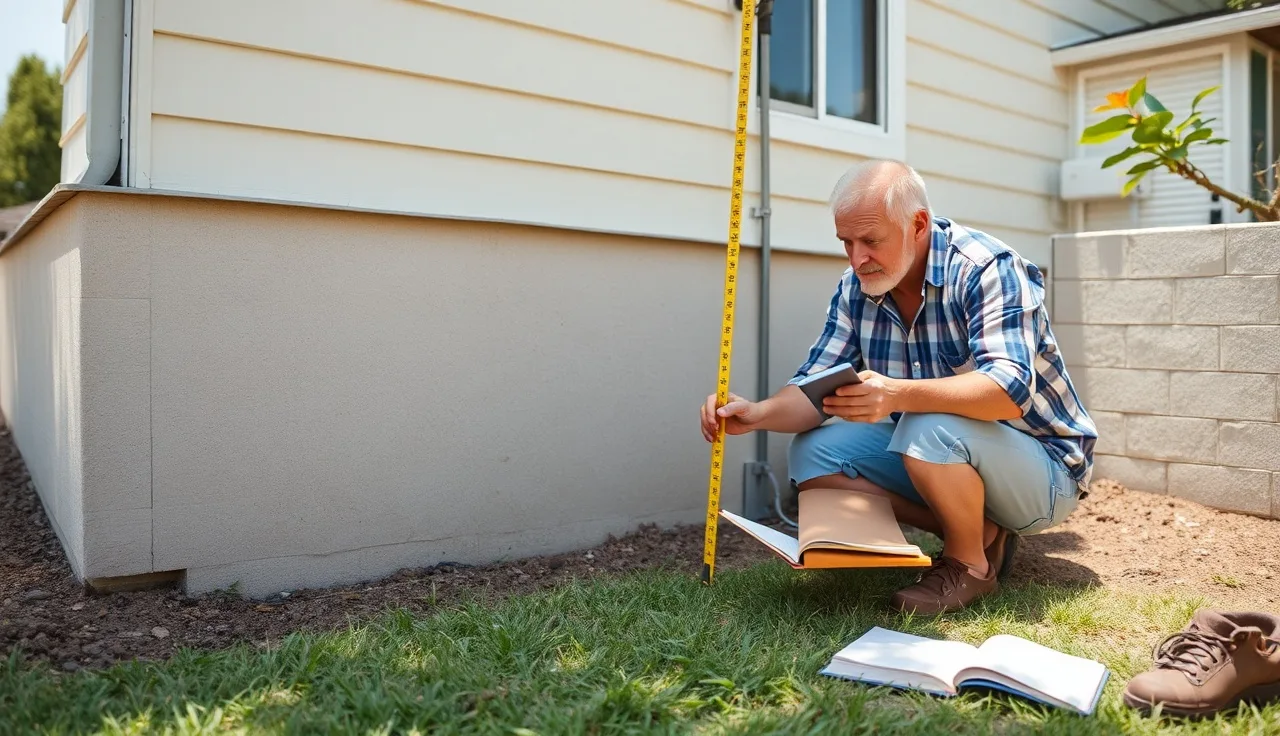
Now grab a tape measure and walk your exterior. Measure corner to corner, outside walls. Sketch it on graph paper. Compare it to the assessor's sketch. A gap of even 50 to 100 square feet in above-grade area is worth thousands in assessed value and is legitimate grounds for an appeal.
What are the most common above-grade vs below-grade misclassification errors?
Pattern one: the walk-out basement counted as above grade. In a walk-out, the rear wall opens to grade but the front and side walls sit below it. Under ANSI Z765, that level is still below grade. Some assessors, especially on sloped lots, count the exposed level as above-grade living area. That inflates your GLA and your bill.
Pattern two: the finished basement not counted at all. An assessor who last visited in 1998 has no idea you finished 800 square feet in 2005. If you never pulled a permit (or the permit never triggered a reassessment), that space may still read as unfinished, which costs the county revenue but leaves neighbors with properly recorded basements paying a higher share.
Pattern three: wrong above-grade footage from sketch arithmetic. A field appraiser measures a bump-out addition and writes it down wrong. Or measures the exterior of an attached garage and folds it into living area. Pure clerical errors, and they turn up in old records with surprising frequency.
Pattern four: ceiling-height disqualification ignored. A finished attic with 7-foot ceilings over only 40% of its area doesn't qualify as living area under ANSI Z765, but it may still sit in the record as finished space.
Pattern five: split-levels classified by floor number instead of grade. In a tri-level or quad-level, the lowest level may or may not be below grade depending on how the lot sits. Assessors often default to counting levels by number rather than by actual grade relationship. That's wrong.
How do you use square footage errors to appeal your assessment?
A square-footage appeal is cleaner than a market-value fight. You're not arguing opinion. You're arguing measured fact.
Step one is documenting your actual square footage. Measure the exterior of each level. Use your mortgage appraisal if you have one, because lenders order ANSI-compliant appraisals and the GLA on that report is done by a licensed professional under standards your assessor is legally required to recognize. If your mortgage appraisal shows 1,380 above-grade square feet and your assessment record says 1,620, that's a 240-square-foot error sitting in writing.
Step two is calculating the tax impact. Take the square footage difference, multiply by your county's above-grade cost rate (from the cost manual or your detail sheet), and that's the overstatement in assessed value. Multiply by your state's assessment ratio (if your state assesses below 100% of market value), then by the mill rate, to get the annual overcharge.
Step three is filing with that evidence attached. Most county boards of revision or equalization accept a written statement, a copy of your measurements or your mortgage appraisal, and a photo of the disputed area. You do not need an attorney or a contingency firm to file this. The TaxFightBack DIY appeal kit walks through this exact evidence format with county-specific forms.
In Bexar County, Texas, the Appraisal Review Board takes square footage evidence at informal hearings. In Los Angeles County, the Assessment Appeals Board lets you introduce your own measurements and any licensed appraisal that contradicts the assessor's sketch.
Deadlines are hard walls. Most states give you 30 to 90 days from the mailing date of your assessment notice to file. Miss it and you're locked in for the year.
Does a finished basement add less value than above-grade space when you appeal on market value?
Yes, and it's more than a cost-model convention. It shows up in sales data.
Research in the Journal of Housing Economics finds buyers discount below-grade finished space relative to above-grade space, with the discount landing somewhere between 40% and 60% depending on market and price tier [5]. A buyer who pays $100 per square foot for a main-floor bedroom pays roughly $40 to $60 per square foot for the same bedroom in the finished basement.
That matters for your appeal two ways. First, if your assessor's cost model prices below-grade space too high against your local market, you can argue the model is out of step with sales evidence. Second, when you pick comparable sales for a market-value appeal, you need comps with similar above-grade square footage. A comp with 2,200 square feet all above grade is a bad match for your 1,600 above-grade plus 600 below-grade home, even if total footage looks close. Bad comps are one of the most common DIY appeal mistakes.
In Santa Clara County, California, Proposition 13 means your assessed value doesn't track the market automatically, so a market-value argument may carry less weight. Square footage errors still matter there for setting the base-year value, especially on a new purchase or new construction assessment.
How do split-level and walk-out basement homes get assessed?
These are the problem cases. Grab a coffee.
In a standard walk-out ranch, the lower level has the rear and sometimes one side wall exposed to grade, while the front and opposite side walls sit underground. ANSI Z765 is clear: a level counts as above grade only if it's at or above grade on all sides. A walk-out basement is still a basement for measurement [1].
But rushed assessors, or ones working off outdated field cards, sometimes tag the walk-out level as a second above-grade floor. Now the homeowner gets a bill that treats a 1,400-square-foot walk-out ranch as a 2,800-square-foot two-story. Common error. Expensive one.
Split-levels are murkier because the grade relationship depends entirely on the lot. A bi-level where the entry sits at grade and the lower level is half buried gets classified differently than one where the lower level is fully underground. If your home is a split-level, walk the perimeter with your tape and a cheap line level. Note the exterior grade elevation at each corner of each level. That documentation, paired with the ANSI Z765 definition, is your appeal evidence.
In LA County, the assessor's published guidelines flag that hillside-lot properties need special attention to grade classification. Same goes for any jurisdiction with topographic variation.
Hennepin County, Minnesota publishes residential grading and sizing guidelines that explicitly separate walk-out basements from above-grade levels. That's more than many counties bother to do.
Can you use your mortgage appraisal to challenge the assessor's square footage?
This is one of the most underused pieces of evidence in a property tax appeal. When you bought or refinanced, a licensed appraiser measured your home under ANSI Z765. That appraisal has a floor area summary separating above-grade GLA from below-grade square footage, done by a credentialed professional whose license depends on getting it right.
If your mortgage appraisal shows 1,380 above-grade square feet and your assessment record claims 1,620, you're holding a standards-compliant document that directly contradicts the assessor's data. Most county boards give mortgage appraisals real weight precisely because they're independent and built on the same measurement standard the assessor is supposed to use.
The Uniform Standards of Professional Appraisal Practice (USPAP) governs licensed appraisers and requires them to report GLA separately from non-GLA space, with measurements following recognized standards including ANSI Z765 [6]. That's the same standard the assessor uses, or should. You're not introducing a foreign method. You're showing the assessor applied the shared method wrong.
Get a copy of your appraisal from your loan file. If you don't have it, your lender must provide it under the Equal Credit Opportunity Act (ECOA) [7]. The appraisal sketch and floor area summary sit on pages 2 and 3 of the standard Uniform Residential Appraisal Report (URAR, Fannie Mae Form 1004).
What happens after you win a square footage correction?
If the assessor or the board agrees your square footage was wrong, they issue a corrected assessment. That corrected value becomes the basis for your tax bill.
Depending on your jurisdiction, you may get a refund of overpaid taxes for the appeal year, and in some states for prior years if the error counts as clerical. Ohio allows correction of clerical errors going back three years. Texas allows retroactive correction of appraisal roll errors within a defined window under Tax Code Section 25.25 [8].
The corrected footage also updates your property record card going forward. That matters when you sell, because a buyer's appraiser sees an accurate record. It matters for future assessment cycles too, since mass appraisal models feed off existing data, so a wrong number compounds year after year until somebody fixes it.
If you lose or the assessor refuses to correct the record, you usually can escalate to the state board of equalization or, in some states, to tax court. At that point the cost-benefit of hiring help versus self-help shifts with the dollars at stake. The TaxFightBack DIY appeal kit covers how to escalate and how evidence standards change at the board versus the court level.
For NYC property tax appeals, the Tax Commission runs a New York-specific process with separate procedures for Class 1 (one-to-three-family) homes, where square footage corrections are among the most commonly accepted grounds for a reduction.
Should you worry if the assessor has your basement listed as unfinished when it's finished?
This is a different problem than most people expect. If your finished basement reads as unfinished, your assessed value is lower than it should be. You're paying less than you technically owe. Sounds great, until three things sink in.
First, when you sell, a buyer's appraiser counts the finished basement correctly. The assessor's record then looks inconsistent with the appraisal, which can raise questions during underwriting.
Second, if the assessor catches the discrepancy during a reassessment cycle or a permit audit, they can retroactively correct the record and, in many states, assess back taxes with interest for the misclassified years. That's a nasty surprise letter.
Third, equity. If your neighbor's identical finished basement is assessed correctly, they're paying more than you for the same home. That's unfair to them, and in states with strong uniformity requirements the assessor has a duty to fix it.
Here's the practical read. If you finished the basement without a permit, you're in an ambiguous spot. Talk to a local real estate attorney before self-reporting. If you finished it with a permit, the assessor probably already has the data, and the record is the thing that needs investigating.
Frequently asked questions
What is the definition of above grade square footage in a home assessment?
Above grade square footage is every finished room at or above the exterior ground level on all sides of the building. Assessors follow ANSI Z765, which requires a room to be at or above grade on all four walls to count as above-grade gross living area. A room that dips below grade on even one side is classified as below grade, regardless of finish level.
Is a finished basement counted as living area for property taxes?
No, not as gross living area (GLA). A finished basement is assessed separately from above-grade living area under ANSI Z765 and Fannie Mae guidelines. It adds to your assessed total, but at a lower per-square-foot rate, usually 20% to 50% of the above-grade rate. It appears as its own line item on your property record card, labeled finished basement or below-grade finished area.
How much less is below-grade square footage worth than above-grade for tax purposes?
Most county cost schedules value below-grade finished space at 20% to 50% of above-grade finished space. The Lincoln Institute of Land Policy cites this range based on mass appraisal cost models and market data. In dollars, if your county's above-grade rate is $90 per square foot, expect below-grade finished area valued at $18 to $45 per square foot.
What does grade mean in property assessment terminology?
Grade means the finished ground surface right next to the exterior of your home. It's not the floor level inside, and it's not the lowest point of your lot. It's the ground level outside each wall. A room is above grade only if the ground outside sits at or below that room's floor on every side. Sloped lots make this judgment call complicated.
How do I find what square footage my assessor has on record?
Look up your parcel on your county assessor's website and download your property record card, also called a field card or property detail sheet. It lists each component (first floor, second floor, finished basement, garage) with its recorded area and cost rate. Most county assessors post these online for free. If yours doesn't, call and ask for a copy; you're legally entitled to it.
What is ANSI Z765 and why does it matter for my tax assessment?
ANSI Z765 is the American National Standard for measuring floor area in detached single-family homes. It defines gross living area, sets the rules for above-grade vs below-grade classification, and establishes the 7-foot ceiling height minimum for habitable space. Most county assessors and all Fannie Mae appraisers must follow it. If your assessor's square footage breaks ANSI Z765 rules, that's grounds for a factual appeal.
Can I appeal my property tax assessment based on wrong square footage?
Yes, and it's one of the stronger grounds because it's factual, not opinion. Measure your exterior perimeter, compare it to the assessor's property record card, and document any gap. A mortgage appraisal showing different square footage than the tax record is especially persuasive. Most county boards of revision accept this evidence at an informal hearing without an attorney.
Is a walk-out basement above grade or below grade for assessment purposes?
Below grade, under ANSI Z765. A walk-out basement has one exposed wall opening to grade, but the remaining walls sit underground or partially underground. ANSI Z765 requires all four sides of a level to be at or above grade to count as above-grade gross living area. Misclassifying a walk-out basement as above grade is one of the most common assessment errors on sloped-lot properties.
Do I need a new appraisal to prove my square footage is wrong?
Not necessarily. Your existing mortgage appraisal, if you have one, already holds an ANSI-compliant floor area measurement done by a licensed appraiser. That document alone can support an appeal. Without a mortgage appraisal, you can measure the exterior yourself and submit your numbers with a clear sketch. Only escalated hearings or tax court cases usually require a fresh licensed appraisal.
What rooms or areas are excluded from above-grade gross living area?
Any space below grade, any unfinished space, garages, open porches, decks, and areas with ceiling heights under 7 feet over more than half their area are excluded from GLA under ANSI Z765. Finished attics with adequate ceiling height can count, but they must clear the 7-foot rule. Bonus rooms over garages count only if they connect to the main living area and meet ceiling-height requirements.
If my finished basement isn't listed on my assessment record, should I report it?
It's a real trade-off. An unlisted finished basement means a lower tax bill now, but the assessor can discover it and retroactively assess back taxes with interest in many states. It also creates inconsistency if you sell or refinance. Talk to a local tax attorney if the space was finished without a permit. If it was permitted, the assessor likely already has the data, and a simple comparison of permit records against the assessment record will surface the gap.
How do I calculate how much I'm overpaying if my above-grade square footage is overstated?
Find the overstated square footage (your measured area minus the assessor's recorded area), multiply by the per-square-foot cost rate from your county's cost schedule, apply your state's assessment ratio if it's under 100%, then multiply by the mill rate. Example: 200 excess square feet at $90 per square foot = $18,000 over-assessed value. At a 25-mill rate (0.025), that's $450 a year in excess taxes.
What evidence should I bring to an assessment appeal about square footage?
Bring your exterior measurements with a labeled sketch, a copy of the assessor's property record card showing their recorded dimensions, any mortgage appraisal you have, and photos showing the grade relationship of any disputed level. If you have a survey or site plan from when you bought the home, include it too. Written evidence beats verbal testimony at most county board hearings.
How far back can I recover overpaid taxes if a square footage error is corrected?
It depends on state law. Ohio allows three-year retroactive corrections for clerical errors. Texas Tax Code Section 25.25 allows appraisal roll corrections within a defined window. Other states limit refunds to the current appeal year only. Ask your county assessor or a local tax attorney what the retroactive correction statute is in your state before assuming you can recover multiple years.
Sources
- Appraisal Institute, American National Standard for Single-Family Residential Buildings (ANSI Z765): Below-grade areas must be measured and reported separately from above-grade gross living area; a room must be at or above grade on all sides to count as GLA.
- Fannie Mae, Selling Guide: Appraisal and Property-Related Policies: Appraisers must note below-grade square footage separately and must follow ANSI Z765 for GLA measurement; below-grade finished space cannot be included in above-grade GLA.
- Cook County Assessor's Office, Residential Valuation Model Documentation: Cook County applies separate cost-table rates to finished below-grade square footage versus above-grade living area in its residential mass appraisal model.
- Lincoln Institute of Land Policy, Fundamentals of Mass Appraisal: Finished basement space is generally valued at 20% to 60% of above-grade space in cost-approach mass appraisal models, reflecting market discounts buyers apply to below-grade area.
- Journal of Housing Economics (Elsevier), research on the value of basement finishing in residential real estate: Buyers discount below-grade finished space relative to above-grade space by roughly 40% to 60% depending on market and price tier.
- Appraisal Foundation, Uniform Standards of Professional Appraisal Practice (USPAP): USPAP requires licensed appraisers to report GLA separately from non-GLA space and to document all measurements in compliance with recognized standards including ANSI Z765.
- Consumer Financial Protection Bureau, Equal Credit Opportunity Act (ECOA) appraisal disclosure requirements: Under ECOA, lenders must provide borrowers a free copy of any appraisal obtained in connection with a credit application for a dwelling.
- Texas Comptroller of Public Accounts, Property Tax Code Section 25.25: Texas Tax Code Section 25.25 allows retroactive corrections to the appraisal roll for clerical errors and other qualifying errors within specified time limits.
- International Association of Assessing Officers (IAAO), Standard on Mass Appraisal of Real Property: IAAO standards require assessors to classify and measure residential square footage consistently, distinguishing above-grade from below-grade finished area for cost model inputs.
- Maryland State Department of Assessments and Taxation, Real Property Assessment Procedures: Maryland's assessment records distinguish above-grade from below-grade finished area explicitly on property detail sheets, with separate contributory values for each component.