Last updated 2026-07-11
TL;DR
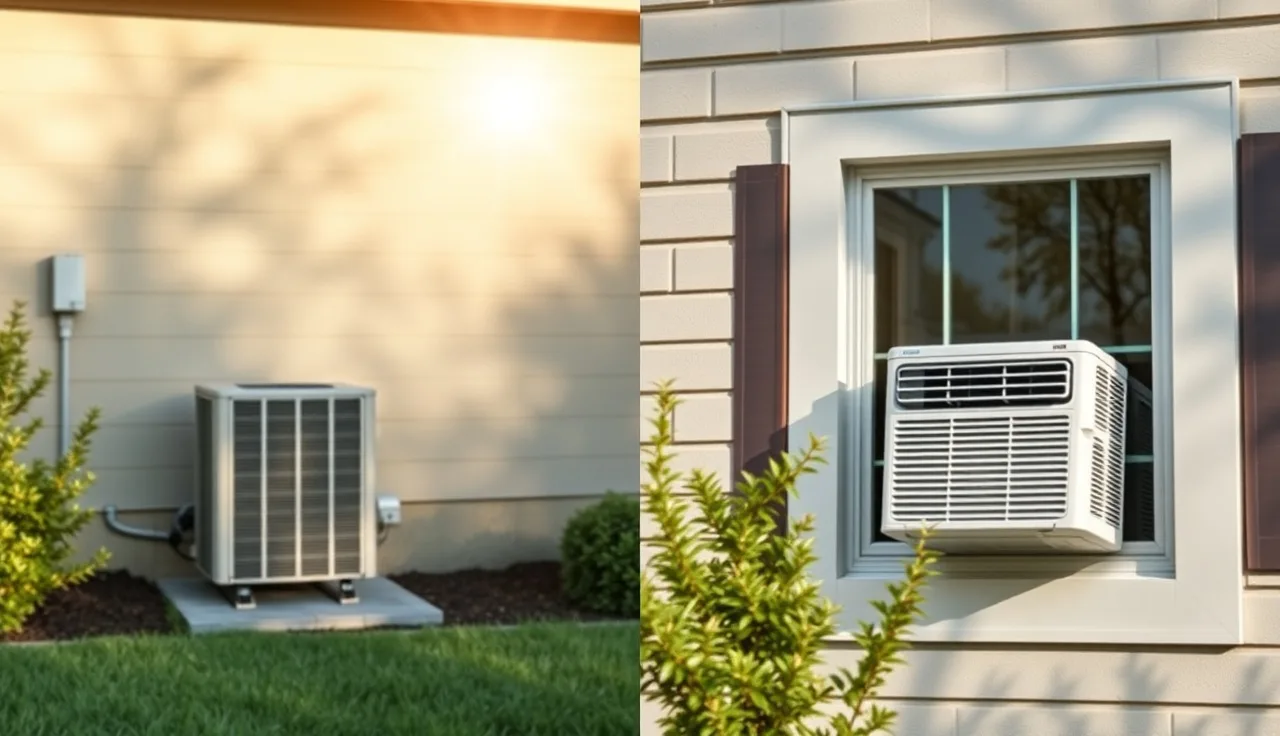
Central air conditioning is permanent, built-in equipment that assessors treat as a fixture, which raises your home's assessed value and your property taxes. Window and portable AC units are personal property in most states and are not assessed as part of the real estate. The difference in assessed value runs from a few thousand dollars to over $15,000 depending on your jurisdiction and home size.
Why does the type of air conditioning affect your property tax bill?
Property taxes hit real property, meaning the land and anything permanently attached to it. Central air conditioning, with its ductwork, condenser, air handler, and thermostat wired into the house, meets the legal definition of a fixture in every state. It becomes part of the real estate. Window and portable AC units are chattel, meaning movable personal property you can take with you when you leave. That one distinction drives the entire difference in how assessors treat them.
Assessors use one of three valuation approaches: the sales comparison approach (comparing your home to recent sales of similar homes), the cost approach (estimating what it would cost to rebuild your home today minus depreciation), and the income approach (used almost exclusively for rentals and commercial property). For most single-family homes, the sales comparison approach dominates. An assessor comparing your home to a sale down the street adjusts upward if that comparable sale had central air and yours doesn't, or downward if yours has central AC and the comp doesn't [1].
Under the cost approach, the central AC equipment itself has a replacement cost. The Marshall & Swift Residential Cost Handbook, one of the two industry-standard cost manuals assessors use, lists forced-air central AC as a component that adds measurable value per square foot, typically in the $8 to $18 per square foot range depending on system type, region, and age of the home, though those figures update annually and vary by edition [2]. A 2,000-square-foot home could therefore carry $16,000 to $36,000 in gross replacement cost for its HVAC system before depreciation. After a standard depreciation schedule, the net contributory value added to the assessment usually lands in the $5,000 to $15,000 range, though outliers exist in both directions.
A window unit sitting in a bedroom adds nothing. The assessor isn't permitted to assess it as part of the real estate, and almost no jurisdiction does.
What makes something a fixture versus personal property for assessment purposes?
The fixture versus personal property question is more than common sense. Courts and legislatures have defined it with tests that assessors are supposed to apply consistently. The three most common tests used across U.S. jurisdictions are the intent test, the annexation test, and the adaptation test, sometimes called the "three-part fixture test" in property law [3].
Intent: Did the owner intend the item to be permanent? A central AC system installed by a contractor, permitted, and tied into the home's electrical and duct system signals permanence. A window unit bought at a hardware store and propped in a window does not.
Annexation: Is the item physically attached to the real estate? Central AC attaches via refrigerant lines, duct connections, electrical wiring, and a pad-mounted condenser bolted to a concrete slab. A window AC is held in by a window sash and a support bracket that comes out in minutes.
Adaptation: Is the item adapted to the specific property's use? Ductwork sized and routed for a specific house layout is adapted to that property. A 10,000 BTU window unit can go in any house.
All three tests point the same direction for central AC versus window units. That's why the treatment is so consistent across states. A mini-split system is where the answer gets murkier: wall-mounted heads are screwed into the wall and connected to refrigerant lines, which most assessors treat as fixtures. Check your specific county's schedule [4].
How much more assessed value does central AC add compared to no AC or window units?
Honest answer: there is no single nationwide number, and anyone quoting one is guessing. The contributory value of central AC depends on local market conditions, the age and condition of the system, the home's square footage, and which valuation method your assessor uses.
Here is what the real data looks like from authoritative sources.
The National Association of Realtors and Remodeling Magazine's annual Cost vs. Value report doesn't isolate central AC as a standalone project, but HVAC replacement data from the report consistently shows that HVAC systems hold roughly 85 to 100 percent of their cost at sale in many markets, which signals how much value the market assigns to the system [5]. A system installed for $8,000 in a mid-tier market might contribute $7,000 to $8,000 in market value.
The Appraisal Institute's guidance makes a point that flips the usual thinking: in hot-climate markets (Phoenix, Houston, Miami, Atlanta), central AC isn't a luxury, it's a baseline expectation. In those markets, the absence of central AC is a negative adjustment in a comp analysis rather than the presence of it being a positive one. So the real question becomes: if your home lacks central AC and all your comps have it, your assessment should be lower than your neighbors', not higher.
In cooler northern markets, central AC is more of an amenity. Assessors there are likelier to apply a positive adjustment for its presence.
The table below shows approximate assessed value adjustments for central AC reported in cost-manual guidance and appraisal literature, by climate region. These are ranges, not guarantees.
| Climate Region | Typical Assessed Value Contribution of Central AC |
|---|---|
| Hot-humid (FL, TX Gulf Coast, LA) | $3,000, $8,000 (baseline expectation; absence penalized) |
| Hot-dry (AZ, NV, inland CA) | $5,000, $12,000 |
| Mixed-humid (GA, NC, VA, TN) | $5,000, $10,000 |
| Cool/Northern (MN, WI, ME, ND) | $2,000, $7,000 |
| Pacific Coast (OR, WA, coastal CA) | $1,000, $4,000 (AC penetration historically low) |
Sources: Appraisal Institute guidance, Marshall & Swift cost data, and county assessor schedules [1][2][6].
Do assessors actually check whether your AC is central or window-based?
They're supposed to, and most large counties do, but the enforcement is patchy. Assessors build their property records from building permits, sales disclosure forms, physical inspections, and MLS listing data when a home sells. Central AC installation almost always requires a permit, which becomes a permanent record in your county's database. That permit triggers an assessment update in many jurisdictions.
Window units require no permits and never appear in assessor records. So if you swapped a central AC system for window units and never told the assessor's office, your record probably still shows central AC and you're paying taxes on equipment you no longer own. That's a legitimate basis for a reduction.
Physical inspections happen unevenly. Some counties run full interior inspections every few years; others rely on drive-by exteriors or aerial imagery. A condenser pad with nothing on it is visible evidence of removed central AC. Several county assessor offices, including those in Cook County, Illinois and Los Angeles County, use third-party data aggregators that pull from building permits, utility records, and public MLS photos. If your listing photos showed window units, that data may already sit in the assessor's system.
The bottom line: if your property record says you have central AC and you don't, fix it. File a correction request with your assessor's office, usually a one-page form with photos. Many offices accept a correction without requiring a formal appeal [4][6].
What if your assessment incorrectly lists central AC that you don't have?
This happens more often than people expect. A previous owner installed central AC, the permit was pulled, the assessor updated the record, and the equipment was later removed or failed and got replaced with window units. The assessor has no way to know unless you tell them.
Step one is to pull your property record from the assessor's website. Most counties now post every assessed characteristic online: bedrooms, bathrooms, garage, fireplaces, and HVAC type. Look for field labels like "cooling type," "air conditioning," or "HVAC." If it says "central" and you have window units, you have a clear, documentable discrepancy.
Step two is to photograph your window units, the lack of a condenser pad or outdoor compressor, and the interior (no registers or ductwork visible). These photos are your evidence.
Step three is to contact the assessor's office to correct the record. This is not the same as filing a formal appeal. Many counties have a property data correction or review process that's faster and requires no hearing. The Gwinnett County Tax Assessor in Georgia, for example, accepts informal review requests outside the formal appeal window for factual errors like this.
If the assessor refuses to correct the record, then you file a formal appeal. You'll need your photos, a statement of the error, and possibly a contractor's statement confirming no central AC is present. Keep every piece of documentation dated [7].
How do you prove the difference in AC type during a property tax appeal?
Evidence is the whole game. The assessor's job is to defend their number; your job is to show it's wrong. For a central-AC-versus-window-unit dispute, your evidence package should include:
Photographs. Exterior shots showing no condenser unit, no refrigerant lines entering the house, no AC disconnect box on an exterior wall. Interior shots showing window units in place, no supply/return registers, no ductwork in visible attic or basement space.
A contractor's written statement. A licensed HVAC contractor can write a one-paragraph statement on company letterhead confirming no central air conditioning system is installed. This costs you a service call at most; some will provide the statement for free if they've worked on the property.
Your property record, printed from the assessor's website. Circle the incorrect field in red. Attach it as Exhibit A.
Comparable sales with notated AC type. Pull three to five recent sales of similar homes in your neighborhood. Find ones that sold with only window AC and note their sale prices. If they sold for less than homes with central AC, that spread is the market's own measure of the value the assessor is wrongly adding to your property.
Utility records can help in a secondary way. A home running on window units typically shows higher per-BTU cooling costs than a central system, and the pattern of separate window-unit draws may show up in detailed electrical records. This is secondary evidence, not primary, and not all appeals officers will care about it.
In jurisdictions where the formal appeal process is well-defined, like Montgomery County in Maryland, the evidence submission rules are explicit: you typically file your evidence package at least 10 days before your hearing date, or it may not be admitted [8].
Does removing central AC and switching to window units actually lower your taxes?
Potentially yes, but with real caveats.
If you removed central AC and your assessment still reflects it, then correcting the record should cut your assessed value by the contributory amount the assessor assigned to that system. On a $10,000 contributory value, at an effective tax rate of 1.2 percent, that's $120 per year. At 1.8 percent (a common rate in higher-tax states), it's $180 per year. Real money, but not the reason anyone removes central AC.
Here's the question homeowners actually ask: "If I'm planning a renovation and skip the central AC installation, will my taxes be lower?" The honest answer is yes, modestly, but you're trading that annual saving against the probable hit to resale value. The Appraisal Institute's guidance on HVAC contributory value suggests that in most markets, central AC returns more in market value than it costs in property taxes [5]. That's a personal finance tradeoff, not a tax optimization strategy.
What I wouldn't do: deliberately degrade your property to shave your tax bill. Beyond the practical downside, assessors aren't fooled by obvious changes made right before an appeal, and some states have look-back provisions on improvements.
The right move is simpler. Make sure your assessment matches what you actually have. Nothing more, nothing less.
Are mini-split systems treated like central AC or like window units for property tax purposes?
Mini-splits (ductless split systems) fall somewhere in the middle, and the answer genuinely varies by county.
A mini-split wall head is permanently mounted, screwed into the wall, and connected by refrigerant and electrical lines running through a hole in the exterior wall to an outdoor condenser. That permanent mounting and the outdoor unit on a pad or bracket look a lot like central AC to most assessors, and many jurisdictions treat them as fixtures.
Some assessors, though, particularly in counties that haven't updated their property characteristic schedules recently, still categorize homes as either "central air" or "none," with no mini-split option. In those counties, your home may be coded "no central AC" even with a full mini-split system, which could understate your home's cooling equipment value from a market perspective while keeping your taxes lower.
If you have a mini-split system, check your property record carefully. If it's coded "no AC" but you have a multi-zone mini-split that cost $12,000, the assessment may be artificially low, which is fine until you appeal something else and the assessor corrects all your data during the review. If it's coded "central air," make sure the comparable sales used to assess you also have mini-splits, not full ducted systems, because the market value contribution can differ.
The Santa Clara County assessor's property characteristic forms, for example, have separate fields for ductless systems versus ducted central air, reflecting more modern data collection [4].
What do assessors look for during an inspection to classify your cooling system?
When an assessor or field appraiser visits, they're hunting for specific physical markers.
For central AC, they check: an outdoor condenser unit (typically on a concrete pad or wall bracket), refrigerant lines running into the home, an indoor air handler or coil unit (often in the attic, basement, or utility closet), supply and return air registers throughout the home, and a thermostat controlling the cooling system. Most assessors also note whether ductwork is visible in the attic or basement.
For window units, they would see: window-mounted or portable equipment, no condenser pad outside, no refrigerant lines penetrating the building envelope, and no central duct system. Any registers present would typically be heating-only.
For practical purposes, a drive-by inspection (the most common type in large metro counties) notes whether a condenser is visible on the exterior. That's often the entire field data point the assessor collects. If you removed a central AC system and the pad is still there but empty, a drive-by appraiser might still code you as having central AC. Remove the pad or photograph its emptiness [6].
If your county still does periodic interior inspections, you may get notice. You have no obligation to let an assessor inside in most states, but refusing an inspection typically means the assessor estimates your interior characteristics from permit records and neighborhood averages, which may be less accurate than a corrected self-reported record [3].
How do you find your home's assessed cooling system classification?
Your property record is public in almost every U.S. county. Here is how to find it:
1. Go to your county assessor's website. Search by address or parcel ID (also called APN, account number, or folio number depending on the state).
2. Look for a section labeled "building characteristics," "improvement details," "structure data," or similar. The exact label varies by county software platform.
3. Find the cooling or HVAC field. Common values you might see: "Central Air," "Heat Pump," "Evaporative," "None," "Window/Wall Units," or numeric codes that map to a legend in the assessor's handbook.
4. Compare what you see to what your home actually has.
If you can't find your property data online, call the assessor's office directly. You have a legal right to review the property record card in every state. Some jurisdictions, like Bexar County in Texas, post very detailed characteristic data online including HVAC type, year of system, and condition rating [7].
Once you confirm an error, the correction process is usually straightforward. The harder path is when the assessor correctly lists central AC but you believe the value assigned to it is too high relative to actual market impact. That's a valuation appeal, not a data correction, and it needs the comparable sales evidence discussed in the earlier section.
When should you appeal based on the AC classification difference?
Appeal deadlines are real and unforgiving. Miss one by a day and you typically wait a full year. The formal appeal window in most states opens when assessment notices go out, usually January through April, and closes 30 to 90 days later depending on the state [8].
You should file an appeal or data correction if:
Your property record lists central AC and you have window units or no AC at all. This is a factual data error and the strongest possible basis for a reduction.
Your property record lists central AC, you do have it, but the system is old, non-functional, or needs significant repair. Assessors typically code cooling systems without tracking condition beyond basic age depreciation, and a broken 20-year-old system carries far less contributory value than the schedule assumes.
Your comparable sales used in the assessment are all homes with central AC, but your home lacks it. The assessor should be making a negative adjustment for your home. If they didn't, you're paying as if you have an amenity you don't.
For a full-picture DIY approach to building your appeal, the TaxFightBack appeal kit walks through the evidence documentation process step by step, so you keep 100 percent of any reduction rather than splitting it with a contingency firm.
What's not worth appealing: you have central AC, it's correctly listed, and you just wish the value were lower. You need market evidence, not AC data, to win that argument. The cooling system classification question is only the lever when the data is actually wrong [8][9].
Are there states where window units or portable ACs are taxed separately as personal property?
Yes. Some states tax personal property separately from real property, and in those states, high-value portable equipment can appear on a personal property tax schedule. This almost never applies to residential window AC units in practice.
The states most aggressive about business personal property tax (Texas, Virginia, and several Southern states) typically apply it to business equipment, not household goods. A window unit in a residential property falls under household goods exemptions that exist in virtually every state [10].
Here's the exception worth knowing. Vacation rental properties, Airbnb-style rentals, and small residential landlords in states with strong business personal property schedules (notably Virginia, Missouri, and some counties in Georgia) may find that window AC units in rental units are technically subject to personal property tax if the property is registered as a business. This is rarely enforced at the window-unit level, but it's worth knowing if you manage rental properties.
For residential homeowners, the practical answer is simple. Window units and portable AC are not assessed, period. The only property tax exposure from AC comes from central systems classified as fixtures of the real estate.
If you're managing rental property in Missouri, the St. Louis County personal property tax system is a good example of a jurisdiction where business-type personal property is actively assessed and billed separately from real estate.
Frequently asked questions
Does replacing central AC with window units lower your property taxes automatically?
No. You have to notify the assessor's office. Most counties don't update your property record unless you report the change, pull a permit for new work, or they conduct an inspection. File a property data correction request with photos showing the removed condenser and installed window units. Once the record is corrected, your next assessment cycle should reflect the lower value.
How much does central AC add to assessed value compared to no cooling?
The range is roughly $3,000 to $15,000 in contributory value, varying by climate region, home size, and system age. Hot-dry markets like Phoenix and Las Vegas tend to show the higher end. Cool northern markets like Minnesota and Oregon show the lower end. Your county's cost schedule or a recent comp analysis will give you the most accurate local figure.
Can I appeal my property taxes just because the assessor coded my cooling type wrong?
Yes, and it's one of the cleaner appeals you can file. A factual data error like incorrect HVAC type is a straightforward correction. Document the error with your printed property record and photos of actual conditions. Many counties process this as an administrative correction rather than a formal appeal, which is faster and requires no hearing.
Are window AC units included in a home's appraised value for property tax purposes?
In virtually all U.S. jurisdictions, no. Window and portable AC units are personal property, not real property fixtures. Assessors are restricted to valuing real property, which means land and permanent improvements. A window unit you can remove in five minutes doesn't qualify as a permanent improvement under any state's fixture test.
What evidence do I need to prove I don't have central air conditioning?
Photos are your primary evidence: exterior showing no condenser pad or unit, interior showing window units and no supply registers or ductwork. A written statement from a licensed HVAC contractor confirming no central system is installed adds credibility. Your printed property record with the incorrect field circled completes the package. Date all photos with your phone's timestamp.
Do mini-split systems get assessed the same way as central AC?
Usually yes, because wall-mounted heads and outdoor compressors meet the fixture tests: they're permanently attached, adapted to the specific property, and intended to stay. But some older county assessment schedules don't have a separate mini-split category and may code them as no central air, which can work in your favor or against you depending on whether your comps have full ducted systems.
How do I find out what cooling system my county assessor has on file for my home?
Go to your county assessor's website and look up your parcel by address. Find the building characteristics section and look for a field labeled cooling type, HVAC, or air conditioning. The value will be a text description or a numeric code. If you can't find it online, request your property record card directly from the assessor's office; it's public record in every state.
Will the assessor's office catch it if I add central AC without pulling a permit?
Possibly. Assessors in many counties use aerial imagery, MLS listing photos, utility permit databases, and third-party data aggregators to catch unpermitted improvements. A new condenser unit on your exterior slab is visible from aerial data and drive-by inspection. Unpermitted work can result in back-assessment for multiple years in some jurisdictions, so permitting is the safer path regardless.
Is a broken central AC system still assessed at full value?
Standard cost schedules depreciate HVAC systems by age, typically over a 15- to 25-year useful life, but they don't account for functional obsolescence from a broken system. If your central AC is non-functional or needs major repair, that's a legitimate basis for requesting a condition-based adjustment in your appeal. A repair estimate from a contractor is the supporting evidence.
Can a landlord appeal if they switched rental units from central AC to window units?
Yes, and the process is the same as for owner-occupied property. Document the change with photos, update the assessor's property record, and file a formal appeal if the office won't correct it administratively. Note that in states with personal property tax on business equipment, window units in rental units may technically appear on a personal property schedule, though enforcement at that level is rare.
How does the presence or absence of central AC affect comparable sales adjustments in an appeal?
If you're appealing on market value, your comparable sales should be adjusted for cooling type. A comp with central AC that sold for $350,000 needs a downward adjustment when compared to your home without central AC. If your assessor used all central-AC comps without adjusting, that's a documented flaw in their methodology and a strong appeal argument. Present at least three adjusted comps in your evidence package.
What appeal deadline applies if my assessment has the wrong HVAC type listed?
Formal appeal deadlines vary by state, typically 30 to 90 days from when you receive your assessment notice. But a data error correction can often be submitted outside the formal appeal window as an administrative review request. Check with your county assessor's office to confirm whether a factual correction like HVAC type has its own process separate from the annual appeal window.
Sources
- Appraisal Institute, The Appraisal of Real Estate, 15th Edition (summary guidance on cost and sales comparison approaches): Assessors use the sales comparison approach for most single-family homes and make adjustments for features like central AC when comps differ from the subject property.
- CoreLogic (Marshall & Swift), Residential Cost Handbook: Forced-air central AC systems are listed as a building component with a cost contribution typically in the $8 to $18 per square foot range depending on system type and region.
- Cornell Law School Legal Information Institute, Fixture (property law definition): Courts apply the intent, annexation, and adaptation tests to determine whether an item is a fixture (real property) or chattel (personal property).
- Santa Clara County Assessor's Office, Property Characteristic Definitions: County assessor property record forms include separate classifications for ducted central air and ductless (mini-split) cooling systems.
- Remodeling Magazine / JLC, 2024 Cost vs. Value Report: HVAC systems typically retain a high percentage of their installed cost in resale value, with national averages near or above 85 percent in many markets.
- International Association of Assessing Officers (IAAO), Standard on Mass Appraisal of Real Property: Assessors are instructed to collect and verify physical property characteristics, including HVAC type, through field inspection, permit records, and data verification.
- Bexar County Appraisal District, Property Search and Characteristics: Bexar County posts detailed building characteristic data online including HVAC type, year of system, and condition rating for all residential parcels.
- U.S. Census Bureau, State and Local Government Finance (property tax administration overview): Property tax assessment and appeal procedures, including notice and appeal windows, are administered at the state and local level and vary across jurisdictions.
- Lincoln Institute of Land Policy, A Primer on Property Tax Administration and Policy: Property tax assessments are based on the characteristics of real property as of a specific assessment date; corrections to property data can affect subsequent assessments.
- Tax Foundation, Personal Property Tax: Does Your State Tax Business Personal Property?: Most states that levy personal property tax apply it to business equipment rather than household goods; residential window AC units fall under household goods exemptions in virtually every state.