Last updated 2026-07-10
TL;DR
Homes within 1,500 feet of a visible cell tower sell for 10 to 20% less than comparable homes without one nearby, according to peer-reviewed Appraisal Journal research. Assessed value is supposed to track market value, so that discount is legitimate grounds for a property tax appeal. You need comparable sales data, a measured proximity argument, and a filed appeal before your jurisdiction's deadline.
Does a cell tower on a neighboring property actually lower home values?
Yes, and there's transaction data behind it, more than complaints. A 2014 study in the Appraisal Journal looked at 1,200 home sales in Duval County, Florida and found homes within 1,500 feet of a cell tower sold for an average of 14.9% less than otherwise comparable homes away from one [1]. That's no fluke. A 2005 study in the same journal found discounts running from 2% to 20% depending on how visible the tower was and how close [2].
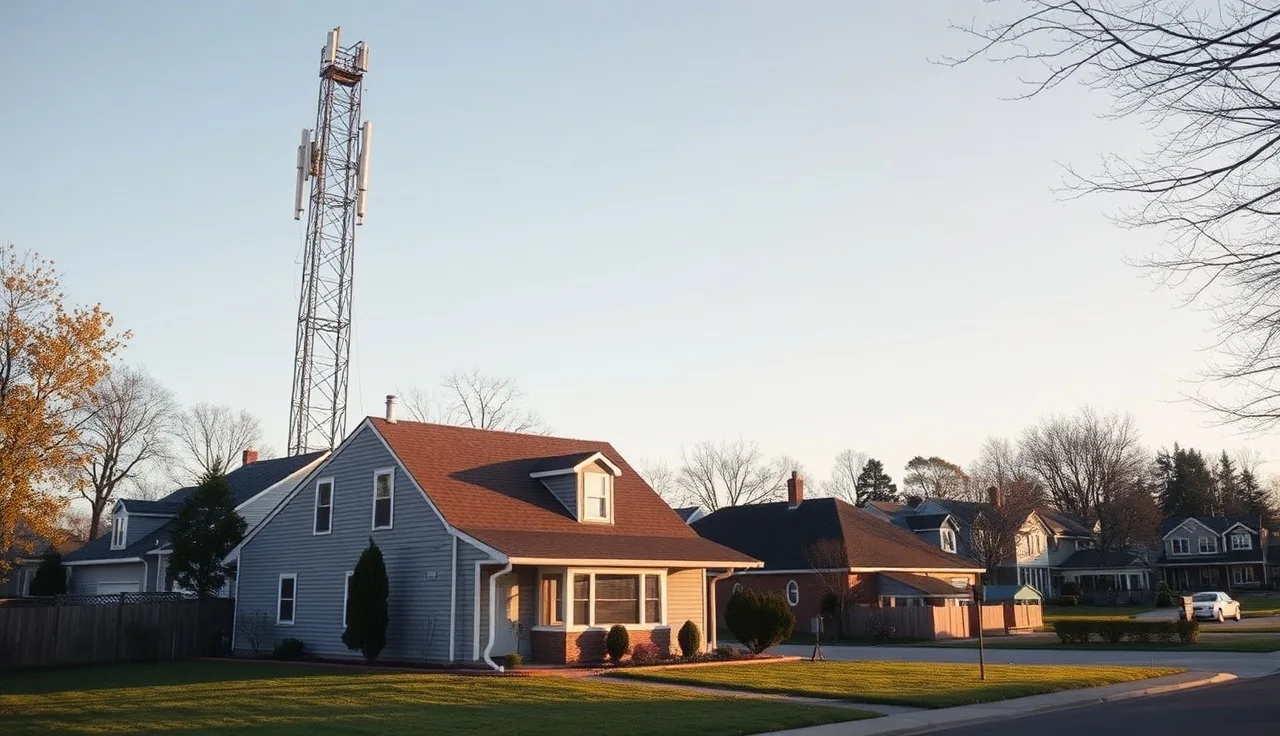
The discount peaks when the tower is visible from the home and within about 500 feet. Push past 1,500 feet and the measured effect fades into statistical noise. So a tower two blocks away and hidden by trees gives you a weak case. A tower 200 feet from your bedroom window gives you a strong one.
One honest caveat. These studies measure sale prices, not assessed values. Assessors usually lag the market by one to three years, and stigma effects rarely produce a clean comparable sale every month. That lag helps you during an appeal, because the assessor has almost certainly never marked your value down for the tower at all.
Why do cell towers depress nearby home values?
Buyers discount tower proximity for a few overlapping reasons, and knowing them helps you frame the appeal.
Visual impact is the obvious one. A 100-to-200-foot steel monopole or lattice tower changes the view from windows, the yard, and the street. Buyers see it, and some walk. Noise is a secondary factor. Equipment huts and cooling fans run around the clock, and the hum carries on quiet nights.
Health perception is the elephant in the room. Whether RF emissions at typical residential distances pose a real health risk is a separate scientific question. Buyer perception is not. Survey studies show a meaningful share of homebuyers say they wouldn't buy near a cell tower, or would demand a price cut to do it [3]. In valuation, perceived stigma counts even if the physical risk is debated or zero. Courts have upheld testimony about buyer perception as a legitimate market factor in condemnation and appeal cases.
Lease permanence adds to it. Cell tower leases commonly run 25 to 30 years with renewal options, so the structure isn't leaving anytime soon. That locked-in quality makes the discount worse, not better, because buyers know they can't wait it out.
How do assessors handle cell tower proximity in practice?
Most county assessors have no written policy on cell tower stigma at all. They run mass appraisal systems that estimate values with statistical models fed by recent sales, property characteristics, and neighborhood factors [4]. Unless a dense cluster of tower-adjacent sales forces the model to recognize a discount, the model ignores it.
That's good for you. It means the assessor probably hasn't already baked in the discount you're owed. Your job in the appeal is to surface the market evidence the model missed.
Assessors in high-volume jurisdictions, like Cook County, Illinois or Los Angeles County, California, will consider a comparable sales argument that explicitly controls for tower proximity. But you have to make that argument and attach the evidence. Nobody at the assessor's office hunts for reasons to cut your bill. For how those appeals run in large urban counties, see the guides for cook county tax assessor tax bill and los angeles county property tax.
A few states, Georgia among them, have case law or administrative guidance on environmental stigma in appeals. Gwinnett County's assessor, for example, fields stigma-based appeals regularly through its board of equalization [5]. If you're in Georgia, the gwinnett county tax assessor guide covers that path.
What evidence do you need to build a cell tower appeal?
You need two things: proof the tower depresses sale prices in your market, and proof your current assessment ignores that discount.
Start with comparable sales. Pull five to ten recent arm's-length sales of homes like yours in size, age, and neighborhood. Then split them: which comps sit near a cell tower, which don't. If the tower-adjacent sales closed lower after you adjust for square footage and condition, that's your core exhibit. County recorder or MLS data is the source, and in most states you can pull sales free from the county assessor's website [4].
Add a map. Use Google Maps or your county's GIS portal to show the tower's exact spot relative to your property. Measure the distance in feet. Note whether the tower is visible from your home. Print it as a labeled exhibit.
Get the tower's lease or permit records if you can. Cell tower permits sit with the local zoning or building department. The permit usually shows tower height, lease term, and carrier. That confirms the structure is permanent, which matters because temporary structures don't scare buyers the same way.
The Appraisal Journal studies are citable peer-reviewed sources you can attach to your brief [1][2]. Print the abstracts. "Peer-reviewed research in the Appraisal Journal finds a 14.9% average discount for homes within 1,500 feet" opens stronger than a bare assertion.
A licensed appraiser's opinion letter adds weight but runs $350 to $600. For a small residential appeal it may not pencil out. A clean, well-documented comp analysis you build yourself often does the same job at the informal hearing. If the assessor rejects the informal appeal and you escalate to a formal board or tax court, a paid appraisal starts to matter more.
How do you calculate how much your assessment should be reduced?
You're not asking the assessor to invent a number. You're showing what the market says your property is worth with the tower present, then comparing that to what the assessor thinks it's worth pretending the tower isn't there.
Here's the math. Say your home is assessed at $400,000 and comparables away from towers suggest a market value around $390,000. But comps near towers in your area sold for 12% less on average. That points to a market value closer to $343,000. The assessment overstates value by roughly $47,000 to $57,000 depending on which comps you lean on.
Your ask is simple: assess my property at the tower-adjusted market value, not the tower-blind model output.
Keep the adjustment conservative. If the research shows a 10% to 20% range, argue the low end unless your facts (very close proximity, high visibility) clearly justify the middle. Boards trust modest, documented adjustments far more than aggressive claims that invite pushback.
Check your assessment ratio too. Some states assess at 100% of market value; others at 80%, 50%, or some other fraction [6]. The reduction argument runs on market value, not the assessed number, so make sure you're working in the right units before you file.
What is the deadline to file a property tax appeal?
This is the question people blow. Every jurisdiction has a hard deadline, and once it passes the appeal window shuts for that tax year. Miss it by a day and you wait until next year.
Deadlines usually run from when the assessment notice is mailed, not when the tax bill lands. Most states give you 30 to 90 days from the mailing date of the notice of assessment [6]. A handful use a fixed calendar date no matter when the notice goes out.
The table below samples state deadlines. Always confirm with your county assessor, because local rules sometimes stray from state defaults.
| State | Appeal deadline | Measured from |
|---|---|---|
| California | 60 days | Assessment notice mailing |
| Texas | May 15 or 30 days after notice | Whichever is later |
| Illinois (Cook County) | 30 days | Assessment publication |
| New York City | March 15 (most classes) | Fixed calendar date |
| Georgia | 45 days | Assessment notice mailing |
| Minnesota | April 30 or 30 days after notice | Whichever is later |
| Florida | 25 days | TRIM notice mailing |
Sources: California State Board of Equalization [6]; Texas Property Tax Code Sec. 41.44 [7]; Minnesota Department of Revenue [10]; Florida Department of Revenue [11]; New York City Department of Finance [12].
If you're in a large jurisdiction and don't know where to start, county-specific guides for montgomery county property tax, hennepin county property tax, and santa clara property tax each cover local deadlines in detail.
Does the cell tower have to be on adjacent property, or does distance matter?
Distance matters a lot. The research puts the zone of measurable market impact at roughly 1,500 feet (about 0.28 miles) for visible towers [1][2]. Inside that zone, closer and more visible means a bigger discount. Outside it, the statistical signal mostly vanishes.
Adjacent property (right next door) is the strongest case. But "neighboring property" doesn't have to mean directly abutting. A tower 300 feet away on a parcel two lots over sits well inside the impact zone. A tower 2,000 feet away, even on the next street, probably won't move the board.
Measure the actual distance from the base of the tower to your front door or property line. Use that number in your filing. "My property is 340 feet from the base of the tower at 4521 Main Street" beats "the tower is nearby" every time.
Visibility matters on its own, apart from distance. A tower screened by a large commercial building or dense tree line hits buyer perception less than an unobstructed monopole you stare at from the kitchen. Document visibility with photos from your property line, your front door, and your backyard.
Can you appeal if the tower was there before you bought the house?
Yes. You can appeal any year the assessment is wrong, no matter when the tower went up or when you bought. Property tax law asks whether assessed value equals market value on the assessment date, not whether the situation changed recently [6].
The cleanest fact pattern is a tower installed after you bought, with the assessor either raising your value or failing to cut it. But even if you bought knowing the tower was there and paid a tower-discounted price, you still have a valid appeal when the assessor's model uses a tower-blind value. Your purchase price is evidence. If you paid $340,000 and the assessor values you at $395,000, that gap deserves a look regardless of why you paid what you paid.
One trap to avoid. Don't argue the tower reduced your value since you bought if you bought at a price that already reflected the tower. That's a logical and legal problem, because you never suffered a drop from a higher baseline. Argue instead that the current assessment overstates current market value, and back it with current comps.
What do appeals boards actually think of cell tower stigma arguments?
Mixed, but improving. Boards that see these arguments regularly, especially in suburban or exurban counties with heavy cell coverage, have grown more receptive over the past decade. The variable that decides it is whether you bring market data or just a grievance.
An appeal that says "the tower is ugly and I'm upset" gets dismissed. An appeal that says "five comparable sales within 0.5 miles that are not in tower proximity averaged $42 per square foot, while two comparable sales within 500 feet of the same tower averaged $37 per square foot, a 12% discount, and my assessment implies $44 per square foot" gets taken seriously.
Some boards won't reduce values on appraiser testimony about stigma alone, without supporting sales. That's why the comp analysis is your foundation, not a garnish. The Appraisal Journal studies help as corroboration, but local transaction data is what actually moves a board.
If the informal hearing fails, escalate. Most states allow a formal appeal to a board of equalization, an assessment appeals board, or tax court as a last resort. At the tax court level a licensed appraiser is basically required, because the proceeding is quasi-judicial. The math shifts there. You're probably only filing in tax court if the annual overpayment justifies $1,000 to $3,000 in total prep costs.
How does this compare to other negative property value factors you can use in an appeal?
Cell tower proximity is one of several external obsolescence or environmental stigma factors that courts and appraisal practice recognize as real value depressants. Here's how it stacks against other commonly appealed factors, drawn from published research and appraisal literature.
| Factor | Typical measured value impact | Research quality |
|---|---|---|
| Cell tower within 1,500 ft | 10 to 20% discount | Good (peer-reviewed, multiple studies) [1][2] |
| High-voltage power line easement | 5 to 15% discount | Good (peer-reviewed) |
| Proximity to landfill (<1 mile) | 5 to 13% discount | Moderate |
| Proximity to highway noise | 3 to 10% discount | Good |
| Superfund site within 1 mile | Up to 25% discount | Mixed |
| Unconventional oil/gas well nearby | 3 to 7% discount | Emerging |
None of these is automatic. Each needs documented comparable sales to win at appeal. The cell tower case is one of the cleaner ones, because the structure is visible, measurable, and permanent, which makes it easy to sort comps into affected and unaffected groups.
For a DIY appeal, the TaxFightBack appeal kit includes a comp analysis worksheet that works for any external obsolescence argument, cell tower proximity included. You keep 100% of whatever reduction you win.
Step-by-step: how to file a cell tower proximity appeal on your own
Here's the process in plain order.
Step 1: Confirm your deadline. Find the date on your assessment notice or call the county assessor's office. Put it on your calendar with a two-week buffer.
Step 2: Measure and document the tower. Find it on your county's GIS map or Google Maps. Measure the distance from the tower base to your property. Take timestamped photos showing the tower as it looks from your property.
Step 3: Pull comparable sales. Go to your county assessor's website or a free public records aggregator and pull six to twelve recent sales (within 12 to 18 months is ideal) of homes like yours. Split them into two groups: within 1,500 feet of any cell tower, and not near any tower. Note the sale prices per square foot.
Step 4: Compute the gap. If tower-adjacent comps sell for 10% to 15% less per square foot, that's your adjustment basis. Apply it to your home to estimate a tower-adjusted market value. Compare that to your current assessment.
Step 5: Write the appeal statement. Be specific: address, tower address, measured distance, comp data table, implied market value, current assessment, requested reduction. Attach the map, the photos, and a copy of the comp table.
Step 6: File on time. Some counties take online filings; others want paper. Confirm the method with your assessor's office. Keep a copy and proof of filing.
Step 7: Attend the informal hearing. Bring two printed copies of your package, one for the hearing officer and one for yourself. State your case in five minutes or less. Answer questions factually. If you get a partial reduction, decide whether to take it or escalate.
For county-specific filing instructions and assessor contacts, the guides at bexar county tax assessor and bibb county tax assessor show exactly how the informal and formal steps run in two different state systems.
Frequently asked questions
How much can a cell tower reduce my home's value for property tax purposes?
Published research in the Appraisal Journal finds average discounts of 10% to 20% for homes within 1,500 feet of a visible cell tower. The exact number turns on distance, visibility, and your local market. For a $350,000 home, a 12% discount means the assessor's value is overstated by roughly $42,000, which turns into real annual tax savings depending on your mill rate.
Does a cell tower have to be on the property right next door to affect my assessment?
No. Research shows measurable value impact up to about 1,500 feet (roughly 0.28 miles) from the tower base. The tower just needs to be visible or close enough that buyers react to it. Measure the actual distance and document visibility with photos. A tower 400 feet away on a parcel two lots over sits well inside the impact zone.
Will my county assessor automatically adjust my assessment when a cell tower is installed nearby?
Almost certainly not. Most assessors use mass appraisal statistical models that won't flag tower proximity unless a dense cluster of tower-adjacent sales shows a discount in the model's data. You have to raise the issue yourself through a formal appeal and supply the comparable sales evidence. The assessor has no reason to lower your bill without a challenge.
What documents do I need to support a cell tower appeal?
You need a map showing the tower's exact location and distance from your property, photos showing tower visibility from your property, a table of comparable sales split into tower-adjacent and non-tower groups showing the price per square foot gap, and a brief written argument tying those facts to your requested reduction. The tower's zoning permit, showing height and lease terms, is a useful supplement.
Can I use the Appraisal Journal cell tower studies as evidence in my appeal?
Yes, as corroborating evidence. Print the abstract and cite the finding: the 2014 Appraisal Journal study found homes within 1,500 feet of a cell tower sold for an average of 14.9% less. Boards treat peer-reviewed research as support for your methodology, but it doesn't replace local comparable sales data. Treat the study as backing your analysis, not substituting for it.
What if the cell tower was there when I bought my home? Can I still appeal?
Yes. You can appeal any year the assessed value exceeds market value on the assessment date. Your argument isn't that the tower reduced your value relative to what you paid. It's that the current assessment sits higher than what your home would sell for today given the tower. Document that with current comparable sales, and the appeal stands regardless of your purchase history.
Is a licensed appraisal required to appeal based on cell tower proximity?
Not at the informal hearing stage in most states. A well-documented comparable sales analysis you prepare yourself is usually enough for the first hearing level. If you escalate to a formal board or tax court, a licensed appraiser's written opinion becomes close to essential because those proceedings are quasi-judicial. A residential opinion letter typically costs $350 to $600.
How far in advance do I need to start preparing my appeal?
Start the moment your assessment notice arrives. Most states give you only 30 to 60 days from the notice mailing date to file, and gathering comps, photographing the tower, and writing a clear brief takes longer than people expect. Aim to have your filing ready at least two weeks before the deadline. Miss the deadline and you wait a full year.
Can I appeal just because a new cell tower went up and my assessment didn't change?
Yes. A cell tower built after your last assessment is grounds to request a review. Your assessment doesn't have to have gone up. You need to show that market value is now lower than the current assessed value. A new tower the assessor hasn't accounted for is exactly the kind of changed condition that supports an appeal in virtually every state.
What happens if the appeal board denies my cell tower reduction?
You can usually escalate to a state board of equalization, an assessment appeals board, or in some states tax court, depending on your state's process. Each level has its own deadline, often 30 to 60 days after the prior decision. At the tax court level you'll generally need a licensed appraiser. Weigh the potential annual tax savings against escalation costs before proceeding.
Does the type of cell tower matter (monopole vs. lattice vs. rooftop antenna)?
Yes, in practice. A tall, visible monopole or lattice tower is the clearest case, because buyers see it and react. A rooftop antenna on a commercial building a few blocks away has a much weaker documented stigma effect, because it's less visible and less tied to the imagery buyers find off-putting. Your photos and visibility documentation matter more when the tower type is ambiguous.
Can I appeal for multiple years if I missed prior deadlines?
Generally no. Property tax appeals are year-specific and run on strict filing deadlines. Miss a year and you usually forfeit that year's remedy. A small number of states allow retroactive corrections for clerical errors or certain assessment failures, but a missed stigma argument isn't a clerical error. File this year and set a recurring reminder for every future assessment notice.
Do other negative factors near my property combine with a cell tower to support a larger reduction?
Yes. You can argue multiple external obsolescence factors in one appeal if they independently affect market value. A cell tower plus a highway noise corridor, for example, might support a larger combined adjustment than either alone. Present each factor with its own comparable sales evidence. Don't just stack the percentages from published research; show actual sales data reflecting the combined impact.
Sources
- Appraisal Journal, "Cell Towers: An Examination of the Effect on Property Values" (2014): Homes within 1,500 feet of a cell tower sold for an average of 14.9% less than comparable homes in Duval County, Florida
- Appraisal Journal, "Cellular Phone Towers: Are There Effects on the Value of Real Property?" (2005): Cell tower proximity discounts ranging from 2% to 20% depending on visibility and distance, documented via comparable sales analysis
- Appraisal Institute, report on cell tower stigma and buyer perception: Survey data shows a meaningful share of homebuyers require a price reduction to purchase near a cell tower, supporting stigma as a market factor
- International Association of Assessing Officers (IAAO), Standard on Mass Appraisal of Real Property: Mass appraisal systems use statistical models fed by sales data and property characteristics; external stigma factors require explicit market evidence to be captured
- Gwinnett County, Georgia, Tax Assessor and Board of Equalization appeals information: Gwinnett County fields stigma-based property assessment appeals through its board of equalization process
- California State Board of Equalization, Property Tax Rules and Assessment Appeals: California property owners have 60 days from the assessment notice mailing to file an appeal; assessment ratio and market value standards apply
- Texas Property Tax Code Section 41.44 (Texas Comptroller): Texas appeal deadline is May 15 or 30 days after the notice of appraised value is delivered, whichever is later
- Minnesota Department of Revenue, property tax appeal process: Minnesota property owners may appeal to the County Board of Appeal by April 30 or within 30 days of the assessment notice, whichever is later
- Florida Department of Revenue, Property Tax Oversight, TRIM notice information: Florida property owners have 25 days from the mailing of the TRIM (Truth in Millage) notice to file a value adjustment board petition
- New York City Department of Finance, property tax appeal deadlines: NYC Class 1 property owners must file appeals by March 15 of the tax year; the fixed calendar deadline does not vary by notice date