Last updated 2026-07-10
TL;DR
External obsolescence is a loss in your home's market value caused by something outside your property, like a busy highway, truck depot, or commercial strip. Assessors routinely miss it. You can document it with paired sales studies, noise studies, or traffic data and use it to appeal your assessment. No attorney required.
What is external obsolescence in property tax terms?
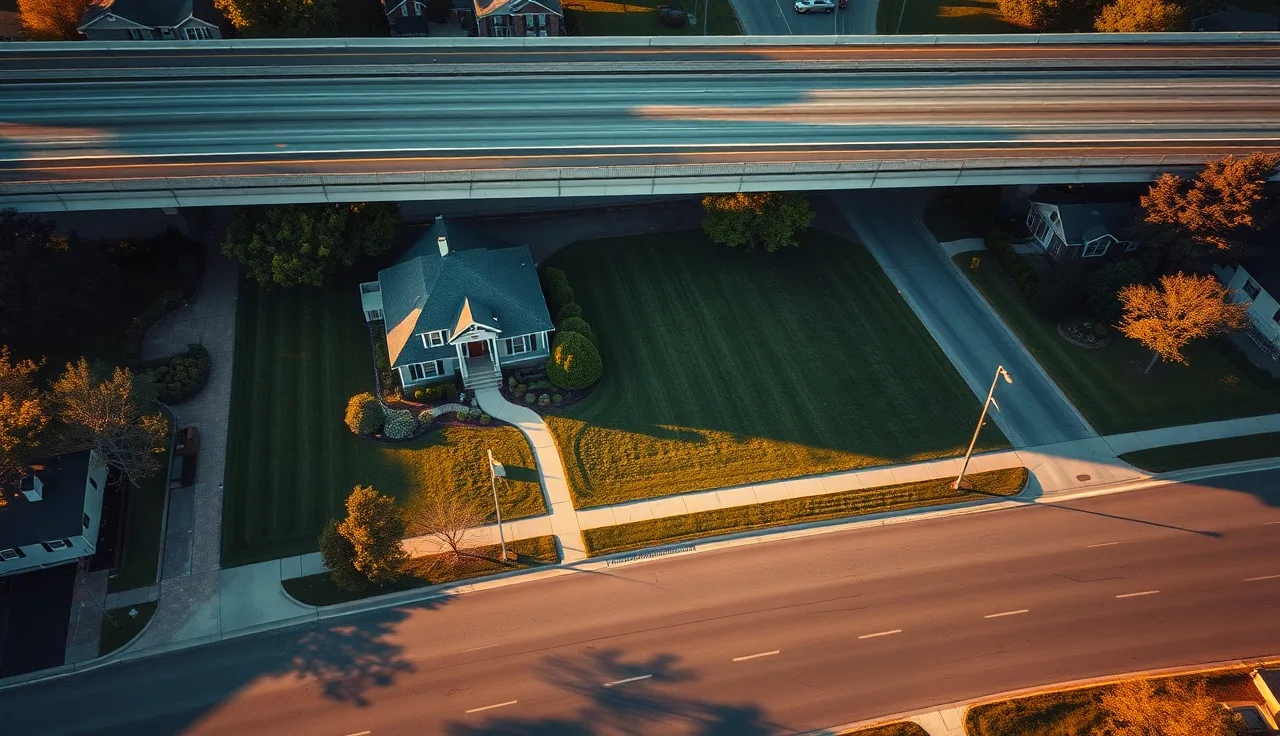
External obsolescence is a drop in your home's market value caused by something outside your property lines. Your neighbor painted their house an ugly color? That's not it. A six-lane interchange appeared 400 feet from your bedroom window? That is it.
The term also goes by economic or environmental obsolescence. The Appraisal Institute defines it as "a loss in value caused by negative influences outside the property," and separates it from physical deterioration (the roof is rotting) and functional obsolescence (the floor plan is bizarre) [1]. All three matter in a full appraisal. For property tax appeals near highways or commercial zones, external obsolescence is almost always the one assessors get wrong.
Here are the sources assessors miss most: interstates and high-traffic arterials, truck depots and distribution centers, rail yards, flight paths, large shopping centers, industrial parks, cell towers next to residential lots, and big-box retail running overnight deliveries. Each one drags down what a real buyer will pay.
The legal grounding is simple. Most state property tax codes require assessors to value your home at "fair market value" or "true value" as of a specific lien date [2]. If the assessor's model never accounts for the highway noise penalty that any buyer would demand, the assessed value is wrong. That gap is your appeal.
How much can a highway or commercial zone actually lower home values?
A high-traffic interstate within 500 feet of your home can cut its market value 8% to 20%, and the research behind that number is consistent enough to put in front of a review board. You need real figures here, not guesses, because the board will ask.
Start with traffic noise. A widely cited survey by Nelson in the Journal of Transport Economics and Policy found that a 10-decibel increase in traffic noise is associated with roughly a 5.8% drop in residential property values, a figure called the Noise Depreciation Index (NDI) [3]. Other studies land between 0.5% and 1.4% per decibel over a background threshold, so the range across the literature is roughly 5% to 15% for homes in high-noise corridors.
Commercial adjacency runs a similar range. Proximity to large retail centers can trim residential values 5% to 10% depending on traffic, lighting, and hours of operation, though some well-buffered commercial uses show almost no effect. Industrial neighbors hit harder. Several studies find 10% to 20% discounts for homes within a quarter mile of active industrial uses [4].
Nobody has a perfect universal number. The closest thing to a consensus is Nelson's NDI of roughly 0.5% to 0.6% per decibel above ambient, tested across dozens of markets. So here's the practical read: if you're 300 feet from an interstate, the penalty is measurable, very likely 5% or more, and probably invisible to your assessor's mass appraisal model.
| Proximity/Source | Typical Value Penalty (literature range) | Common Study Method |
|---|---|---|
| Highway / interstate, < 500 ft | 8%, 20% | Hedonic regression, paired sales |
| Major arterial, high truck traffic | 5%, 12% | Hedonic regression |
| Commercial strip / big-box retail | 3%, 10% | Paired sales |
| Industrial / warehouse park | 10%, 20% | Hedonic regression, income approach |
| Rail yard or freight corridor | 8%, 15% | Hedonic regression |
| Airport flight path | 5%, 15% | FAA noise contour studies |
How do assessors typically miss external obsolescence?
Mass appraisal is fast by design, and speed is exactly why the highway next door gets ignored. County assessors value tens of thousands of parcels using computer-assisted mass appraisal (CAMA) systems that run statistical models across large areas. The models feed on sale prices, square footage, bedroom count, lot size, age, and a few location adjustments. Most CAMA systems apply a broad "neighborhood factor" that may not tell a quiet cul-de-sac apart from a lot backing onto a freeway sound wall [5].
Think about what that means in practice. Two homes with the same square footage and age in the same ZIP code can get nearly identical assessed values even when one stares at a strip mall parking lot and the other backs onto a greenbelt. The model lumped them together.
Assessors are short-staffed, too. Most counties can't verify on-the-ground noise, measure actual traffic counts, or apply property-specific obsolescence deductions for every residential parcel. So they don't. The burden of showing the assessor got it wrong lands on you.
One more trap. Many assessors anchor to sales that predate a new commercial development. If a warehouse opened in 2022 and the comp pool is mostly 2019 to 2021 sales, those pre-development values get baked into your 2024 or 2025 assessment. That's a specific, documentable gap, and you can use it.
What evidence do you need to prove external obsolescence on appeal?
You need to show the board a measurable gap between what the assessor assumed your property is worth and what it would actually sell for with the highway, rail yard, or commercial zone next door. Evidence that makes the gap concrete wins. Vague complaints lose.
Paired sales analysis. This is the most persuasive method. Find two or three homes very similar to yours in the same neighborhood, without the adverse condition, that sold recently. Then find two or three that do have it. The price difference, adjusted for size and age, isolates the external obsolescence. You don't need a licensed appraiser for this. You need good MLS or public record data, and your county assessor's website often lets you pull recent comparable sales for free [6].
Before-and-after sales. If the commercial use or highway expansion opened after a set of pre-development sales, those same properties (or close matches) reselling at lower prices afterward are strong evidence. Boards find this persuasive because it holds the property constant and changes only the external condition.
Traffic count data. State DOTs publish annual average daily traffic (AADT) counts for most major roads. If your street or the adjacent highway carries 40,000 to 80,000 vehicles per day, that's a fact you can drop in front of the board with a simple printout. Many state DOT sites have interactive maps where you grab the number in five minutes [7].
Noise measurements. For serious cases, hire an acoustic engineer for a one-time reading, or use a calibrated sound level meter app as a starting point. The EPA and HUD use 65 dB Ldn (day-night average) as the threshold above which residential use is "generally unacceptable" [8]. Above that, you have a statutory basis for the claim, more than market perception.
Listing history. If your home sat on the market a long time, took price cuts, or failed to sell before you bought it, those facts back the argument that buyers priced in the adverse condition.
Assessor's own sales ratio study. Many states publish a sales ratio study comparing assessed values to actual sale prices by neighborhood. If your neighborhood's ratio is high (assessed above what things sell for), that study is your exhibit A [9].
Put all of it into a clean written presentation. Board members are not appraisers. Keep it short, make it visual, and lead with the number: "Comparable homes without highway exposure sold at $X per square foot. My home sold or would sell at $Y per square foot. The difference is $Z, which implies an assessed value of $W, not the current $V."
What is the paired sales method and how do you run it yourself?
Paired sales analysis is the appraiser's standard tool for isolating a single value influence. You match two sales that are as close to identical as possible except for the one factor you're measuring. Here's how to run it without paying for a full appraisal.
Step 1: Define your adverse condition clearly. "Adjacent to a commercial truck depot" is specific. "Near commercial stuff" is not.
Step 2: Pull sales from the past 12 to 18 months from your county assessor's website or a free site like Zillow, Redfin, or Realtor.com. You want homes in your neighborhood or ZIP code with similar beds, baths, square footage (within 15%), lot size, and age (within 10 years).
Step 3: Split them into two groups. Group A: homes that also face or abut the adverse condition. Group B: comparable homes that don't. Aim for three to five sales per group.
Step 4: Calculate the median price per square foot for each group. The difference in median price per square foot, multiplied by your home's square footage, gives you a rough dollar impact.
Step 5: Sanity check. Is the gap consistent across the pairs? If two out of five pairs show a gap and three don't, your case is weak. If four out of five show a consistent gap, you have something real.
Step 6: Write a one-page table showing each comparable, its distance from the adverse condition, its price per square foot, and its group. That table is your exhibit.
This method won't replace a certified appraisal in every jurisdiction. For residential appeals before a county board of equalization, it's often exactly what the board wants. Boards deal with self-represented homeowners all the time, and a clear, honest paired sales table beats a rambling narrative every time.
Do you need a licensed appraiser to make an external obsolescence argument?
For most residential appeals before a county board of equalization or assessment appeals board, no. Homeowners present their own evidence and win without any professional representation, routinely.
There are cases where a licensed appraiser's report earns its cost. If your property is worth more than $500,000, if the tax savings at stake top a few thousand dollars a year, or if you're heading to district or state tax court after a lost board hearing, an appraisal is worth it. Residential appraisals typically run $400 to $700; a full appraisal with an external obsolescence adjustment can run $600 to $900 [10]. If a corrected assessment saves you $5,000 over three years, that math works.
Take a $300,000 home assessed 10% high. The annual tax overcharge might be $450 to $900 depending on your effective rate. In that case, a DIY approach with paired sales data and traffic count printouts is entirely reasonable. This is exactly where a tool like the TaxFightBack appeal kit earns its keep: it walks you through organizing your evidence and writing your protest letter without handing a contingency firm 30% to 50% of your first year's savings.
One caveat. Some states require that evidence submitted to the state board (above the county level) come in the form of a certified appraisal. Check your state's rules before you skip the appraiser, especially if you plan to escalate.
How do you file an appeal based on external obsolescence?
The mechanics of filing are the same whether your basis is external obsolescence or a plain comp argument. What changes is the evidence package.
Step 1: Find your appeal deadline. Most states set a hard deadline 30 to 90 days after your assessment notice is mailed. Miss it and you wait a full year. Your county assessor's website lists the deadline; so does your state department of revenue or taxation [2].
Step 2: File your protest form. Most counties post a one-page form online. Fill it out and check the box that says something like "the assessed value exceeds market value" or "the assessor failed to account for adverse factors." Keep a copy and get confirmation of receipt.
Step 3: Request the assessor's property record card. This is the internal sheet the assessor used to value your property. You're entitled to it in virtually every state under public records law. It shows the comparable sales used, the adjustments applied (or not), and whether any location adjustment was made for the adverse condition. If the card shows zero adjustment for being next to an interstate, that's a clean gap to argue.
Step 4: Assemble your package. Paired sales table, traffic count data or noise measurement, an aerial photo showing proximity to the adverse condition (Google Earth is fine), and a one-page summary that opens with "The assessed value is $X. The correct market value, accounting for [specific adverse condition], is $Y."
Step 5: Attend the hearing. Most residential hearings are informal, 10 to 20 minutes, and the board members are local citizens, not appraisers. Speak plainly. Lead with the number. Show the table. Offer the exhibits.
Step 6: If the board denies you or gives a partial reduction, weigh whether the remaining gap justifies the next level (state board, district court, or tax court depending on your state).
Homeowners who appeal often win something. The National Taxpayers Union has tracked this for years and consistently finds that a majority of well-prepared residential appeals produce some reduction [11]. The obstacle is almost always preparation, not the merits.
What deadlines apply to property tax appeals, and when does external obsolescence change the timeline?
Appeal deadlines vary hard by state, from as few as 30 days in some jurisdictions to 90 or even 120 days after the assessment notice date. A handful of states allow year-round filing. The table below covers a sample of major jurisdictions.
| State / County | Typical Appeal Deadline | Where to Confirm |
|---|---|---|
| California (most counties) | 60 days from notice; Sept. 15 regular roll deadline | County Assessment Appeals Board |
| Texas | May 15 or 30 days from notice, whichever is later | Texas Property Tax Code § 41.44 |
| Illinois (Cook County) | 30 days from board publication date | Cook County Assessor |
| New York City | March 1 for most Class 1; Jan. 15 for some | NYC Tax Commission |
| Georgia | 45 days from assessment notice | O.C.G.A. § 48-5-311 |
| Minnesota | April 30 (most counties) | Minn. Stat. § 278.01 |
| Missouri | Third Monday in June (most counties) | Mo. Rev. Stat. § 137.385 |
External obsolescence usually doesn't move your filing deadline. It can change your strategy if a new adverse condition appeared mid-year. Some states allow mid-cycle petitions when a significant change in value happens outside the normal assessment date [2]. A warehouse that opened six months ago might qualify. Check your state statute or ask the assessor's office directly.
For Illinois appeals, especially in Cook County, you can find current cycle deadlines at the Cook County tax assessor's office. Texas homeowners in Bexar County should check the Bexar County tax assessor site for current protest windows. Georgia homeowners in Gwinnett or Bibb counties should check the Gwinnett County tax assessor and Bibb County tax assessor sites directly; both post current-year deadlines on their homepage.
Does external obsolescence work differently for commercial vs. residential property?
The legal concept is the same. The evidence and the stakes are not.
For residential property, the external obsolescence argument comes down to what a buyer would pay. Your evidence is sales data, noise studies, and traffic counts.
For commercial property, the analysis usually turns on income. An office building next to a noisy distribution center may run higher vacancy, lower achievable rents, or higher tenant improvement costs to offset the conditions. A licensed appraiser working a commercial appeal applies an obsolescence adjustment to the income approach: a lower gross rent multiplier, a higher vacancy assumption, or a direct deduction from the indicated value. If you own a commercial property and the tax bill is large, the professional appraisal route is almost always worth it. The numbers are bigger and the procedure is more formal.
For large commercial markets like Los Angeles County property tax, NYC property tax, Santa Clara property tax, and Hennepin County property tax, commercial appeals routinely bring in sophisticated appraisers and attorneys. External obsolescence arguments in those markets get accepted by review boards, but they need solid backup.
For residential appeals in those same markets, DIY still works. A complex market doesn't make the concept harder. It just means you may need more comparables to isolate the effect cleanly.
What if the assessor disagrees that any discount is appropriate?
Expect this. Assessors routinely argue that the market already captured the adverse condition in the comparable sales that set the assessment. Sometimes they're right. More often, they're using comps that are too broad (wrong neighborhood, wrong time period) or they never identified and measured the external factor at all.
Your counter has two parts. First, show that the assessor's comps aren't genuinely comparable because they don't share the same adverse condition. If the assessor's comps are all interior lots a half-mile from the highway, and you're 200 feet from the on-ramp, they didn't control for the variable that matters.
Second, cite the literature directly. Nelson's Noise Depreciation Index [3] and similar hedonic studies are published in peer-reviewed journals, and boards in several states have accepted them as supporting evidence. You don't need a PhD to say "the published research on residential highway adjacency shows a 5% to 15% discount; my assessment reflects no such discount."
If the board still denies you, request the assessor's written rationale. In most states you're entitled to a written explanation. That document becomes your roadmap for the next level of appeal.
For Montgomery County homeowners facing assessor pushback, the Montgomery County property tax process includes an informal conference before the formal hearing. Use it specifically for this kind of back-and-forth.
Are there any state laws or regulations that specifically address highway adjacency or environmental factors in assessments?
Most state property tax codes don't name highways at all. Instead, they require assessors to consider "all factors" that affect market value, or they mandate assessments that reflect "fair market value" as defined by what a willing buyer and willing seller would agree on [2]. Courts in multiple states have held that this standard obligates the assessor to consider external obsolescence.
A few states go further. California's State Board of Equalization property tax rules (Rule 8 of Title 18, California Code of Regulations) require appraisers to account for depreciation from all causes, including external obsolescence [12]. Rule 8 states that depreciation "includes all losses in value from any cause," language courts have applied to highway and commercial zone impacts.
Texas Property Tax Code Section 23.01 requires appraisals to reflect "market value" and that all appraisal methods be used when appropriate; the Texas Comptroller's appraisal standards manual treats external obsolescence as a required consideration in the cost approach [13].
The Uniform Standards of Professional Appraisal Practice (USPAP), which govern licensed appraisers in all 50 states, require any appraisal to consider all forms of depreciation, including external obsolescence [14]. If your assessor used the cost approach and left the external obsolescence line at zero, that's a USPAP departure you can point to.
The practical upshot: in every state, the legal requirement to value at market value is your foundation. External obsolescence is not an exotic theory. It's standard appraisal doctrine.
How do you calculate the dollar value of your external obsolescence claim?
You need to hand the board a specific number, not a vague claim that your house is worth less. Here are three ways to get there.
Method 1: Paired sales dollar estimate. If your paired sales analysis shows similar homes with highway adjacency sold at $20 per square foot less than those without, and your home is 1,800 square feet, your external obsolescence estimate is $36,000. At a 1.2% effective tax rate, that's $432 a year in over-assessment. Your ask: "Please reduce the assessed value by $36,000."
Method 2: Percentage from the literature. No paired sales? Use the published NDI range. If your home is assessed at $350,000 and the literature supports a 7% to 10% highway adjacency discount (within Nelson's range for a high-noise location), your external obsolescence is $24,500 to $35,000. Your ask: reduce the assessed value by $24,500 to $35,000, or at minimum by the lower bound.
Method 3: Decibel-based calculation. Say you have a measured noise level of 70 dB Ldn and the ambient background in your broader area is 55 dB. That's a 15 dB excess. Apply Nelson's 0.5% to 0.6% per dB figure and you get a 7.5% to 9% value reduction. On a $350,000 assessed value, that's $26,250 to $31,500.
Present at least one of these, show your work, and name your source. A board member who can see how you got the number is far more likely to accept it than one who hears a bare assertion.
The TaxFightBack appeal kit includes worksheets for exactly this calculation, plus a template for presenting paired sales in the format most county offices expect.
Frequently asked questions
Can I appeal my property tax assessment because my house is next to a busy road?
Yes. Highway or high-traffic road adjacency is a textbook example of external obsolescence, a recognized category of value loss in appraisal standards. Show the board that comparable homes without the road exposure sell for measurably more. Pair that with traffic count data from your state DOT and you have a credible appeal. You don't need an attorney or appraiser for most residential boards.
How much value does a highway typically reduce on a home?
The published research clusters between 5% and 20% depending on traffic volume, distance, and whether sound barriers exist. The most-cited benchmark is Nelson's Noise Depreciation Index of roughly 0.5% to 0.6% per decibel of noise above ambient levels. A home 300 feet from a high-volume interstate with no sound wall can easily see a 10% to 15% discount versus a comparable interior lot.
What documents do I need to prove external obsolescence to the assessment board?
You need a paired sales table showing comparable homes with and without the adverse condition and their sale prices per square foot; traffic count data or a noise measurement; an aerial or map showing your home's proximity to the highway or commercial use; and the assessor's property record card showing what comparable sales and adjustments were used. One clear summary page tying these together beats a thick binder.
Will the board take my external obsolescence argument seriously if I don't have a licensed appraisal?
Most county boards of equalization accept homeowner-presented evidence without a licensed appraisal report. A well-organized paired sales analysis, cited traffic data, and a reference to published research like the Nelson NDI study will be taken seriously. An appraisal helps most at the state board or tax court level, or when the dollar amount at stake makes the appraisal cost clearly worthwhile.
Does external obsolescence apply to commercial properties near highways or industrial areas?
Yes, and the stakes are often higher. For commercial properties the analysis usually focuses on income: lower achievable rents, higher vacancy, or reduced gross rent multipliers tied to the adverse location. A licensed appraiser applying the income approach will include an external obsolescence adjustment. For large commercial markets, a professional appraisal is almost always worth the cost given the tax dollars involved.
What is the deadline to appeal my property tax assessment?
It varies by state: Texas is May 15 or 30 days from notice; California is typically 60 days from notice with a September 15 regular roll cutoff; Georgia is 45 days from notice; Illinois Cook County varies by township publication date; New York City is March 1 for most Class 1 properties. Missing the deadline almost always means waiting a full year. Check your county assessor's website or state revenue department right after your notice arrives.
Can I use Google Earth or satellite images as evidence of proximity to a highway or commercial zone?
Yes. Aerial images from Google Earth or Google Maps are routinely accepted as exhibits by assessment boards. Print a screenshot showing your parcel, the highway or commercial property, and a scale bar or measurement overlay. Boards find visual evidence compelling because it makes the proximity concrete without requiring technical expertise. Combine it with a traffic count figure from your state DOT for maximum impact.
What if a new warehouse or shopping center opened after the assessment date?
This is a timing question that depends on your state's valuation date. If the adverse condition didn't exist on the assessment lien date, you may not be able to use it for the current year's appeal. Some states allow mid-cycle petitions for significant new value-affecting events. More likely, the strongest play is to document the condition now, track post-opening sales, and be ready with strong evidence for the next assessment cycle.
How do I find traffic count data for the road near my property?
State departments of transportation publish Annual Average Daily Traffic counts for most state and federal routes. Search your state DOT's website for an interactive traffic map or AADT data portal. Many county public works departments publish counts for local arterials. The Federal Highway Administration also maintains national traffic data. Print the relevant count for the road adjacent to your property and include it as an exhibit.
Is there a decibel level at which the EPA or HUD says a home is impacted?
Yes. The EPA and HUD both use 65 dB Ldn (day-night average sound level) as the threshold above which residential use is considered generally unacceptable for federal programs involving noise. HUD's environmental standards for federally assisted housing cite this threshold directly. If you can document that your property exceeds 65 dB Ldn, you have a federal-standard basis for the external obsolescence argument, more than a subjective complaint.
What happens if the assessor used my property's value before a highway expansion as a comparable?
This is a documented gap you should use directly. Request the assessor's property record card to check the comp sale dates. If the sales predate the highway opening or expansion, tell the board plainly: "The assessor's comparables reflect pre-highway conditions; the correct market evidence is post-highway sales showing the actual discount buyers demand." Bring post-opening sales as your counter-evidence.
Can I claim external obsolescence if there's a sound wall between my house and the highway?
A sound wall reduces but rarely eliminates the value impact. You'd need to show that, even with mitigation, comparable homes behind sound walls sell at a discount versus interior lots. Some research finds sound walls cut the noise penalty by roughly 30% to 50% depending on wall height and construction. If your paired sales show a persistent gap even with the wall, your claim stands; it may just be smaller.
What is a property record card and why do I need it for my appeal?
A property record card is the internal document your county assessor used to calculate your assessment. It shows square footage, condition rating, comparable sales used, and any adjustments applied. You're entitled to request it under public records law in virtually every state. For an external obsolescence appeal, the card tells you whether the assessor applied any location adjustment for the adverse condition. If the adjustment field is blank or zero, that's your clearest argument.
What if my appeal is denied? Are there further steps?
Yes. Most states have a multi-level process: informal conference with the assessor, formal county board hearing, then appeal to a state board or district/tax court. Each level has its own deadline, often 30 to 60 days from the previous decision. Courts generally require more formal evidence, including a certified appraisal. Do the math before escalating: if the remaining over-assessment is $10,000 and the annual tax savings is $150, court costs won't pencil out.
Sources
- Appraisal Institute, The Appraisal of Real Estate (15th ed.): External obsolescence defined as a loss in value caused by negative influences outside the property, distinct from physical deterioration and functional obsolescence.
- National Conference of State Legislatures, Property Tax Assessments: State property tax codes require assessors to value property at fair market value as of a specific lien date; appeal deadlines typically run 30 to 90 days from notice.
- Nelson, J.P. (2008), 'Highway noise and property values: A survey of recent evidence,' Journal of Transport Economics and Policy: Survey finding that a 10 dB increase in traffic noise is associated with roughly a 5.8% decrease in residential property values; NDI of 0.5% to 0.6% per decibel.
- Davis, L.W. (2011), 'The Effect of Power Plants on Local Housing Values and Rents,' Review of Economics and Statistics: Industrial proximity (including distribution and industrial uses) associated with residential value discounts of 10% to 20% within a quarter mile.
- IAAO (International Association of Assessing Officers), Standard on Mass Appraisal of Real Property: CAMA systems apply statistical models and broad neighborhood factors that may not distinguish fine-grained location influences such as highway adjacency at the parcel level.
- Cook County Assessor's Office, online property and comparable sales search: County assessor websites typically provide free access to recent comparable sales data usable for paired sales analysis.
- Federal Highway Administration, Office of Highway Policy Information (AADT and traffic monitoring data): State DOTs and FHWA publish Annual Average Daily Traffic counts for most state and federal routes, usable as documentary evidence in assessment appeals.
- U.S. Department of Housing and Urban Development, environmental noise standards: EPA and HUD use 65 dB Ldn (day-night average) as the threshold above which residential use is generally unacceptable for federal noise-related programs.
- IAAO, Standard on Ratio Studies: State-published sales ratio studies compare assessed values to actual sales prices by neighborhood; a high ratio indicates systematic over-assessment in a geographic area.
- Angi, Cost to Hire a Real Estate Appraiser (2024 national data): Residential appraisals typically cost $400 to $700; appraisals requiring obsolescence analysis can run $600 to $900.
- National Taxpayers Union Foundation, property tax assessment appeal guidance: NTU tracking finds a majority of well-prepared residential property tax appeals result in some reduction in assessed value.
- California State Board of Equalization, Property Tax Rules (Title 18 CCR, Rule 8): California Property Tax Rule 8 requires appraisers to account for depreciation from all causes, including external obsolescence; depreciation includes all losses in value from any cause.
- Texas Comptroller of Public Accounts, Property Tax Assistance Division: Texas Property Tax Code Section 23.01 requires market value appraisals; the Comptroller's appraisal standards treat external obsolescence as a required consideration in the cost approach.
- The Appraisal Foundation, Uniform Standards of Professional Appraisal Practice (USPAP): USPAP requires licensed appraisers in all 50 states to consider all forms of depreciation including external obsolescence in every appraisal assignment.