Last updated 2026-07-11
TL;DR
Gross living area (GLA) is finished, above-grade, heated space measured from exterior walls using ANSI Z765 standards. Assessors commonly overcount by including garages, unfinished basements, or below-grade rooms. A 200 sq ft error can inflate your assessed value by $20,000-$40,000 depending on your market. Measure each floor with a laser measure, sketch it on graph paper, and compare to your assessment card.
What is gross living area and why does it matter for your tax bill?
Gross living area is the total finished, above-grade, heated and cooled living space in your home, measured from the exterior face of the exterior walls. That definition comes directly from the ANSI Z765-2021 standard, which most assessors, appraisers, and multiple listing services follow when calculating square footage [1].
Why does it matter? Because assessed value is almost always derived from a cost or sales-comparison model that uses price-per-square-foot as a key input. If your county records say your home has 2,400 sq ft of GLA and the real number is 2,150 sq ft, you're being taxed on 250 phantom square feet. In a market where the assessor values finished space at $150 per square foot, that error adds $37,500 to your assessed value and roughly $450-$900 to your annual tax bill depending on your effective rate.
This is one of the most common errors in property tax records, and one of the easiest to fix. County assessors typically measure a home once, when the building permit closes, then carry that number forward for decades. Additions get mis-measured. Data entry errors compound. Finished basements get counted as above-grade space when they shouldn't be [2].
You can check the number yourself in an afternoon. A $30 laser measure and free graph paper is all it takes. No contractor, no appraiser, no contingency firm.
What does ANSI Z765 actually say about what counts as living area?
ANSI Z765-2021 ("Calculating and Reporting Gross Living Area in Residential Properties") is the governing standard published by the National Association of Home Builders [1]. The key rules are:
Space must be finished. Walls, floor, and ceiling must be complete with permanent surfaces. Rough framing, exposed insulation, and unfinished drywall do not count.
Space must be above grade. ANSI is explicit: any level that is below grade on any wall does not count as GLA, even if it is finished. A walkout basement with three finished walls and one wall below the exterior ground line is not GLA. It has separate value as "finished below-grade area," but it is not the same thing and should not be added into the GLA figure [1].
Space must be directly connected and accessible from the living area. A heated garage that shares a wall is not GLA. A finished bonus room above the garage counts only if it meets the ceiling height rules and is accessible from the main conditioned space.
Ceiling height minimums apply. ANSI requires at least 7 feet of ceiling height over at least 50% of the finished area for a full story. For sloped ceilings, you count only the portion with at least 5 feet of clearance, and you include it in GLA only if the area with 7+ feet covers at least half the room [1].
The Uniform Standards of Professional Appraisal Practice (USPAP) require licensed appraisers to follow ANSI Z765 on most residential mortgage appraisals since Fannie Mae and Freddie Mac mandated it in March 2022 [3]. Your county assessor may or may not follow the same standard, but ANSI is the industry baseline you can cite in an appeal.
A verbatim extract from the ANSI Z765-2021 scope section reads: "This Standard establishes a consistent method for calculating and reporting the above grade finished square footage for single-family detached dwellings." [1] That phrase "above grade" is the hook you use when a finished basement has been counted in your GLA.
What tools do you need to measure your own home?
You do not need professional equipment. Here's what actually works:
Laser distance measure. A Bosch GLM 20 or similar tool costs $25-$40 at any hardware store and measures to within 1/16 inch at distances up to 65 feet [4]. This beats a tape measure for interior room dimensions because you're bouncing the laser off a hard surface rather than trying to hold a tape level across a long span.
Graph paper or free sketching app. Print free 1/4-inch graph paper (each square equals 1 foot works well) or use a free app like MagicPlan that lets you walk a room and auto-generate a floor plan. MagicPlan's free tier is enough for documentation.
A 25-foot tape measure. You'll still need a physical tape for outside, measuring from the exterior face of the siding or brick.
A camera or smartphone. Photograph every measurement and every ambiguous condition (the low-ceiling knee wall, the garage wall, the window well that might signal below-grade space).
Your property record card. Pull this before you measure. Almost every county posts it online through their assessor's GIS or property search portal. Search "[your county] property record card" or "[your county] assessment data." Cook County posts property records at its Assessor's website; LA County posts them through the Office of the Assessor [5][6]. The card shows the assessor's claimed dimensions, often as a rough sketch. That sketch is what you're auditing.
How do you actually measure GLA step by step?
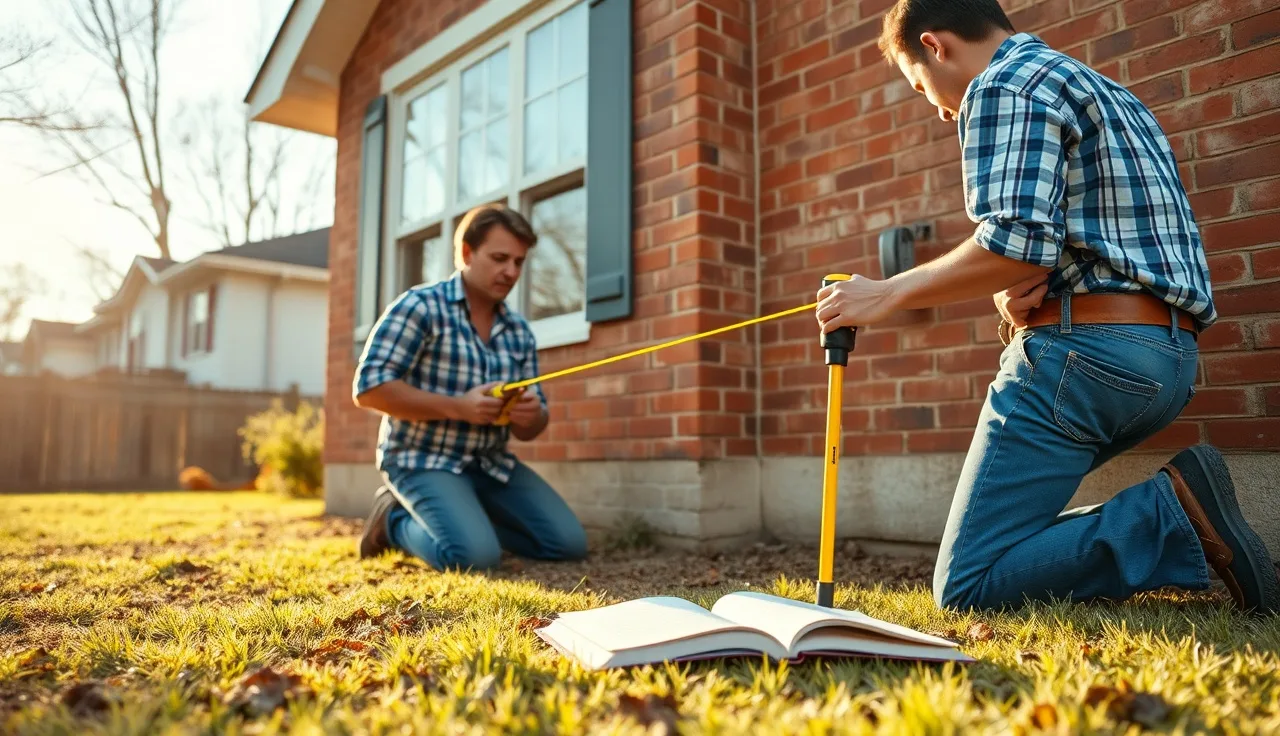
Start outside. The ANSI standard measures from the exterior face of the exterior wall, which means you measure the outside of the structure, not the inside of each room. Outside measurements are cleaner because you're not adding up room-by-room numbers that accumulate small errors.
Step 1: Sketch the footprint. Walk around the house and sketch the perimeter on graph paper. Note every jog, bump-out, garage, and attached structure. Label each segment as you go. If the house is a simple rectangle, you have two dimensions. Most houses are L-shapes or T-shapes with several segments.
Step 2: Measure each wall segment from outside. Hold the laser measure flat against the exterior wall face. Measure each run and write it on your sketch. Recheck any measurement that surprises you.
Step 3: Identify what to exclude from the footprint. Before multiplying footprint by stories, subtract the garage footprint, any unfinished attached structure (workshop, storage bay), and any covered porches. Covered porches are not GLA even if they are enclosed on three sides, because they typically lack heating and permanent finished surfaces.
Step 4: Handle multiple stories. For a two-story house, measure the first floor footprint and the second floor footprint separately. They are often different, especially if the second floor is smaller due to a garage below or a front porch. Add the two above-grade finished footprints together.
Step 5: Assess ceiling heights. Go to each room on each floor and measure ceiling height at the peak and at the walls. For any room with a sloped ceiling (common in finished attics), measure where the ceiling drops to 5 feet, to 7 feet, and the room's full width. Calculate the area at 7 feet or more. If that area is at least half the room, the room counts. If not, count only the portion above 5 feet by the ANSI rule.
Step 6: Examine any basement or below-grade space. Go outside and check whether any portion of the foundation is below the exterior ground surface. Look at window well depths. If the ground comes above the bottom of any window, that portion of the space is below grade and must not be counted in GLA regardless of how finished it is.
Step 7: Add up and compare. Total your above-grade finished square footage. Now open the property record card. If the assessor's number is more than 2-3% higher than yours, that difference is worth pursuing. Small rounding differences are normal. A 5% or larger gap (say, 125 sq ft on a 2,500 sq ft house) is a legitimate dispute.
What are the most common ways assessors overcount square footage?
A handful of errors show up again and again across assessment dispute records. Here they are.
Counting finished basements as above-grade GLA. This is the single biggest error. A fully finished basement with a home theater, a bath, and carpeting is still not GLA if it's below grade. It should appear on your property card as finished below-grade space with a lower per-square-foot value. When an assessor mistakenly folds it into the GLA figure, your home suddenly looks 800-1,200 sq ft larger than comparable homes.
Including the garage. An attached garage shares walls with the house, which sometimes causes it to get swept into a rough exterior measurement. Check whether the assessor's claimed square footage is suspiciously close to the house plus garage total.
Recording permit data as finished area. When a homeowner pulls a permit to "finish 800 sq ft of basement," the county sometimes adds 800 sq ft to the GLA field without verifying whether the space is above or below grade.
Counting unfinished bonus rooms. The bonus room above a garage that's used for storage, has exposed rafters, and lacks drywall does not count. Some assessors grab the structural floor area from blueprints and assume it's finished.
Data entry errors that survive re-assessments. A transposition (2,140 entered as 2,410) or a wrong number carried from a demolished addition can live in the record for 20 years. The assessor never re-measured because reassessment in most counties is statistical, not physical.
According to a 2022 analysis by the Lincoln Institute of Land Policy, assessment errors are more common in lower-income neighborhoods partly because the measurement data tends to be older and less frequently field-verified [7]. Your specific error, though, can happen to any property.
How do you document the measurement discrepancy for an appeal?
Documentation wins appeals. An undocumented claim that "my house is smaller" goes nowhere. A well-organized package showing exterior measurements, interior photos, and a comparison to the assessor's sketch is hard to ignore.
Here's what to assemble:
A scaled floor plan sketch. Draw it neatly on graph paper and label all dimensions. You don't need CAD software. A clean hand-drawn sketch with legible numbers carries weight. Write your total GLA calculation at the bottom: show the rectangle or polygon dimensions, the excluded spaces, and the math.
Photographs with context. Photograph each exterior wall face with a tape or laser measure visible in the frame showing the measurement. Photograph any below-grade condition: window wells with the ground level visible, the transition from above grade to below grade on walkout walls. If the garage is being counted, photograph the garage interior and its unfinished ceiling.
A comparison table. Put your numbers and the assessor's numbers side by side. Show the difference in square feet and, if you can, multiply it by the assessor's rate per square foot (often available from the property card) to show the dollar impact.
A citation to ANSI Z765 or your state's appraisal standard. If the assessor counted below-grade space as GLA, cite the ANSI definition. If your state has a statutory definition, cite that instead. Many states have assessment manuals that are public documents and reference ANSI or equivalent standards [8].
If your discrepancy is over 5%, consider hiring a licensed appraiser for a measurement-only report, which typically costs $150-$300 and produces a credentialed document with legal weight in an appeal hearing [9]. If you're self-filing, the TaxFightBack appeal kit includes a measurement worksheet and a documentation checklist you can use to organize everything before the hearing.
File all of this with your formal appeal before your county's deadline. Missing the deadline is the only unrecoverable error in this process. Check your county assessor's website for the exact date; deadlines range from 30 days after the assessment notice in some states to as late as December 31 in others [10].
How does the assessor's GLA affect comparable sales adjustments?
A wrong GLA figure corrupts the sales-comparison result even when the model looks perfect on paper. Here's why.
When an assessor or their automated valuation model compares your home to recent sales, the model adjusts for size differences between your home and each comparable. If your GLA is recorded as 2,400 sq ft but it's really 2,100 sq ft, the model treats your home as larger than it is. It then either selects comparables that are genuinely larger (and thus more expensive), or it applies a positive size adjustment that inflates your value.
Fannie Mae's selling guide adjustment guidance (which assessors borrow as a benchmark) suggests a range of $50-$130 per square foot for GLA differences in suburban markets, though actual adjustment rates vary by location [3]. A 300 sq ft overcount at $100/sq ft adds $30,000 to an assessed value before any other factor.
Correcting the GLA record beats arguing about the final value. Fix the square footage in the assessor's database once, and the error stops repeating in every future reassessment cycle. You argue it one time and benefit for years.
What if your assessor uses a different square footage standard than ANSI?
Some states have their own assessment standards that differ from ANSI Z765 in minor ways. The International Association of Assessing Officers (IAAO) publishes a Standard on Mass Appraisal of Real Property that many assessors follow, and it generally agrees with ANSI on the above-grade, finished, heated definition, though it may set different ceiling height thresholds for specific property types [8].
A few things to check:
Your state's assessor manual. Most state revenue or taxation departments publish an official assessment manual. California's Board of Equalization publishes a Property Tax Assessment manual; Georgia's Department of Revenue publishes an Appraisal Procedures Manual. These are public and searchable. Look for the definition of "gross living area" or "finished area" in the manual that applies to your county.
Your county's specific instructions. Some large counties, including Cook County in Illinois, have their own classification and valuation systems that define how space is categorized [6]. Pull your property class code and look up what it means.
The comparable sales in your appeal. If the assessor's office measured your comparables the same wrong way (counted finished basements as GLA for everyone), the error may be internally consistent and not cause an overassessment relative to neighbors. But if neighboring homes have finished basements that were correctly excluded from their GLA, you're at a disadvantage.
The practical rule: use ANSI Z765 as your baseline argument, note where your state's manual agrees with it, and let the assessor explain any deviation. The burden of justifying a non-standard measurement falls on them, not you.
How much can a GLA error actually lower your property tax bill?
The dollar impact rides on three variables: the size of the error, the assessor's per-square-foot rate for finished space, and your effective tax rate.
Here's a real-numbers example:
| Error size (sq ft) | Assessed value per sq ft | Overassessment | Effective tax rate | Annual tax savings |
|---|---|---|---|---|
| 100 sq ft | $120 | $12,000 | 1.2% | $144/yr |
| 200 sq ft | $120 | $24,000 | 1.2% | $288/yr |
| 300 sq ft | $120 | $36,000 | 1.2% | $432/yr |
| 200 sq ft | $200 | $40,000 | 1.5% | $600/yr |
| 400 sq ft | $200 | $80,000 | 1.5% | $1,200/yr |
The per-square-foot assessed rate varies widely by market. In high-cost metro areas (Los Angeles, New York, the DC suburbs), finished space is assessed at far higher rates than in rural counties. In a high-value market, even a modest 150 sq ft error can produce $500-$900 in annual tax savings [5][6].
In markets like those tracked by Montgomery County Property Tax or Cook County, where assessments are high and tax rates are substantial, a GLA error is often the single largest correctable mistake on a property record.
If the error goes back multiple years and your jurisdiction allows retroactive appeals (typically 2-3 years, depending on state law), the cumulative savings can top $2,000-$3,000. Check your state's refund window before assuming you can only fix future years.
How do you find and read your property record card?
The property record card (also called an appraisal card or field card) is the assessor's working document for your parcel. It typically shows:
- A rough sketch of the structure with labeled dimensions
- The GLA figure used for valuation
- Classification codes for each area (finished above grade, unfinished basement, garage, etc.)
- Year built, construction type, condition rating
To find yours:
1. Google "[your county] assessor property search" and use the official county site. 2. Enter your address or parcel number. 3. Look for links labeled "Property Record Card," "Appraisal Card," "Building Details," or "Assessment Data."
Gwinnett County Tax Assessor, Bexar County Tax Assessor, and Bibb County Tax Assessor all publish searchable property records online, as do the vast majority of counties in the US. If your county doesn't post them, you can request the card in person or by public records request under your state's open records law.
When you open the sketch, check three things immediately. First, does the perimeter math add up? Multiply length by width (adjusting for L-shapes) and see if you get the claimed GLA. Second, is the basement or garage labeled separately or merged into the main figure? Third, do the labeled dimensions match what you measured? Any discrepancy over 3% is worth investigating.
For large metro counties, LA County Property Tax and Santa Clara Property Tax records include detailed building sketches that are often more accurate than smaller counties because the assessed value base gets scrutinized more heavily.
When should you hire a licensed appraiser instead of measuring yourself?
Most GLA disputes don't need a professional appraiser. If the error is obvious, a clean sketch and photos are enough for an informal appeal or a board of review hearing.
Hire an appraiser when:
The discrepancy is over 10% and your taxes are high. A $1,200/year tax correction is worth a $250 appraisal fee. The appraiser's signed measurement report adds credibility that a self-prepared sketch doesn't have at a formal hearing.
The geometry is genuinely complex. Multi-story homes with wings, additions built at different times, and unusual rooflines can produce honest disagreement about what's above grade and what counts. A licensed appraiser who follows ANSI Z765 as part of their credential can sort that out definitively.
The county is resisting your informal appeal. Once you escalate to a formal hearing or a state tax court, having a licensed professional who can testify under oath strengthens your position.
You're also disputing the value, not only the size. An appraiser can produce a full market value opinion alongside the GLA measurement, killing two arguments with one report.
For most homeowners with a straightforward discrepancy (a finished basement counted as GLA, a garage included in the footprint), self-measurement plus good documentation is enough. The TaxFightBack appeal kit walks through the evidence standards for each appeal level so you can decide what you actually need before spending money on professional fees.
One honest note: appraisers vary in experience with assessment disputes. Ask specifically whether the appraiser has testified at a board of review or state tax tribunal and whether they're familiar with your county's valuation model.
What if the assessor won't correct the GLA even after your appeal?
If the informal appeal doesn't fix it, you escalate. Every state has a formal administrative review level, typically a Board of Review, Board of Equalization, or Assessment Appeals Board. You present your evidence at a hearing, often in front of three to five appointed board members. The bar for winning a GLA factual dispute is lower than winning a pure valuation argument because you're presenting physical measurements, not competing opinions of market value.
If the board rules against you, most states allow you to escalate to state tax court or circuit court. At that level, you'll almost certainly want the appraiser report mentioned above, because courts give more weight to credentialed expert testimony.
The thing most homeowners don't know: you can also ask the assessor's field office to re-measure the property before the formal hearing. Many counties will send a field appraiser, free of charge, to verify disputed measurements. Request this in writing. If their field appraiser confirms your number, the correction happens administratively without any hearing.
Deadlines are different at each level. Missing an appeal deadline eliminates that year's remedy entirely. Your state's department of revenue website will list the specific timelines, or check your county assessor's FAQ page. For jurisdictions covered in our county guides, the deadline information is specific to that market, and it varies more than most people expect.
Frequently asked questions
Does a finished basement count as gross living area?
No, under ANSI Z765-2021, finished basement space does not count as GLA if any portion of the basement wall is below the exterior grade. It should be valued separately as finished below-grade area at a lower per-square-foot rate. If your assessor has included your finished basement in the GLA total, that is a correctable error and a strong basis for an appeal.
Does an attached garage count toward gross living area?
No. An attached garage, even one that is heated and drywalled, is not GLA under ANSI Z765. It shares walls with the house but is not finished living space. If your property record card dimensions seem suspiciously large, check whether the garage footprint was accidentally swept into the exterior measurement.
How do I find my assessor's square footage record?
Search your county assessor's website for "property search" or "property records" and enter your address or parcel number. Most counties post a property record card or building detail page showing the assessor's GLA figure and a rough sketch of the structure. If your county doesn't post records online, you can request the card by public records request.
What is the ANSI Z765 standard and do assessors have to follow it?
ANSI Z765-2021 is a consensus standard from the National Association of Home Builders defining how to measure residential GLA. Licensed appraisers on Fannie Mae loans must follow it since March 2022. Assessors are not federally required to use ANSI, but most state assessment manuals adopt the same above-grade, finished, heated definition. You can cite it as the industry standard in any appeal.
How accurate does my measurement need to be to win an appeal?
A 2-3% difference from the assessor's figure is usually rounding and measurement tolerance. A gap of 5% or more, especially one that reflects a structural issue like a miscounted basement, is meaningful. Most boards of review expect you to show a material error, not a minor discrepancy. Focus on clearly excluded spaces (garages, below-grade areas) rather than arguing over a few feet of perimeter measurement.
Can I use Google Maps or Zillow square footage to challenge my assessment?
No. Zillow and Google Maps square footage data come from public records (your assessor) or MLS data and are not independent measurements. Using them to challenge the assessor is circular. You need your own physical measurement from the exterior walls, documented with a floor plan sketch and photos, to have credible evidence.
Does ceiling height affect what square footage counts as living area?
Yes. ANSI Z765 requires at least 7 feet of finished ceiling height over at least half a room's area for the full room to count as GLA. For sloped ceilings, only the portion with at least 5 feet of clearance counts, and only if the 7-foot area covers at least half the room. Finished attic space with low knee walls often gets overcounted because of this rule.
How much does a professional appraisal to verify square footage cost?
A measurement-only appraisal report typically costs $150-$300 from a licensed residential appraiser. A full appraisal that includes both a GLA verification and a market value opinion runs $400-$700 in most markets, higher in expensive metro areas. The measurement-only report is usually enough for board of review hearings; full appraisals are worth the cost if you're going to state tax court.
What is the difference between gross living area and gross building area?
Gross living area applies to residential properties and counts only above-grade, finished, heated space. Gross building area is a commercial appraisal term that includes all enclosed floor area, typically measured from the exterior walls, regardless of finish or use. If your county uses GBA terminology on your residential property record, verify that the definition they're applying matches the residential ANSI standard.
How do I measure a room with a sloped ceiling correctly?
Measure the room's total floor area first. Then measure where the ceiling drops below 7 feet. The ANSI rule is: count the full room only if at least 50% of the floor area has 7 or more feet of ceiling. If the 7-foot zone covers less than half the room, count only the area between the 5-foot and 7-foot ceiling heights. Document with photos and measurements labeled on your sketch.
Can I get a refund if I find a GLA error from prior years?
Many states allow retroactive corrections for 2-3 prior years if the error is factual rather than a valuation dispute. The window varies: New York allows up to 3 years in some circumstances; other states limit corrections to the current assessment year only. Check your state's revenue department website or ask your county assessor's office specifically about refund windows for factual corrections.
What if my house was measured wrong when it was built and the error has always been there?
The length of time the error has persisted doesn't waive your right to correct it in most jurisdictions. A long-standing measurement error is still a factual error. However, some counties require you to appeal within a set window after each assessment notice, meaning very old errors may only be correctable going forward. File your appeal in the current cycle and ask the assessor's office what retroactive correction is available.
Does a screened porch or sunroom count as gross living area?
Only if it meets all ANSI criteria: finished walls and ceiling, permanent heating that connects to the home's main HVAC system, and above-grade location. A screened porch with no insulation or permanent heat does not count. A four-season sunroom with a mini-split and permanent finished surfaces likely does. The test is whether the space is genuinely finished, heated, and above grade, not simply whether it has walls.
Sources
- National Association of Home Builders, ANSI Z765-2021 Calculating and Reporting Gross Living Area: ANSI Z765-2021 defines GLA as above-grade, finished, heated space measured from the exterior face of exterior walls; below-grade space does not qualify regardless of finish level
- International Association of Assessing Officers (IAAO), Standard on Mass Appraisal of Real Property: Assessment records are typically set at permit-close and carried forward statistically, making measurement errors a persistent source of inaccuracy
- Fannie Mae Selling Guide, Appraiser and Property Requirements: Fannie Mae required lender appraisers to follow ANSI Z765 for single-family residential properties beginning March 2022; GLA adjustment guidance references $50-$130 per square foot range in suburban markets
- Bosch Tools, GLM 20 Laser Distance Measurer product specifications: Consumer laser distance measures in the $25-$40 price range achieve accuracy within 1/16 inch at ranges up to 65 feet
- Los Angeles County Office of the Assessor: LA County Assessor publishes property record cards including building sketches and GLA figures through its online parcel search
- Cook County Assessor's Office: Cook County Assessor publishes property classification and assessment details including building characteristics through its online property search portal
- Lincoln Institute of Land Policy, Inequity in Property Assessment (2022): A 2022 Lincoln Institute analysis found assessment data tends to be older and less frequently field-verified in lower-income neighborhoods, contributing to more frequent measurement errors
- International Association of Assessing Officers (IAAO), Standard on Mass Appraisal of Real Property: IAAO standards generally agree with ANSI on the above-grade, finished, heated definition for gross living area in residential property assessment
- Appraisal Institute, Residential Appraiser Fee Survey: Measurement-only appraisal reports from licensed residential appraisers typically cost $150-$300; full residential appraisals cost $400-$700 in most markets
- National Taxpayers Union Foundation, Property Tax Appeal Deadlines by State: Property tax appeal deadlines vary from 30 days after assessment notice to December 31 of the assessment year depending on state law
- Georgia Department of Revenue, Appraisal Procedures Manual: Georgia DOR publishes an Appraisal Procedures Manual defining assessment standards including definitions of finished living area for residential properties
- California Board of Equalization, Property Tax Assessment Manual: California BOE publishes assessment guidelines used by county assessors including definitions of residential finished area for valuation purposes