North Carolina Senior Property Tax Exemption: Complete Guide for 2026
If you are 65 or older and own a home in North Carolina, you may qualify for property tax exemptions that could save you hundreds or thousands of dollars every year. Many seniors miss these benefits because they do not know they exist, do not realize they qualify, or assume the savings are not worth the paperwork. They are wrong.
Here is everything you need to know about senior property tax exemptions in North Carolina, including eligibility requirements, income limits, application deadlines, and exactly how much you can save.
TL;DR
- Age requirement: 65+
- Exemption: Homestead Exclusion: the greater of $25,000 or 50% of appraised value for homeowners 65+ with income under $36,700 (2026).
- Income limit: $36,700 (2026, adjusted annually)
- Deadline: June 1
- Where to apply: County Tax Assessor's Office
- Estimated savings: $500-$3,000+ per year depending on home value and local rate
- Can you stack with other exemptions? The Homestead Exclusion is the primary senior benefit. It includes the assessment freeze automatically.
What Senior Property Tax Exemptions Does North Carolina Offer?
Homestead Exclusion: the greater of $25,000 or 50% of appraised value for homeowners 65+ with income under $36,700 (2026).
The 50% exclusion makes this one of the most valuable senior exemptions in the country for homeowners with higher-value properties. A $400,000 home gets a $200,000 exclusion. The program also covers totally disabled homeowners of any age.
Eligibility Requirements
| Requirement | Details |
|---|---|
| Age | 65+ (as of January 1 of the tax year in most cases) |
| Income Limit | $36,700 (2026, adjusted annually) |
| Primary Residence | Must be your primary residence. Vacation homes and rentals do not qualify. |
| Ownership | Your name must be on the deed. |
| Application Deadline | June 1 |
How Much Can Seniors Save on Property Taxes in North Carolina?
The total savings depend on your home value, local tax rate, and which exemptions you qualify for. Here is a general estimate:
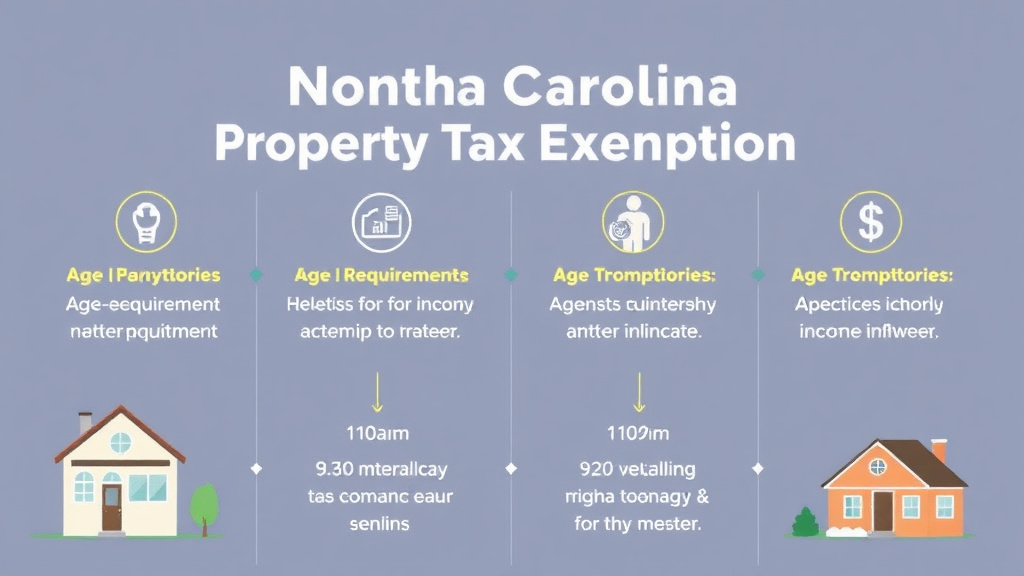
Estimated annual savings: $500-$3,000+ per year depending on home value and local rate
The average effective property tax rate in North Carolina is 0.84%. On a $300,000 home, that translates to roughly $2,520 per year in property taxes before any exemptions. Senior exemptions can take a significant chunk off that number.
Tax Freeze Programs for Seniors in North Carolina
The Homestead Exclusion freezes the appraised value at the time of application for qualifying homeowners. Values cannot increase while you receive the exclusion.
A tax freeze or assessment freeze is one of the most powerful property tax benefits for seniors because it prevents your taxes from ever increasing as long as you qualify. Even if home values in your neighborhood double, your tax base stays locked at its current level.
Property Tax Deferral for Seniors in North Carolina
Property tax deferral available for homeowners receiving the Homestead Exclusion who are unable to pay. Deferred taxes accrue interest.
Tax deferral programs let you postpone paying property taxes. The deferred amount typically becomes a lien on your home that is paid when you sell or pass away. This can be a lifeline for seniors on fixed incomes who want to stay in their homes but struggle with rising tax bills.
Stacking Exemptions for Maximum Savings
The Homestead Exclusion is the primary senior benefit. It includes the assessment freeze automatically.
Many seniors qualify for multiple property tax benefits and do not realize they can combine them. Here are the programs available to North Carolina seniors:
- General homestead exemption (if available in North Carolina)
- Senior-specific exemption or credit
- Assessment freeze or tax ceiling
- Disability exemptions (if applicable)
- Veteran exemptions (if applicable)
- Property tax deferral
Check every program you might qualify for. The combined savings from stacking multiple exemptions can be double or triple what a single exemption provides.
How to Apply for the Senior Exemption in North Carolina
Step 1: Gather Your Documents
You will need: Proof of age (65+), income documentation (federal tax return), proof of primary residence
Step 2: File Before the Deadline
The application deadline is June 1. Do not wait until the last minute. Missing the deadline means waiting another full year to get the exemption, and that is another year of overpaying.
Step 3: Submit Your Application
Apply at the County Tax Assessor's Office. Some jurisdictions accept online applications. Call ahead or check the website to confirm.
Step 4: Follow Up
After submitting, verify your application was received and processed. Check your next property tax bill to confirm the exemption is applied. If it is not showing, contact the office immediately.
Special Programs for Seniors in North Carolina
North Carolina offers these additional programs that may benefit senior homeowners:
Homestead Exclusion with assessment freeze, property tax deferral
Each program has its own eligibility criteria and application process. Do not assume you do not qualify without checking. Many seniors are surprised to find they are eligible for programs they never knew existed.
Common Mistakes Seniors Make
- Not applying at all. This is the biggest mistake. Nobody will come knocking on your door to tell you about your exemption. You have to apply for it.
- Assuming you do not qualify. Income limits and eligibility rules change frequently. Even if you were denied before, you may qualify now.
- Missing the deadline. Deadlines are strict. Mark June 1 on your calendar right now.
- Only claiming one exemption. If you qualify for multiple exemptions, claim all of them. They often stack for bigger savings.
- Not reapplying after moving. Exemptions do not transfer to new properties. If you move, file a new application at your new address.
- Not checking for local programs. Many cities and counties offer additional senior tax relief beyond the state programs. Always check locally.
Should You Also Appeal Your Property Tax Assessment?
Absolutely consider it. A property tax exemption and a property tax appeal serve different purposes.
The exemption reduces your taxable value by a set amount or percentage. An appeal challenges whether your assessed value is accurate. If your home is over-assessed, an appeal can reduce the base number that all exemptions are applied to, giving you even bigger total savings.
For example, if your home is assessed at $350,000 but should be $300,000, winning an appeal saves you money every single year. Combine that with your senior exemption, and the total savings add up quickly.
Related Guides
- North Carolina Homestead Exemption Guide
- Over-65 Property Tax Exemption: How It Works in Every State
- Disability Property Tax Exemption Guide
- How to Apply for a Homestead Exemption: Step-by-Step
Try our free tools
Frequently Asked Questions
What age do I need to be for the senior property tax exemption in North Carolina?
You must be 65 or older. In most cases, you need to be 65 as of January 1 of the tax year.
Is there an income limit for the senior exemption in North Carolina?
$36,700 (2026, adjusted annually). Income limits are often adjusted annually, so check the current year's threshold.
When is the deadline to apply for the senior exemption in North Carolina?
The deadline is June 1. Late applications may be accepted in some cases, but do not count on it.
Can I combine the senior exemption with the homestead exemption?
The Homestead Exclusion is the primary senior benefit. It includes the assessment freeze automatically, so you do not need to apply for a separate senior exemption.
Does my surviving spouse keep the senior exemption?
In many states, surviving spouses can continue receiving senior property tax benefits. Check with your County Tax Assessor's Office for North Carolina-specific rules on spousal continuation.
What if my income is just over the limit?
Some programs exclude certain income sources (like Social Security) from the calculation. Ask the assessor's office exactly what counts as income for the exemption. You may qualify even if your total income appears to exceed the limit.
Find Out What You Qualify For
You may be leaving hundreds or thousands of dollars on the table every year. Many seniors qualify for exemptions they have never claimed. Our free assessment analyzer checks your property and identifies every exemption you may be entitled to, including senior benefits, disability programs, and veteran exemptions.
It takes about two minutes and could save you real money.
Check your exemptions now to see what property tax savings you are missing.