What Is a Mill Levy? How Local Taxes Fund Schools and Services
TL;DR
A mill levy is the tax rate applied to your property's assessed value. One mill equals $1 of tax per $1,000 of assessed value. Your total mill levy is the sum of rates from every taxing authority that covers your property: county, city, school district, fire district, library, and others. School districts typically account for 50-70% of your total mill levy. You cannot appeal the mill levy itself, but you can appeal the assessed value it is applied to.

What Is a Mill?
A mill is a unit of taxation equal to one-tenth of one cent, or $0.001. In property tax terms, one mill means $1 of tax for every $1,000 of assessed value.
The math is simple:
Property Tax = (Assessed Value / 1,000) x Mill Rate
If your home's assessed value is $250,000 and the total mill rate is 30 mills, your property tax is:
$250,000 / 1,000 x 30 = $7,500 per year
How Mill Levies Are Set
Each taxing authority in your area sets its own mill levy based on its budget. The process works backwards from how most people think about it:
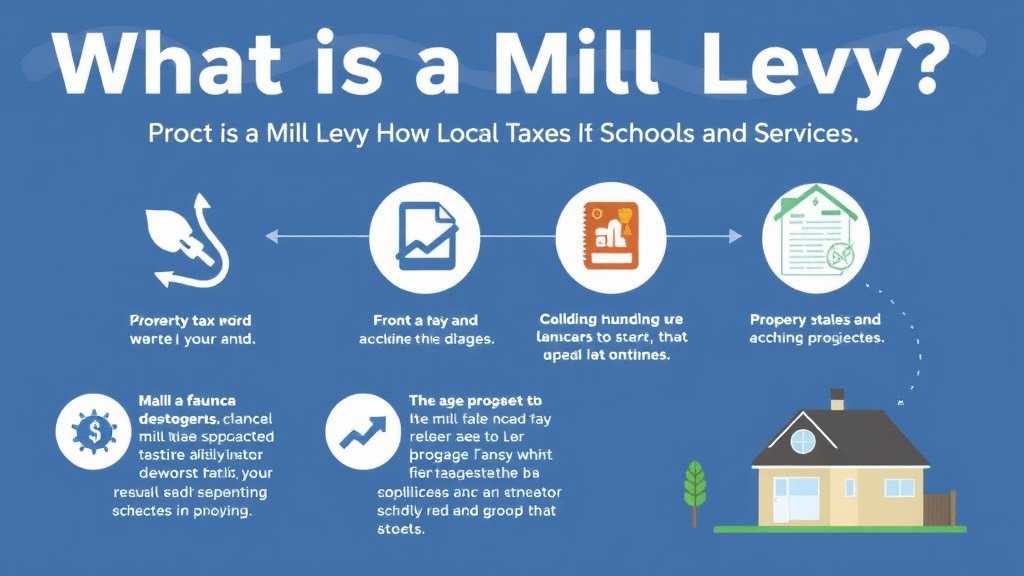
- The taxing authority (school board, county commission, city council) determines its budget for the coming year
- They subtract any non-property-tax revenue (state aid, fees, federal funding)
- The remaining amount must come from property taxes
- They divide that amount by the total assessed value of all property in their jurisdiction
- The result is the mill rate
This is why the tax rate is called a "budget-based" system. The budget comes first. The rate is whatever it needs to be to raise that amount of money.
Stacking Multiple Mill Levies
Your property tax bill is not based on a single mill levy. It is the total of every levy from every taxing authority whose jurisdiction covers your property. A typical breakdown looks like this:
| Taxing Authority | Mill Levy | Tax on $250,000 Home | % of Total |
|---|---|---|---|
| School District (Operating) | 14.0 | $3,500 | 46.7% |
| School District (Bond) | 4.5 | $1,125 | 15.0% |
| County | 5.0 | $1,250 | 16.7% |
| City | 3.5 | $875 | 11.7% |
| Fire Protection | 2.0 | $500 | 6.6% |
| Library | 0.5 | $125 | 1.7% |
| Parks | 0.5 | $125 | 1.7% |
| Total | 30.0 | $7,500 | 100% |
Notice that school district levies make up over 60% of the total in this example. That is typical across the country. Education is the largest expense funded by property taxes.
Why Mill Levies Change
Mill levies change for several reasons:
Budget Increases
When a taxing authority needs more money, they increase their mill levy. This requires a public vote in many states (for new levies or increases beyond a cap) or just a board vote in others.
Property Value Changes
When overall property values in the jurisdiction go up, the mill levy often goes down. The taxing authority needs the same amount of money, and now the total assessed value is higher. But this does not always reduce your individual tax bill, because your assessed value went up too.
New Levies
Voter-approved bond measures for new schools, road projects, or other infrastructure add new mill levies on top of existing ones. These are often temporary but can last 20-30 years until the bonds are repaid.
Expired Levies
Some levies have sunset dates. When they expire and are not renewed, the total mill rate drops.
Mill Levy Caps by State
Many states limit how high mill levies can go:
| State | Cap Details |
|---|---|
| Colorado | TABOR limits revenue growth to inflation + population growth |
| Kansas | County levy cap of 17.5 mills for general fund |
| Montana | Voter approval required for mill levy increases above inflation |
| Oregon | Measure 5 limits taxes to $5/$1,000 for education and $10/$1,000 for general government |
| Washington | 1% annual revenue growth limit per taxing district |
How to Find Your Mill Levy
Your mill levy is listed on your property tax bill, usually broken down by taxing authority. You can also find it by:
- Checking your county assessor or treasurer's website
- Looking up your property on the county's GIS (mapping) system
- Calling your county treasurer's office with your parcel number
Can You Lower Your Mill Levy?
You cannot individually appeal the mill levy. It applies equally to every property in the taxing district. You can influence it by:
- Voting against new levies or bond measures on the ballot
- Attending budget hearings for your county, city, and school district
- Advocating for spending reductions in local government
What you can control is the assessed value the mill levy is applied to. If your home is over-assessed, you pay more than your share of every single levy. Lowering your assessed value through an appeal reduces your tax bill even if the mill levy stays the same.
Want to check whether your assessment is fair? Our free property tax analyzer compares your assessed value to similar properties in your area. If you are over-assessed, an appeal could save you hundreds or thousands per year.
Your Next Steps
Put this information to work this week:
- Review your assessment notice. Check every detail: assessed value, property characteristics, square footage, lot size. Errors are more common than you think and they directly inflate your tax bill.
- Pull comparable sales. Find 3 to 5 similar properties near you that sold recently for less than your assessed value. This is the strongest evidence for any appeal.
- Check your exemption status. Contact your county assessor to confirm which exemptions are on file for your property. You may qualify for programs you have not applied for.
- Set a deadline reminder. Find your appeal deadline and put it on your calendar with a 2-week advance warning. Missing it costs you a full year of potential savings.
Why Timing Matters
Property tax appeals have strict deadlines, and procrastination is the number one reason homeowners miss their chance to save. Once the filing window closes, there is no extension and no second chance until next year. That is another 12 months of overpaying.
The homeowners who save the most money treat their assessment notice as a call to action. They review it immediately, check for errors, pull comparable sales within the first week, and file their appeal well before the deadline. This approach leaves time to gather additional evidence if needed and avoids the last-minute scramble that leads to weak cases.
If your deadline has already passed for this year, do not wait until next year's notice arrives to start preparing. Begin gathering comparable sales data now. When your next notice arrives, you will be ready to file immediately with strong evidence already in hand.
Try our free tools
Frequently Asked Questions
What Is a Mill Levy? How Local Taxes Fund Schools and Services?
A mill levy is the tax rate applied to your property's assessed value. One mill equals $1 of tax per $1,000 of assessed value. Your total mill levy is the sum of rates from every taxing authority that covers your property: county, city, school district, fire district, library, and others.
What Is a Mill??
A mill is a unit of taxation equal to one-tenth of one cent, or $0.001. In property tax terms, one mill means $1 of tax for every $1,000 of assessed value.
How Mill Levies Are Set?
Each taxing authority in your area sets its own mill levy based on its budget. The process works backwards from how most people think about it: The taxing authority (school board, county commission, city council) determines its budget for the coming year, then subtracts any non-property-tax revenue (state aid, fees, etc.) to calculate the amount it needs to raise from property taxes.
How do multiple mill levies affect my property taxes?
Your property tax bill is not based on a single mill levy. It is the total of every levy from every taxing authority whose jurisdiction covers your property. A typical breakdown looks like: School District (Operating) 14.0 mills, School District (Bon
What are the mill levy caps in my state?
Many states limit how high mill levies can go. For example, Colorado has TABOR limits revenue growth to inflation + population growth, Kansas has a county levy cap of 17.5 mills for the general fund, Montana requires voter approval for mill levy incr
How to Find Your Mill Levy?
Your mill levy is listed on your property tax bill, usually broken down by taxing authority. You can also find it by checking your county assessor or treasurer's website, looking up your property on the county's GIS (mapping) system, or calling your county treasurer's office with your parcel number.