What Evidence Do You Need for a Property Tax Appeal?
TL;DR
The strongest property tax appeals are built on comparable sales data, photos of property condition issues, and documentation of assessment errors. You need 3-5 recent comparable sales showing lower values, photos of any damage or deferred maintenance, and a copy of your property record card to check for factual mistakes. Organize everything into a clean packet and present it clearly at your hearing or in your appeal letter.
Evidence Is Everything in a Property Tax Appeal
Filing a property tax appeal without solid evidence is like showing up to court without a case. You might get lucky, but the odds aren't in your favor.
Review boards hear dozens of appeals each day. The homeowners who win are the ones who come prepared with organized, specific evidence that proves their assessed value is too high. The ones who lose? They usually walk in with opinions instead of data.
The good news is that gathering strong evidence doesn't require professional help. You just need to know what to collect and how to present it. This guide breaks down every type of evidence that works in a property tax appeal, ranked by how much weight review boards give each one.
The Five Types of Evidence That Win Appeals
Not all evidence carries equal weight. Here's the hierarchy, from strongest to weakest:
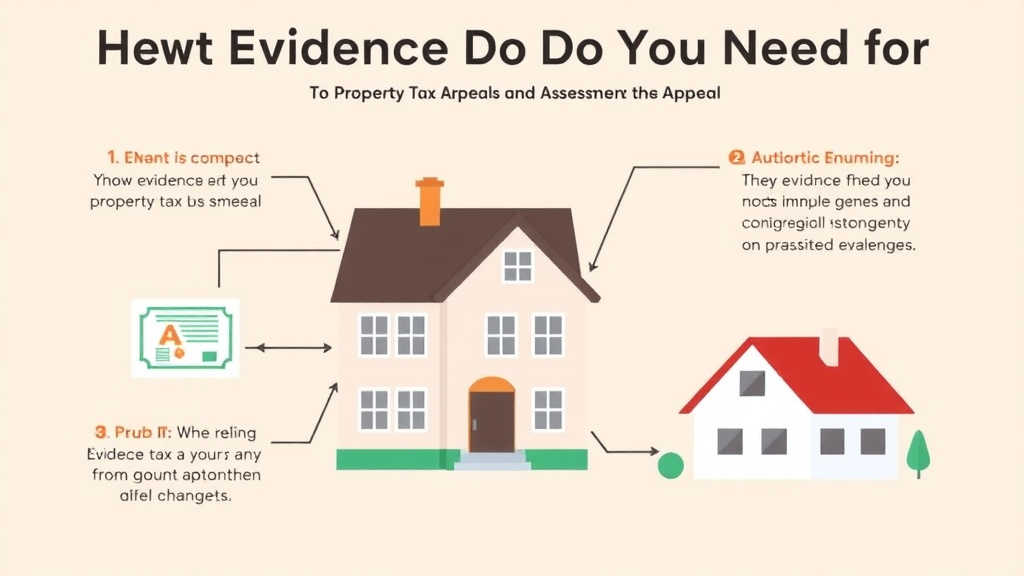
| Evidence Type | Weight | Why It Works |
|---|---|---|
| Comparable sales | Strongest | Shows what similar homes actually sold for |
| Assessment errors | Very strong | Proves the assessor used wrong facts |
| Independent appraisal | Strong | Professional opinion of market value |
| Property condition photos | Moderate | Documents issues that reduce value |
| Neighborhood factors | Moderate | External conditions affecting value |
Comparable Sales: The Foundation of Your Case
Comparable sales are the single most important piece of evidence in any property tax appeal. They show what buyers actually paid for homes similar to yours, which is the best indicator of market value.
Review boards expect to see comps. If you only bring one type of evidence, make it this one.
What Makes a Good Comparable Sale
Not every recent sale qualifies as a useful comp. The best comparable sales share these characteristics:
- Sold within the last 6-12 months - More recent sales carry more weight. Sales older than 12 months are harder to justify unless your market has been flat.
- Located within 1 mile of your property - Closer is better. Same neighborhood is ideal. Same school district is acceptable. Across town is usually too far.
- Similar size - Within 200-300 square feet of your home. A 1,500 sq ft ranch is not comparable to a 3,000 sq ft colonial.
- Similar age and style - A 1960s ranch compared to another 1960s ranch. Not a 1960s ranch compared to a 2020 new build.
- Similar lot size - Within about 20% of your lot size.
- Arm's-length transactions - Regular sales between unrelated parties. Skip foreclosures, short sales, estate sales, and sales between family members unless they help your case.
For a deeper dive on finding and selecting comps, read our complete guide to comparable sales for tax appeals.
How Many Comps Do You Need?
Bring 3-5 comparable sales. Three is the minimum to establish a pattern. Five is the sweet spot. More than five can actually weaken your case if the extra comps are not as strong.
For each comp, document:
- Address
- Sale price and date
- Square footage
- Number of bedrooms and bathrooms
- Year built
- Lot size
- Any significant differences from your property (pool, garage, recent renovation)
Where to Find Comparable Sales Data
You don't need expensive databases. These free sources work:
- Your county assessor's website - Most publish recent sales with prices, dates, and property details.
- Zillow and Redfin - Filter by "recently sold" and narrow by size, age, and location.
- Realtor.com - Has sold data going back several years in most markets.
- County recorder's office - Official sale records are public information.
- A local real estate agent - Many will pull MLS comps for you for free, hoping to earn your business later.
Assessment Errors: Low-Hanging Fruit
Before you even get to market value arguments, check your property record card for factual mistakes. Assessment errors are the easiest type of evidence to present because they are objective and undeniable.
Common errors include:
- Wrong square footage - This is the most common mistake. Assessors often use records from the original construction and miss changes over time, or they include unfinished space that should not count.
- Incorrect bedroom or bathroom count - If the record says 4 bedrooms but you have 3, that inflates your value.
- Phantom features - The record might list a finished basement, fireplace, or central air conditioning that your home does not actually have.
- Wrong lot size - Particularly common in rural areas or with irregularly shaped lots.
- Incorrect year built - A home recorded as built in 2005 when it was actually built in 1985 will be over-valued.
- Wrong property classification - Your home might be classified as commercial when it is residential, or vice versa.
How to Check Your Property Record Card
Request a copy of your property record card from the assessor's office. Most counties make these available online. The card shows every characteristic the assessor used to calculate your value.
Walk through your home with the card in hand and compare every detail. Measure rooms if you need to. Check the lot dimensions against your survey. Look at the condition ratings and see if they match reality.
If you find errors, document them with photos and measurements. This evidence alone can get your assessment reduced without a full hearing in many jurisdictions.
Independent Appraisal: The Professional Opinion
A professional appraisal from a licensed appraiser carries significant weight with review boards. It costs $300-$500 for a residential property, so it is an investment, but it can be worth it for larger reductions.
When an Appraisal Makes Sense
Consider getting an appraisal if:
- Your potential tax savings exceed $1,000 per year
- Your property is unique and comps are hard to find
- You have a high-value home where small percentage changes mean big dollars
- You have already been denied at the informal level and are heading to a formal hearing
When to Skip the Appraisal
If your potential savings are modest (under $500/year) or you have strong comparable sales data, the appraisal cost may not be justified. Our consultant vs DIY guide breaks down the cost-benefit math in more detail.
If you do get an appraisal, make sure the appraiser uses a valuation date that matches your assessment date. An appraisal showing your home's value as of today will not help if the assessment is based on values from January 1 of the tax year.
Property Condition Evidence: Photos and Documentation
Your home's condition directly affects its market value, but assessors rarely inspect the interior. If your home has issues that reduce its value, you need to document and present them.
Condition Issues That Support Your Appeal
- Foundation cracks or structural problems
- Roof damage or an aging roof that needs replacement
- Water damage, mold, or moisture problems
- Outdated electrical, plumbing, or HVAC systems
- Significant deferred maintenance
- Environmental issues (lead paint, asbestos, radon)
- Flood zone location or drainage problems
How to Document Condition Issues
Take clear, well-lit photos of every issue. Include wide shots to show context and close-ups to show detail. Date-stamp your photos. If you have repair estimates from contractors, include those too. A written quote showing that your roof needs a $15,000 replacement is powerful evidence that your home is not worth as much as the assessor thinks.
If you have had a home inspection recently, the inspection report can serve as evidence. It is an objective third-party assessment of your home's condition.
Neighborhood and External Factors
Sometimes the issue is not just your property. External factors can reduce value across a neighborhood:
- Proximity to noise or pollution - Busy roads, airports, train tracks, industrial sites, or landfills.
- Environmental contamination - Nearby Superfund sites or known contamination.
- Declining neighborhood - Increasing vacancy rates, rising crime, or commercial encroachment.
- Infrastructure problems - Poor drainage, no sidewalks, deteriorating roads.
- Easements or restrictions - Utility easements, HOA restrictions, or zoning changes that limit property use.
Document these with photos, maps, news articles, or public records. If a new cell tower went up across the street, print the Google Maps screenshot showing its location relative to your home.
Evidence That Does Not Work
Some things that seem like good evidence actually carry little or no weight with review boards:
- "My taxes are too high" - This is not evidence. The board rules on assessed value, not tax amounts.
- "I can't afford it" - Financial hardship does not change market value. Look into deferral programs or relief programs instead.
- "My neighbor pays less" - Unless you can show that a similar neighboring property is assessed at a lower value per square foot, this is just a complaint.
- Zillow Zestimate printouts - Most boards do not accept automated valuations as evidence. Use actual sales data instead.
- Foreclosure or distressed sales as comps - These are not arm's-length transactions and most boards will dismiss them.
How to Organize Your Evidence Packet
Presentation matters. A messy pile of papers will not impress anyone. Organize your evidence into a clean, professional packet:
- Cover page - Your name, property address, parcel number, current assessed value, and the value you are requesting.
- Summary statement - One paragraph explaining why the assessment is too high.
- Comparable sales analysis - A table showing your comps with addresses, sale prices, key features, and how they compare to your property.
- Assessment error documentation - Side-by-side comparison of what the assessor says vs. what is accurate, with supporting photos or measurements.
- Property condition photos - Labeled and organized by issue.
- Supporting documents - Appraisal, repair estimates, inspection reports, or other professional documentation.
Make three copies of everything: one for the board, one for the assessor's representative, and one for yourself. If your jurisdiction allows digital submissions, create a single PDF with bookmarks for each section.
For a template to follow, see our guide to writing a property tax appeal letter.
How TaxFightBack's Evidence Packet Helps
Gathering all this evidence takes time, especially the comparable sales research. Our $79 Evidence Packet does the heavy lifting for you. It pulls verified comparable sales data, identifies assessment errors, and packages everything into a professional appeal-ready document.
Compare that to hiring a property tax consultant at 25-40% of your savings, or a property tax attorney at $500+, and the math is clear.
Try our free tools
Frequently Asked Questions
What Evidence Do You Need for a Property Tax Appeal??
The strongest property tax appeals are built on comparable sales data, photos of property condition issues, and documentation of assessment errors. You need 3-5 recent comparable sales showing lower values, photos of any damage or deferred maintenance, and a copy of your property record card to check for factual mistakes. Organize everything into a clean packet and present it clearly at your hearing.
How do comparable sales help in a property tax appeal?
Comparable sales are the single most important piece of evidence in any property tax appeal. They show what buyers actually paid for homes similar to yours, which is the best indicator of market value. Review boards expect to see comps.
What are the different types of the five types of evidence that win appeals?
Not all evidence carries equal weight. Here's the hierarchy, from strongest to weakest:
What kind of assessment errors can I find on my property record card?
Before you even get to market value arguments, check your property record card for factual mistakes. Assessment errors are the easiest type of evidence to present because they are objective and undeniable. Common errors include wrong square footage, incorrect number of bedrooms/bathrooms, or missing renovations.
Why should I get an independent appraisal for my property tax appeal?
A professional appraisal from a licensed appraiser carries significant weight with review boards. It costs $300-$500 for a residential property, so it is an investment, but it can be worth it for larger reductions.
Can photos and documentation of my home's condition help in a property tax appeal?
Your home's condition directly affects its market value, but assessors rarely inspect the interior. If your home has issues that reduce its value, you need to document and present them.
Is an independent appraisal required for a property tax appeal?
A professional appraisal from a licensed appraiser carries significant weight with review boards. It costs $300-$500 for a residential property, so it is an investment, but it can be worth it for larger reductions.
Ready to Build Your Appeal Evidence?
Take our 2-minute quiz to see if your property is over-assessed, then get a professional Evidence Packet with comparable sales and appeal documents for just $79.