Property Tax Appeal Evidence Packet: How to Organize Your Case
TL;DR
A well-organized evidence packet makes a strong impression on the review board. Structure it with a cover page, summary of your request, comparable sales table with adjustments, property record corrections, condition documentation with photos, and any additional supporting evidence. Keep it under 15 pages. Number every page. Make copies for each board member. Organization alone does not win appeals, but disorganization loses them.

Review board members see dozens of cases per session. We cover property Tax Appeal Evidence Packet: How to Organize Your Case from start to finish here.
If you cannot find enough sales in your immediate area, expand your search radius gradually. Start within half a mile, then one mile. Explain to the review board why each comparable is relevant to your property, especially if it is not on the same street.
Why Organization Matters
Review board members see dozens of cases per session. They spend 10-15 minutes on each one. A well-organized packet lets them follow your argument without confusion. A disorganized stack of papers signals that your case may not be well-thought-out.
Understanding this topic fully means looking at both the big picture and the specific details that apply to your situation. Every property is different, and the strategies that save the most money are the ones tailored to your particular home, location, and circumstances.
Start by gathering the basic facts about your property: its assessed value, the tax rate in your jurisdiction, and any exemptions currently applied. Then compare your situation to what is available. You may find opportunities for savings that you did not know existed.
The Standard Evidence Packet Structure
Page 1: Cover Page
- Your name and contact information
- Property address and parcel number
- Current assessed value
- Requested assessed value
- Date
Page 2: Summary Statement
One page summarizing your case. State what you are requesting, why, and what evidence supports it. This is the executive summary that frames everything that follows.
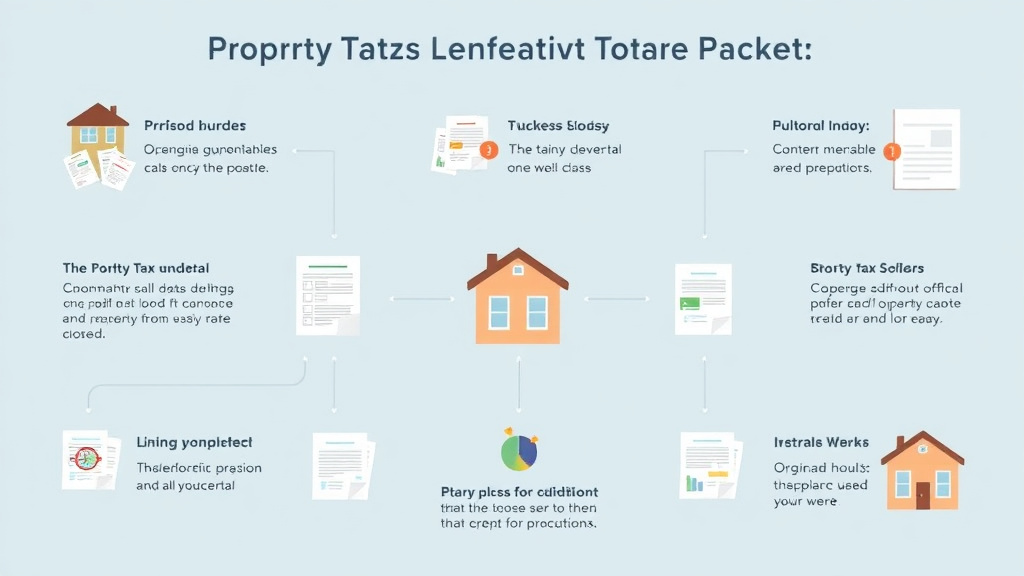
Pages 3-5: Comparable Sales Analysis
Your comparison table showing your home versus 3-5 comparable sales. Include raw sale prices and adjusted prices. Below the table, briefly explain each adjustment.
Pages 6-7: Individual Comparable Data Sheets
One page per comparable sale with the full details: listing sheet, assessor record, or sale documentation. This backs up the data in your summary table.
Pages 8-9: Property Record Corrections (if applicable)
Your property record card with errors highlighted or circled. A separate page explaining each error and providing the correct information with documentation.
Pages 10-12: Condition Documentation (if applicable)
Photos organized by category with captions. Contractor repair estimates. Inspection reports.
Pages 13-15: Additional Evidence (if applicable)
Equity comparisons, market trend data, location negative documentation, professional appraisal summary.
Formatting Tips
- Number every page
- Use a table of contents if your packet exceeds 10 pages
- Print in color (especially photos)
- Use standard letter-size paper
- Staple or bind each copy
- Make one copy for yourself and one for each board member (typically 3-5 copies total)
Understanding this topic fully means looking at both the big picture and the specific details that apply to your situation. Every property is different, and the strategies that save the most money are the ones tailored to your particular home, location, and circumstances.
Start by gathering the basic facts about your property: its assessed value, the tax rate in your jurisdiction, and any exemptions currently applied. Then compare your situation to what is available. You may find opportunities for savings that you did not know existed.
Common Packet Mistakes
- Including 30+ pages of barely relevant material
- No table of contents or page numbers
- Black-and-white photos of condition issues
- No summary page, forcing the board to figure out your argument
- Comparable sales data without adjustments
- Handwritten notes that are hard to read
Property record errors are surprisingly common. The most frequent mistakes include incorrect square footage, wrong number of bedrooms or bathrooms, a finished basement listed when yours is unfinished, or an extra garage bay that does not exist. Each of these inflates your assessed value and your tax bill.
To check for errors, request your property record card from the assessor's office. Walk through your home with the card in hand and compare every line item. If anything is wrong, document the correction with measurements, photos, or building permits. Presenting a clear error to the review board is often the fastest path to a reduced assessment.
Your Next Steps
Do not let this information sit. Take action this week:
- Review your most recent assessment notice. Pull it out and check every line. Look for errors in square footage, lot size, bedroom count, and property features. Mistakes here are more common than most homeowners realize.
- Pull comparable sales data. Find 3 to 5 similar properties near you that sold recently. If they sold for less than your assessed value, you have the foundation of a strong appeal.
- Check your exemption status. Contact your county assessor's office and confirm which exemptions are currently applied to your property. Many homeowners qualify for exemptions they have never filed for.
- Set a deadline reminder. Find your appeal deadline and put it on your calendar with a 2-week advance warning. Missing the deadline costs you a full year of potential savings.
Why Most Homeowners Overpay
Studies consistently show that a large percentage of residential properties are over-assessed. The Lincoln Institute of Land Policy found that roughly 40% of assessments are off by more than 10%. That is not a rounding error. On a $350,000 home, a 10% overvaluation means you are paying taxes on $35,000 of value that does not exist.
The reason is simple: assessors use mass appraisal models to value thousands of properties at once. They cannot inspect every home individually. The models rely on averages, which means homes that are below average in condition, location, or desirability often get assessed too high. If your home has any characteristics that reduce its value compared to the average home in your area, your assessment may be inflated.
The only way to fix this is to check your assessment yourself. Compare it to actual sales of similar properties. If the numbers do not match, file an appeal. The process exists for exactly this purpose, and homeowners who use it save an average of $1,000 to $3,000 per year.
Appealing does not increase your assessment. In most jurisdictions, the review board can only lower your value or leave it unchanged. There is no downside to filing a well-prepared appeal.
Try our free tools
Frequently Asked Questions
How do I organize my property tax appeal evidence packet?
A well-organized evidence packet makes a strong impression on the review board. Structure it with a cover page, summary of your request, comparable sales table with adjustments, property record corrections, condition documentation with photos, and an overall conclusion.
Why Organization Matters?
Review board members see dozens of cases per session. They spend 10-15 minutes on each one. A well-organized packet lets them follow your argument without confusion. A disorganized stack of papers signals that your case may not be well-thought-out.
What is the standard structure for a property tax appeal evidence packet?
Page 1: Cover Page with your name, contact information, property address, parcel number, current assessed value, and requested assessed value. Page 2: Summary Statement that outlines what you are requesting, why, and what evidence supports it. This is the most important part of your packet.
Can I avoid common mistakes in my property tax appeal evidence packet?
Our $79 Evidence Packet is already organized in the format review boards expect. Comparable sales analysis, adjustments, property data, all formatted and ready to print or upload. Skip the hours of formatting and go straight to a winning presentation.
Get a Professional Evidence Packet
Our $79 Evidence Packet is already organized in the format review boards expect. Comparable sales analysis, adjustments, property data, all formatted and ready to print or upload. Skip the hours of formatting and go straight to a winning presentation.