Last updated 2026-07-09
TL;DR
A drive-by assessment relies on exterior observation and public records only. A full interior assessment includes inside measurements, condition notes, and direct inspection. Studies and assessor audits consistently find drive-by methods produce larger valuation errors, sometimes missing 10-25% of value-relevant information. That gap is often your best grounds for a property tax appeal.
What is a drive-by assessment and how does it work?
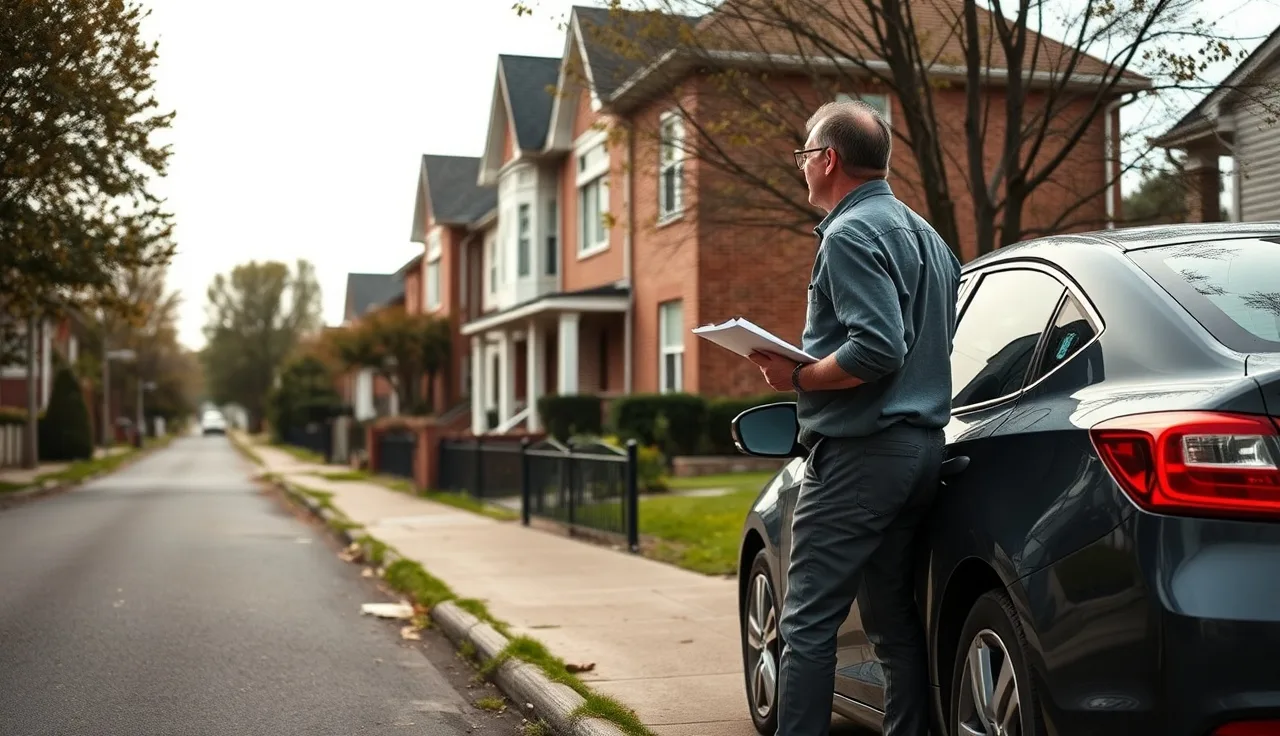
A drive-by assessment is exactly what it sounds like: the assessor, or more often a data collector working for the assessor's office, drives past your property, photographs the exterior, and records what they can see from the street or sidewalk. No one knocks on the door. No one measures the kitchen. No one sees the cracked foundation in the basement or the addition you tore down six years ago.
Assessors use drive-bys for a few reasons. They're fast. A single data collector can cover dozens of parcels in a day. For a jurisdiction reassessing tens of thousands of properties on a fixed schedule, it's often the only logistically practical option. Some states actually require physical inspections of every parcel on a cycle (Illinois mandates quadrennial inspections in Cook County, for example), but many others set no minimum standard at all, leaving the method entirely to the local assessor's discretion [1].
The data collected in a drive-by typically goes into the assessor's computer-assisted mass appraisal system (CAMA). That system then estimates value using a statistical model calibrated to recent sales. The exterior photo and any observable characteristics, such as siding type, roof condition, garage presence, and approximate story count, get entered as inputs. Everything behind the front door is estimated or carried over from whatever the record already shows.
This matters because the CAMA model can only be as accurate as the inputs it receives. If the record says your home has three bedrooms and two bathrooms because that's what it had in 1987, and a drive-by assessor never corrects it, the model runs on bad data. Your tax bill runs on bad data too.
What does a full interior assessment actually involve?
A full assessment means an assessor or licensed appraiser physically enters the property, measures the living area, counts and inspects rooms, notes the condition of major systems (roof, HVAC, foundation, windows), and records any functional issues or upgrades. This is the most accurate way anyone values a home.
In a full assessment, the appraiser walks every floor. They measure gross living area (GLA) with a tape or laser measure following ANSI Z765 standard methodology, which is what most lenders and appraisers use [2]. They note whether the basement is finished. They see the water damage behind the water heater. They record that the kitchen was renovated. All of that goes into the record.
Full assessments are common in two contexts. First, when a property transfers, many jurisdictions trigger an automatic interior review. Second, when a homeowner successfully appeals, the assessor often schedules an interior inspection as part of settling the dispute. In some jurisdictions, like many New England towns, the assessor's office conducts full cyclical inspections of every property on a three- to five-year rotation [3].
The accuracy difference is not subtle. A full interior inspection corrects data errors that can pile up for decades. A drive-by cannot.
How accurate is a drive-by assessment compared to a full one?
Significantly less accurate. That's the honest answer, though the gap widens or narrows depending on property type and neighborhood density.
The most widely cited research on mass appraisal accuracy comes from the International Association of Assessing Officers (IAAO). Their Standard on Ratio Studies sets a coefficient of dispersion (COD) target of 15.0 or lower for residential properties, meaning the median assessment ratio should not vary by more than 15% across comparable properties [4]. Drive-by-only reassessments routinely produce higher CODs than full inspection cycles, particularly in neighborhoods with diverse housing stock.
A 2019 analysis of assessment equity in Chicago found systematic under-assessment errors in lower-value homes and over-assessment in higher-value homes, problems tied directly to reliance on exterior-only data and CAMA models calibrated on sparse interior records [5]. The analysis found assessment ratios varying by more than 30 percentage points across income quintiles, far outside the IAAO's acceptable range.
For individual homeowners, the error can run in either direction. The assessor's record might show 1,800 square feet when your home is actually 1,650. Or it might show an unfinished basement as finished. Or it might miss the fact that your detached garage burned down. Drive-by methods have no mechanism to catch these errors. A full inspection does.
Nobody has clean national data on average error rates by method. The closest published benchmarks, from IAAO and state-level audits, suggest CODs in jurisdictions leaning heavily on drive-bys run 3 to 6 percentage points higher than those with strong interior inspection programs [4].
| Assessment Method | Typical COD Range | Interior Data Accuracy | Corrects Record Errors? |
|---|---|---|---|
| Drive-by only | 15-25+ | Exterior only | Rarely |
| Drive-by + CAMA update | 12-20 | Partial | Sometimes |
| Full interior inspection | 8-15 | Complete | Yes |
| Licensed fee appraisal | 5-10 | Complete + comparable sales | Yes |
What errors does a drive-by assessment commonly miss?
Print this section before you open your assessment notice.
Finished basement square footage. Assessors often cannot tell from the street whether your basement is finished, partially finished, or raw concrete. If the record says finished and it isn't, you're being taxed on space that adds no comparable value to a sale. If it says unfinished and you finished it, the opposite problem applies, but many homeowners don't pull permits, so the assessor has no record of the improvement.
Gross living area errors. Measurement mistakes happen more than most homeowners expect. A study of residential appraisal data found GLA discrepancies of more than 5% in roughly 1 in 8 properties reviewed [6]. An error of 200 square feet on a 2,000-square-foot home can translate directly into a value error of 8-12%.
Condition and functional obsolescence. A drive-by assessor cannot see that your roof is 28 years old, that the HVAC was condemned by the city inspector, or that the only full bathroom is reachable only through a bedroom. These are real value-reducing factors that a full appraisal would capture. They're invisible from the curb.
Demolished structures. If you tore down a detached garage or a shed without the assessor updating the record, you may still be paying taxes on it. Drive-by assessors often do not notice structures that are simply gone.
Additions that never existed. Occasionally the assessor's record shows square footage for an addition that was planned, permitted, but never built, or that belongs to a neighboring parcel due to a data entry error from decades ago. A full inspection catches this immediately. A drive-by perpetuates it indefinitely.
For homeowners in large counties using mass appraisal, checking your property record card at the assessor's office is the first thing to do. If you're in Cook County or LA County, those record cards are often available online.
Does the assessment method affect your right to appeal?
Yes. And this is arguably the most useful thing to understand.
In most states, you can appeal your assessed value no matter how it was determined. But the method is directly relevant to your grounds. If your assessment was produced by a drive-by and the assessor's record contains factual errors (wrong square footage, wrong bedroom count, wrong condition grade), those errors give you a strong, document-supported basis for a formal appeal.
Appeals based on factual errors in the assessor's record are often the fastest to win. You don't need to hire an expert. You pull your property record card, compare it to reality, document the discrepancy with measurements and photos, and submit. Many jurisdictions settle these informally before a formal hearing ever happens.
The right to an interior inspection also matters here. In many states, once you file an appeal, you are entitled to request that the assessor conduct a full interior inspection before the hearing. This is worth doing even if you think the square footage is right, because the interior inspection sometimes uncovers additional errors in your favor, and it puts the burden on the assessor to defend a value built from accurate data rather than a drive-by estimate.
If you're in Gwinnett County or Bexar County, check your local assessor's website for the specific form and deadline for requesting a review. Missing the deadline is the most common and most painful mistake homeowners make.
How do you find out which method was used on your property?
Call the assessor's office and ask. That's genuinely the fastest way. Most offices track the last inspection type in the property record: 'exterior only', 'field review', 'full inspection', or similar language. Some jurisdictions post this directly on the online property record card.
You can also infer it from context. If your neighborhood was reassessed county-wide in the past year, and no one knocked on your door or scheduled an inspection, it was almost certainly a drive-by or a CAMA-only update. If you received a letter scheduling an inspection appointment, it was a full assessment.
For mass reassessment years in particular, ask when the last full interior inspection of your property occurred. In many jurisdictions, the honest answer is: never, or 15 years ago. That's useful to know before you appeal, because it means the value on your notice may rest on a record that's been carrying errors for a long time.
Some state statutes require assessors to disclose inspection records on request. Illinois property owners, for example, can request the property record card and inspection history under the Freedom of Information Act [7]. Other states have similar public records provisions. If the assessor resists sharing this information, a brief written FOIA request usually resolves it.
Can a drive-by assessment lead to an over-assessment or under-assessment?
Both happen. The direction of error depends on what the assessor's record says versus what's actually true.
Over-assessment shows up most in older housing stock where improvements have been made without permits, where the record shows obsolete amenities as functional, or where square footage was estimated high at some point and never corrected. If your property record says you have a finished basement, a three-car garage, and 2,400 square feet of living area, and the reality is an unfinished basement, a one-car garage, and 2,100 square feet, you're being taxed on a property that doesn't exist.
Under-assessment happens too, usually when you've made significant permitted improvements. If you added a substantial addition and the assessor's drive-by missed it, you're paying less than your fair share. Most homeowners don't complain about this, but know that under-assessment can be corrected by the assessor at any time, sometimes with back-tax liability depending on state law.
The IAAO's published data on vertical equity consistently shows that drive-by-reliant mass appraisals tend to over-assess lower-value properties and under-assess higher-value ones. As the IAAO notes in its Standard on Ratio Studies, "assessment equity requires that properties of similar value be assessed at similar ratios" [4]. Drive-by methods make that harder to achieve at scale.
What evidence should you gather if your assessment was drive-by only?
Start with your property record card. Print it or save it. Circle every item that doesn't match reality.
Then photograph everything that contradicts the record. Unfinished basement? Wide-angle photos showing the concrete floor and exposed joists. Missing structure? Photos of the empty lot where the garage used to be. Visible exterior damage? Document it thoroughly, because condition is relevant to value even when it's not a data-entry error.
Measure your gross living area yourself, following ANSI Z765 guidelines, which exclude unfinished basements, garages, and areas with ceilings below 5 feet [2]. If your measurement differs from the record by more than 5%, that's strong appeal evidence. You can also hire a local appraiser for a few hundred dollars to provide a written measurement report, which carries more weight before a board of equalization than your own tape measure, though both are admissible in most jurisdictions.
Comparable sales (comps) are the other major evidence category. Pull three to five recent sales of similar properties in your neighborhood. If those properties sold at values implying a lower price per square foot than your assessment assumes, document the gap. Many appeal boards weigh accurate comps heavily.
If you want a structured framework for organizing all of this, TaxFightBack's DIY appeal kit walks through evidence preparation step by step so you keep 100% of whatever reduction you win.
For homeowners in specific large jurisdictions, these guides are worth reading before you file: Montgomery County property tax, Santa Clara property tax, and Hennepin County property tax.
Are drive-by assessments legal, and do assessors have to tell you which method they used?
Drive-by assessments are legal in virtually every U.S. jurisdiction. No federal law regulates assessment methodology. State statutes set the framework, and most simply require that assessed values reflect market value or some statutory percentage of it, without specifying how the assessor must determine that value [8].
Disclosure requirements vary a lot by state. Some states, like California under Proposition 13's implementing statutes, require assessors to notify property owners of changes and provide appeal rights, but don't specifically require disclosure of the inspection method [9]. Others require assessment rolls to be public records (which they almost universally are), which means the property record card, including whatever inspection data exists, is available to any property owner who asks.
There is no federal right to know the inspection method, but there is a broad practical norm: assessors who face organized appeals tend to be more forthcoming with records than those who don't. Asking in writing, referencing your state's public records or FOIA statute, almost always produces the documentation you need.
The legal protection you do have in every state is the right to appeal the assessed value itself. The method is relevant evidence in that appeal. It's not, by itself, grounds to invalidate an assessment in most jurisdictions. What matters is whether the value is accurate, not whether the process was elegant.
How does a bank appraisal compare to a tax assessment in accuracy?
This comes up constantly because many homeowners have a recent mortgage or refinance appraisal and want to use it as evidence.
A bank appraisal (formally, a Uniform Residential Appraisal Report under Fannie Mae Form 1004) is a full interior appraisal completed by a licensed or certified appraiser following USPAP (Uniform Standards of Professional Appraisal Practice) standards [10]. It includes interior inspection, measured GLA, condition rating, and a sales comparison approach using recent comparable sales. It's generally the most accurate valuation most homeowners will ever have done on their property.
For appeal purposes, a recent bank appraisal can be excellent evidence, particularly if it shows a market value below your assessed value (or below the assessed value divided by the statutory assessment ratio). Most appeal boards accept certified appraisals as evidence. The limitation is time: an appraisal done at refinancing in a different market period may not reflect the value as of your assessment date.
Here's the practical comparison. A full tax assessment by a competent assessor using interior data should produce a value within 5-10% of a contemporaneous bank appraisal on the same property. A drive-by tax assessment can be off by much more, because it cannot capture the same inputs. If your bank appraisal and your tax assessment diverge sharply, that divergence itself is worth examining carefully.
What should you do right now if you suspect a drive-by caused your over-assessment?
Three immediate steps, in order.
First, get your property record card. Go to your county assessor's website or call the office. Find the card, print it, and read every line. Square footage, bedroom count, bathroom count, basement finish status, garage type, year built, condition grade. These are the inputs that produced your value. Wrong inputs produce wrong values.
Second, identify the discrepancies. Walk your property with the record card in hand. Measure what you can. Take photos of everything that doesn't match. This takes two hours at most and is the foundation of any successful appeal.
Third, find your appeal deadline. This is the one that kills appeals before they start. Most jurisdictions give you 30 to 90 days from the date on your assessment notice to file a formal appeal [11]. Miss that window and you wait another year. Your state's department of revenue or the assessor's website will have the exact deadline.
Do those three things and you're better prepared than 90% of homeowners who file appeals. The TaxFightBack appeal kit can then help you structure the actual submission and argument so you don't lose money to a procedural error.
For reference on payment deadlines and appeal procedures in your specific county, see resources like the Bibb County tax assessor guide or your state's revenue department.
Frequently asked questions
Can I force the assessor to do a full interior inspection instead of a drive-by?
In most states, you cannot legally compel an interior inspection before the assessment is issued. However, once you file an appeal, many jurisdictions give you the right to request one as part of the review process. Check your state's administrative code or ask the assessor's office directly. Some boards of equalization schedule an interior inspection as a standard step in disputed cases.
How do I get a copy of my property record card?
Most county assessor websites let you search by address and download the property record card directly. If yours doesn't, call the assessor's office and request it, mentioning your state's public records or open records law. You're entitled to it in every state. The card shows the data inputs, including square footage, room counts, and condition ratings, that produced your assessed value.
Is a drive-by assessment the same as a desk review?
Close, but not identical. A desk review uses only existing records and MLS or sales data, with no physical visit at all. A drive-by at least involves a field visit and exterior observation. Both are less accurate than full interior inspections. For appeal purposes, either can produce a flawed value, and either gives you grounds to challenge if the resulting assessment doesn't match your property's actual characteristics.
My neighbor's house looks exactly like mine but is assessed lower. Is that grounds to appeal?
Possibly. If two properties are genuinely comparable in size, condition, and location, a significant assessment disparity is a form of inequity that most appeal boards will consider. Request both property record cards and compare the data inputs. The difference may be a data error on one card, not a deliberate inequity. Either way, documenting the disparity strengthens your appeal argument.
How much can an incorrect square footage measurement affect my property tax bill?
It depends on your local tax rate and the cost-per-square-foot assumption in the assessor's model. A 200-square-foot overstatement on a property the model values at $150 per square foot translates to a $30,000 over-assessment. At a 1.2% effective tax rate, that's $360 per year in excess taxes. Over a decade without correction, that's $3,600. Errors compound.
What is a coefficient of dispersion (COD) and why does it matter for my assessment?
The COD measures how consistently an assessor applies values across similar properties. A COD of 15 means assessments vary by about 15% around the median ratio. The IAAO recommends a COD of 15.0 or lower for residential properties. Higher CODs indicate a less accurate and less equitable assessment system. A jurisdiction with a COD above 20 is statistically likely to have a significant share of properties over-assessed.
Can I use a recent bank appraisal to challenge a drive-by assessment?
Yes, and it's often effective evidence. A certified appraisal from a licensed appraiser, done at or near the assessment date, carries weight before most appeal boards. The key is that the appraisal's effective date should be close to the assessment's valuation date (often January 1 of the tax year). An appraisal from a different market cycle may be discounted, though it still shows interior condition and GLA accurately.
What is CAMA and how does a drive-by feed into it?
CAMA stands for computer-assisted mass appraisal. It's the statistical modeling system most county assessors use to value large numbers of properties at once. Assessors input property characteristics (size, age, condition, features), and the model estimates value based on sales of comparable properties. A drive-by assessment feeds exterior and record data into CAMA. If those inputs are wrong, the modeled value is wrong, regardless of how sophisticated the math is.
How often should a county reassess properties with a full inspection?
There's no universal federal standard. The IAAO recommends annual updates to assessed values, but allows that mass appraisal using statistical methods can maintain accuracy between full inspection cycles. State laws vary widely: some require full inspections every few years, others leave it to local assessors. In practice, many counties go 10-20 years between full interior inspections of individual parcels, relying on drive-bys and CAMA updates in between.
Does a new construction assessment involve a full inspection?
Generally yes. New construction almost always triggers a full interior assessment, often tied to the issuance of a certificate of occupancy. The assessor needs to establish a baseline record for a property that has no prior data. That baseline then gets used, sometimes without update, for many subsequent years of drive-by or CAMA-only reassessments. Errors in the initial assessment record can persist for decades.
Are commercial properties assessed differently than residential ones?
Yes, in most jurisdictions. Commercial properties are more commonly assessed using income capitalization approaches (based on rent rolls and cap rates) rather than mass appraisal CAMA models. Drive-by methods are less common for larger commercial properties because the income approach requires financial data regardless. Small commercial buildings may still be mass-appraised similarly to residential. For more on commercial specifics, see county-level guides for your area.
What's the difference between fair market value and assessed value for appeal purposes?
Fair market value is what a willing buyer would pay a willing seller in an arm's-length transaction. Assessed value is what the assessor records for tax purposes, which in many states is a statutory fraction of fair market value (80%, 100%, or another ratio depending on state law). When you appeal, you're typically arguing that the assessor's implied market value is too high, rather than that the assessed value number looks large. Know your state's assessment ratio before you build your argument.
Sources
- Illinois General Assembly, 35 ILCS 200/9-215 (Property Tax Code, quadrennial reassessment): Illinois mandates quadrennial reassessment inspections in Cook County under state property tax code
- American National Standards Institute / National Association of Home Builders, ANSI Z765 Residential Square Footage Guidelines: ANSI Z765 is the standard methodology for measuring gross living area used by appraisers and many assessors
- New Hampshire Department of Revenue Administration, Property Appraisal Division: New England jurisdictions commonly conduct cyclical full inspections of every property on a multi-year rotation
- International Association of Assessing Officers (IAAO), Standard on Ratio Studies (2013): IAAO sets a COD target of 15.0 or lower for residential properties and notes that assessment equity requires similar ratios for properties of similar value
- ProPublica Illinois / Chicago Tribune, Crain's Chicago Business reporting on Cook County assessment equity, 2017-2019: 2019 analysis found Cook County assessment ratios varying by more than 30 percentage points across income quintiles, tied to exterior-only data and CAMA models
- Fannie Mae, Selling Guide: Appraiser Independence Requirements and URAR form guidance: GLA discrepancies of more than 5% in reviewed residential appraisal data indicate widespread measurement inconsistency
- Illinois Attorney General, Freedom of Information Act (5 ILCS 140): Illinois property owners can request property record cards and inspection history under the Illinois Freedom of Information Act
- Lincoln Institute of Land Policy, Significant Features of the Property Tax (state-by-state database): State statutes generally require assessed values to reflect market value or a statutory fraction thereof without specifying inspection methodology
- California State Board of Equalization, Property Tax Rules and Assessment Appeals Guide: California requires assessors to notify property owners of value changes and provide appeal rights under Proposition 13 implementing statutes
- Fannie Mae Form 1004, Uniform Residential Appraisal Report; Appraisal Standards Board, USPAP: Bank appraisals are completed under USPAP standards using full interior inspection, measured GLA, condition rating, and sales comparison approach
- National Taxpayers Union Foundation, Guide to Property Tax Appeals: Most jurisdictions give property owners 30 to 90 days from the assessment notice date to file a formal appeal
- IAAO, Standard on Mass Appraisal of Real Property (2017): IAAO recommends annual updates to assessed values and addresses acceptable mass appraisal methods between full inspection cycles