Last updated 2026-07-10
TL;DR
Knob and tube wiring is a functional obsolescence defect that assessors and appraisers recognize as reducing market value. In a tax appeal, it can support a 10 to 25% reduction in assessed value if you document it with a licensed electrician's report and comparable sales. You don't need a contingency firm to make this argument work.
What is knob and tube wiring and why do assessors care about it?
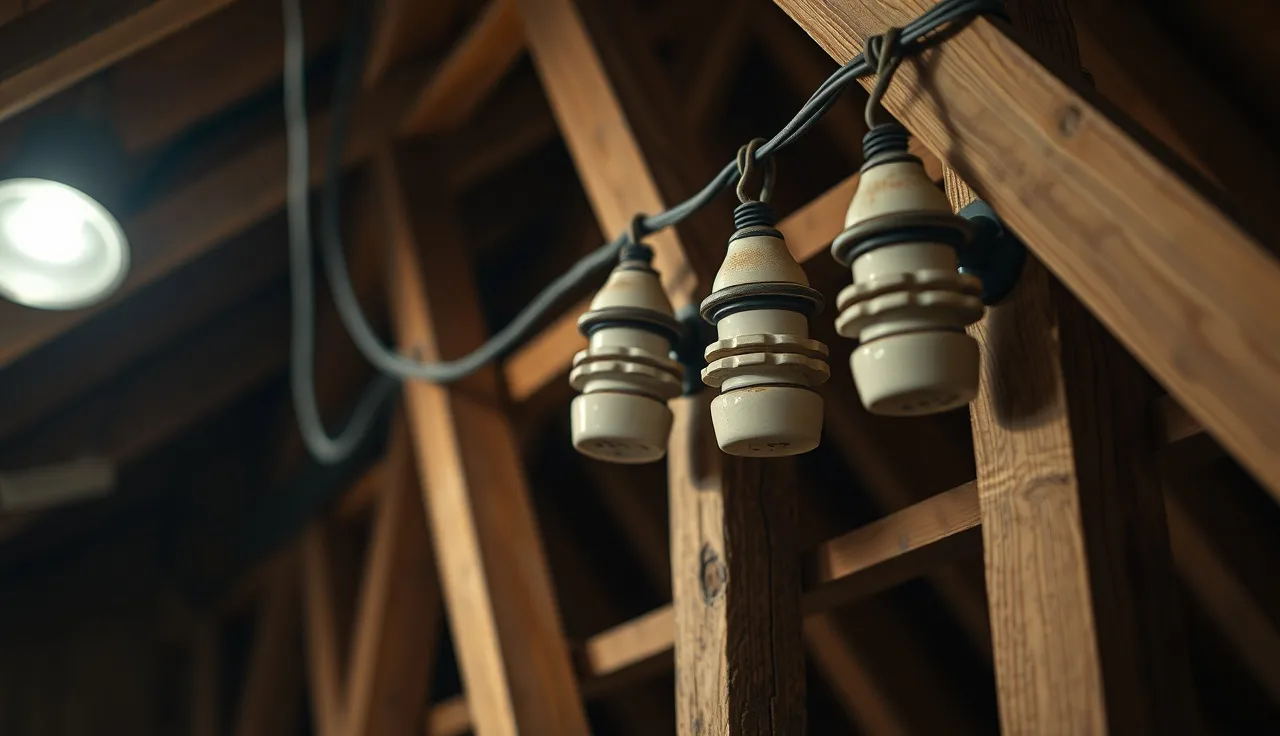
Knob and tube (K&T) wiring was standard construction from roughly the 1880s through the 1940s. It runs ungrounded single conductors through ceramic knobs (for support) and ceramic tubes (where the wire passes through framing). No ground wire. No sheathing between conductors. No protection from contact with insulation. That last point matters a lot. Modern blown-in attic insulation can trap heat around K&T conductors and create a fire hazard, which is why most electricians and insurance underwriters treat the two as incompatible. [1]
Assessors care because assessed value is supposed to reflect market value, and knob and tube wiring changes what buyers will pay and what they can finance. Fannie Mae guidelines require appraisers to note K&T and assess whether it's a safety concern, and lenders routinely condition loans on replacement or at minimum a licensed electrician's letter certifying the system is safe. [2] When something shrinks the buyer pool and raises the cost to own, it pushes price down, and that pressure should flow through to your assessed value.
Functional obsolescence is the appraisal term for this. The Appraisal Institute defines it as "a loss in value from deficiencies or superadequacies in the structure itself." [3] K&T is a textbook case of curable functional obsolescence: the defect exists, it costs money to fix, and buyers price that cost into their offers. An assessor who ignores it is over-assessing your property.
How much does knob and tube wiring actually reduce property value?
Nobody has a single authoritative national study on this. The honest answer is the discount varies by local market, house age, and how much of the K&T system is still live. Appraisers and real estate attorneys who work with older housing stock consistently cite a range of 10 to 25% below comparable updated homes, and some insurance-driven markets (Massachusetts, upstate New York, older Midwest cities) run toward the higher end. [4]
The cost-to-cure method gives you a harder floor. A full rewire of a 1,500-square-foot house typically runs $8,000 to $15,000 in most U.S. markets as of 2024, and past $20,000 in high-cost metros like San Francisco or New York. [5] Assessors using the cost approach are supposed to subtract the cost to cure from replacement cost. If they didn't, you make that argument directly in your appeal.
Here's the practical test. Pull three to five recent sales of similar-era homes in your neighborhood. Sort them by whether the listing disclosed updated electrical or original K&T. If the updated homes sold for $20,000 more than yours on average, and your assessment doesn't reflect that gap, you have a real case.
| Market condition | Typical value discount range | Primary driver |
|---|---|---|
| Insurance-restricted market (MA, NY, some Midwest) | 15 to 25% | Insurer refusal or surcharges |
| Conventional lender-restricted sale | 10 to 20% | Appraisal conditioning, limited buyer pool |
| Cash buyer or investor market | 5 to 15% | Priced as renovation project |
| Partial K&T with updated panel | 5 to 10% | Reduced risk perception |
Does knob and tube wiring affect your property tax assessment?
It should, but it often doesn't automatically. Assessors work from mass appraisal models. They enter square footage, bed and bath count, age, and a handful of condition codes. Unless your jurisdiction has a specific checkbox for ungrounded or original wiring, the K&T may never make it into the model. That's an error in your favor, and you only get it corrected if you raise it.
Here's the good part. Most state assessment statutes set fair market value as the standard, and courts have repeatedly upheld functional obsolescence from outdated systems as a legitimate deduction. In Illinois, the Property Tax Code at 35 ILCS 200/1-50 defines fair cash value as the price a property would bring in an arm's-length market transaction, which directly takes in buyer behavior around defects like K&T. [6] Nearly every state has an equivalent provision.
If your assessed value tops what the property would actually sell for given its K&T condition, you're overpaying. The appeal process exists for exactly this.
Can you use knob and tube wiring as evidence in a property tax appeal?
Yes. It's some of the most concrete evidence you can bring, because the defect is physical, documentable, and carries a quantifiable cost to cure.
The strongest package combines three things. A licensed electrician's written report stating the scope of the K&T system, whether it's been modified or extended, and an estimate to rewire. Make sure it's on letterhead with a license number. Comparable sales showing updated homes versus K&T homes and the price gap between them. And a copy of your insurance policy or a letter from your insurer documenting any surcharge, exclusion, or cancellation tied to K&T.
Insurance is powerful evidence. If your carrier charges an extra $400 a year for a K&T surcharge, or you had to switch to a non-standard carrier, that's an ongoing cost a buyer would price into any offer. Boards of equalization and tax tribunals take insurance-related impairments seriously because a third party with no stake in your appeal documented them. [4]
For appeals in large counties, format and submission rules matter. In Cook County, the Board of Review has specific evidence requirements for condition appeals. Check the cook county tax assessor tax bill overview for the filing specifics before you submit. If you're in LA County, the los angeles county property tax appeal instructions explain how to present physical defect evidence to the Assessment Appeals Board.
What documentation do you need before filing your appeal?
Get the electrician's report first. It anchors everything else. Ask for four things: the approximate percentage of the home still on K&T circuits, whether any K&T runs under insulation (the highest-risk scenario), whether the panel has been updated even if the branch circuits remain original, and an itemized cost estimate to bring the system to current code. Keep the electrician's invoice too, even for an inspection you already paid for.
Next, pull your insurance declarations page and any correspondence where the insurer mentions the wiring. If your insurer dropped you or refused to write you, that letter is gold. If they just haven't asked yet, call them, ask specifically whether K&T affects your rate or coverage, and get the answer in writing.
For comps, use your county assessor's parcel search or a free MLS summary from a cooperating agent. You want same neighborhood, similar square footage, similar age, sold within the last 12 months. Note in your spreadsheet which listings said "updated electrical" or "rewired" and which were silent or disclosed original wiring. The disclosure pattern in your market tells the story.
If you want a structured way to organize all of this before your hearing date, TaxFightBack's appeal kit walks through what to include in a condition-based appeal, in what order, and how to present it to the board without a lawyer.
Texas homeowners, take note: Bexar County has a reputation for negotiating at the informal hearing level when you show up with contractor documentation. See the bexar county tax assessor guide for their informal hearing logistics.
How do assessors value properties with knob and tube wiring when they do account for it?
There are three appraisal approaches, and K&T shows up differently in each.
Under the cost approach, the assessor starts with land value plus depreciated replacement cost of improvements. Physical depreciation covers age and wear. Functional obsolescence is a separate line item, and K&T's cost to cure belongs there. If the assessor's depreciation schedule has no K&T deduction, the cost approach overstates value. Request a copy of the assessor's property record card (most counties provide this free online or by request) and check whether any obsolescence beyond standard age depreciation was applied. [7]
Under the sales comparison approach, the assessor adjusts for differences between your home and the comps they used. If their comps all had updated wiring and they made no downward adjustment for your K&T, the assessed value is inflated. This is the easiest argument to make because it's visible right in the assessment record.
Under the income approach (mostly used for rental or commercial property), K&T cuts value by raising insurance costs and limiting what tenants will accept or what lenders will finance. For a small rental duplex with K&T, the income approach should reflect lower net operating income from higher insurance premiums. If you own a small investment property in gwinnett county tax assessor territory, run the income approach argument alongside the sales comparison.
Does homeowners insurance on knob and tube wiring affect your tax appeal?
More than most people realize. Insurance is a market signal, and assessors and appeal boards treat it as objective third-party evidence of impaired value. A property that's uninsurable, or insurable only at a steep surcharge, has a smaller pool of buyers who can afford to own it. Smaller pool, weaker demand.
The Insurance Information Institute notes that some insurers will not write new policies on homes with K&T wiring at all, while others will only with a signed electrician's certification. [8] Either outcome affects value. If you can document a premium surcharge of, say, $600 a year, you can capitalize it into a value reduction. Use a simple income-capitalization shortcut: $600 a year at a 5% capitalization rate implies a $12,000 reduction in value. That math isn't precise appraisal science, but it gives a board something concrete to weigh.
Get it in writing. An email from your agent saying "your rate includes a $X surcharge due to original knob and tube wiring" beats any verbal statement.
What if your assessor refuses to reduce the value for knob and tube wiring?
Appeal. That's what the process is for.
Start with the informal hearing (most counties offer this as a first step). Bring your electrician's report, your comp spreadsheet, and your insurance evidence. Be specific: "The three updated comparables the assessor used sold for an average of $18,000 more than K&T homes in this neighborhood. No adjustment was made for electrical condition. I'm asking for a reduction of X to reflect that gap." Specific numbers with sourced backing beat vague complaints about condition every time.
If the informal hearing goes nowhere, file for the formal board hearing. Most state boards of equalization and tax appeal tribunals allow property condition evidence. In many states you have the right to subpoena the assessor's work file and see exactly what condition ratings they used.
A few states hand you extra room to work. In California, Revenue and Taxation Code Section 51 requires assessors to consider the condition of the property and any other factor that may affect its value, which courts have read to include functional obsolescence from outdated systems. [9] In New York, RPTL Section 730 allows a small claims assessment review (SCAR) for owner-occupied residential property, a relatively informal and cheap process. [10]
If you're in Montgomery County, Maryland, see the montgomery county property tax guide for their three-year assessment cycle and how to time a condition-based challenge.
How does knob and tube wiring interact with other condition-based tax deductions?
K&T rarely travels alone in older homes. A house old enough to still carry original knob and tube wiring often also has cast iron drain lines, galvanized supply pipes, aging HVAC, and a 60-amp panel that can't support a modern household's load. Each of these is a separate item of functional or physical obsolescence.
The cumulative argument is stronger than any single defect. List the K&T wiring, the galvanized plumbing with reduced water pressure, and the attic you can't insulate because of the K&T, and you're describing a house that a buyer would discount on several fronts. Get contractor estimates for each item. The total cost to cure hands the assessor and any appeal board a hard number to work from.
One caution. Don't overclaim. If the home was partially rewired and only one or two circuits remain on K&T, the market impact is smaller and your discount claim should say so. Boards notice when a petitioner's numbers don't match the physical evidence, and it undermines your credibility on the parts of the claim that are solid. Be accurate about what's actually there.
What are the deadlines for filing a property tax appeal based on knob and tube wiring?
Deadlines vary by state and county. Miss one and you wait another year. The table below covers common state frameworks, but always verify with your local assessor's office, because counties within a state can differ.
| State | Typical appeal window | Notes |
|---|---|---|
| California | 60 days from assessment notice (regular roll filing July 2 to Sept 15) | County AABs have varying schedules [9] |
| Illinois | 30 days from publication of township multiplier | County BOR deadlines differ [6] |
| Texas | May 15, or 30 days from notice, whichever is later | Informal hearing available before formal ARB |
| New York | 30 days from Tentative Roll publication (varies by municipality) | SCAR available for owner-occupied residential [10] |
| Florida | 25 days from TRIM notice (mailed in August) | Value Adjustment Board hears petitions |
| Georgia | 45 days from assessment notice | Board of Equalization |
| Minnesota | April 30 (mail-in to county) or Local Board date | Hennepin County has specific procedures |
For Minnesota properties, the hennepin county property tax page has current local board dates.
The K&T documentation (electrician's report, insurance letter, comps) typically has to be submitted before or at the hearing. Some boards allow supplemental evidence up to a set number of days before the hearing date. Don't wait until the day before to schedule the electrician's inspection.
Is it worth hiring someone to appeal, or can you do it yourself?
For a K&T-based appeal, you can almost certainly do this yourself. The evidence is physical and concrete. You're not making a complex statistical argument about mass appraisal models. You're saying: here is a defect, here is what it costs to fix, here is how similar homes with and without this defect sold. Straightforward.
Contingency firms typically charge 25 to 40% of your first-year tax savings. On a $3,000 annual tax bill with a 15% reduction, that's $450 saved. The firm takes $110 to $180. You keep $270 to $340. Run the math for your own numbers, but on a condition-based case with solid documentation, paying a third of the savings for someone to present your own electrician's report is a hard sell.
Professional help earns its keep on large commercial properties, complex income-approach disputes, or jurisdictions where attorneys have relationships with specific board members that produce better outcomes. For a homeowner with K&T in a 1930s bungalow, the DIY path works fine if you're organized.
TaxFightBack's appeal kit includes the templates for a condition-based appeal: how to format the cost-to-cure section and how to lay out the comparable sales grid so a board can follow it without explanation.
Frequently asked questions
Does knob and tube wiring automatically lower my property tax assessment?
No. Assessors use mass appraisal models that often don't capture wiring type. Your assessed value won't drop on its own. You have to raise the issue through an appeal, present documentation, and ask for the adjustment. The defect is real and legally relevant, but the system doesn't find it for you.
How much can I realistically reduce my assessed value by citing knob and tube wiring?
In most markets, 10 to 25% below comparable updated homes is the documented range. The actual number depends on the cost to rewire your specific house (typically $8,000 to $15,000 for a 1,500 sq ft home), local insurance market conditions, and how your comparables shake out. Get the electrician's estimate first; that gives you a concrete floor to argue from.
What kind of electrician's report do I need for a property tax appeal?
A written report on the electrician's letterhead, with their state license number, describing the extent of the K&T system, any known hazards (especially K&T under insulation), and an itemized estimate to rewire to current code. A verbal assessment won't help you. The report works as expert testimony and has to be citable and credible.
Can I appeal my property taxes if I already rewired the house?
If you rewired before the assessment date, the defect is gone and you can't claim it for the current year. But if you had K&T during a prior assessment year and overpaid then, some states allow retroactive appeals for a limited lookback period (one to three years in most states). Check your state's statute of limitations on assessment appeals.
Will my property taxes go up if I rewire the house?
Possibly, but modestly. Rewiring is a repair, not an addition. Most states separate repairs that restore condition (not typically reassessable) from improvements that add value (reassessable). Rewiring usually falls in the repair category, so a full reassessment is unlikely. That said, pulling permits creates a paper trail, and some jurisdictions run an inspection that could prompt a minor upward adjustment.
My insurance company won't cover knob and tube wiring. How do I document that for the appeal?
Ask your agent or carrier to put it in writing: a letter or email stating that your policy excludes or surcharges K&T circuits, or that coverage was declined because of original wiring. If you had to switch to a non-standard carrier, bring both the declination letter and your current declarations page showing the higher premium. Insurance impairment is strong third-party evidence for a board.
Does Fannie Mae or FHA lending policy on knob and tube wiring help my tax appeal?
Yes, indirectly. Fannie Mae requires appraisers to note K&T and assess safety, and FHA requires correction of K&T that is defective or improperly modified before insuring a loan. These policies limit your buyer pool to cash buyers or those who can get conventional loans with conditions. A smaller buyer pool means downward pressure on price, which is the core argument for a lower assessed value.
Are there states where knob and tube wiring is explicitly addressed in property tax rules?
Most states don't name K&T specifically, but all state property tax statutes require assessment at fair market value and recognize functional obsolescence as a legitimate deduction. California's Revenue and Taxation Code Section 51, Illinois' 35 ILCS 200/1-50, and New York's RPTL Section 730 all create pathways for condition-based appeals that apply to K&T situations.
How do I find comparable sales showing the price difference between knob and tube and updated homes?
Use your county assessor's parcel search to find recent sales in your neighborhood. Then cross-reference those addresses on Zillow or Redfin to read the listing descriptions. Look for language like 'updated electrical,' 'rewired,' or '200-amp service' in the updated homes, and silence or disclosure on K&T in the others. A table of five to six pairs with their sale prices makes a clean exhibit.
Can a property tax appeal based on knob and tube wiring trigger a full reassessment?
In most states, no. An appeal challenges a specific assessment; it doesn't request a new one. The board can lower, maintain, or sometimes raise your value, but a targeted condition-based appeal rarely ends higher than the original assessment. Some states bar the board from raising value above the original unless fraud is found.
Is knob and tube wiring treated differently in commercial property tax appeals?
The principle is the same but the valuation method shifts. For commercial or mixed-use property, the income approach dominates. K&T raises insurance costs and can limit tenant occupancy permits or lender financing, both of which cut net operating income and therefore capitalized value. Document the insurance surcharge and any code compliance costs; those feed straight into an income approach argument.
What if my assessor says knob and tube wiring is already reflected in the age-based depreciation?
Push back. Age-based physical depreciation and functional obsolescence from outdated systems are separate line items under standard appraisal methodology. The Appraisal Institute's guidance treats them as additive, not interchangeable. Bring the Appraisal Institute definition of functional obsolescence to the hearing and ask the assessor to show you exactly where in their model the K&T discount was applied.
How long does a property tax appeal based on an electrical defect take?
At the informal level, most counties schedule hearings within four to eight weeks of filing. Formal board hearings can take three to nine months, depending on the county's backlog. Cook County, Illinois, for example, often runs six months or more for board-level appeals. Plan for the long runway, but the savings apply retroactively to the tax year you appealed.
Sources
- U.S. Consumer Product Safety Commission, Older Wiring: Knob and tube wiring is incompatible with blown-in insulation and poses a fire hazard when the two are in contact
- Fannie Mae, Selling Guide B4-1.3-05 (Improvements Section): Fannie Mae requires appraisers to note knob and tube wiring and assess whether it poses a safety concern
- Appraisal Institute, The Appraisal of Real Estate, 15th Edition: Functional obsolescence is defined as a loss in value from deficiencies or superadequacies in the structure itself
- National Association of Realtors, Research & Statistics: Homes with outdated electrical systems sell at a discount in insurance-restricted markets; industry practitioners cite 10 to 25% below updated comparable homes
- Angi, Cost to Rewire a House Guide: Full rewire of a 1,500 square foot house typically costs $8,000 to $15,000 in most U.S. markets as of 2024
- Illinois General Assembly, 35 ILCS 200/1-50, Property Tax Code definition of fair cash value: Illinois Property Tax Code at 35 ILCS 200/1-50 defines fair cash value as the price property would bring at an arm's-length market transaction
- International Association of Assessing Officers (IAAO), Standard on Mass Appraisal of Real Property: IAAO standards require that functional obsolescence from outdated systems be treated as a separate deduction from physical depreciation in the cost approach
- Insurance Information Institute, Home Insurance Basics: Some insurers will not write new homeowners policies on homes with knob and tube wiring; others require a licensed electrician certification before coverage
- California State Board of Equalization, Revenue and Taxation Code Section 51: California Revenue and Taxation Code Section 51 requires assessors to consider the condition of property and any other factor affecting value, which courts have interpreted to include functional obsolescence
- New York State Department of Taxation and Finance, RPTL Section 730 Small Claims Assessment Review: New York RPTL Section 730 allows owners of owner-occupied residential property to file a small claims assessment review for an informal, low-cost appeal process
- HUD/FHA, Single Family Housing Policy Handbook 4000.1: FHA requires that defective or improperly modified knob and tube wiring be corrected prior to loan insurance on a purchase or refinance transaction