States With the Lowest Property Taxes in 2026
TL;DR
Hawaii has the lowest effective property tax rate in the country at about 0.27%, followed by Alabama at 0.37% and Louisiana at 0.51%. On a $350,000 home, a Hawaiian homeowner pays roughly $945 per year, while the national average is about $3,150. Low property tax states typically make up the difference through higher income taxes, sales taxes, or natural resource revenue. Even in low-tax states, overassessment can still cost you, so it's worth checking your numbers.
The Top 10 Lowest Property Tax States
| Rank | State | Effective Tax Rate | Median Home Value | Median Annual Tax |
|---|---|---|---|---|
| 1 | Hawaii | 0.27% | $722,500 | $1,951 |
| 2 | Alabama | 0.37% | $179,200 | $663 |
| 3 | Louisiana | 0.51% | $192,800 | $983 |
| 4 | Colorado | 0.51% | $468,700 | $2,390 |
| 5 | South Carolina | 0.53% | $218,500 | $1,158 |
| 6 | West Virginia | 0.55% | $128,800 | $708 |
| 7 | Wyoming | 0.56% | $282,500 | $1,582 |
| 8 | Delaware | 0.57% | $305,200 | $1,740 |
| 9 | Utah | 0.57% | $424,700 | $2,421 |
| 10 | Nevada | 0.58% | $376,100 | $2,181 |
Note: These are effective rates based on median taxes paid divided by median home value. Actual rates in specific counties and municipalities can vary significantly.
Why These States Have Low Property Taxes
Alternative Revenue Sources
Most low property tax states make up the difference with other taxes or revenue:
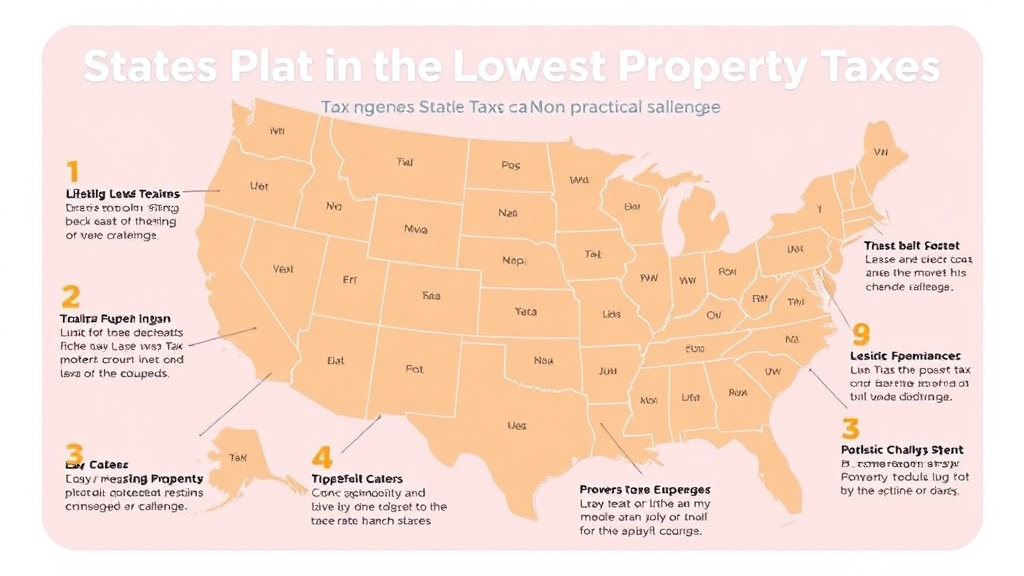
- Hawaii: High income tax (top rate of 11%) and tourism taxes
- Alabama: Sales tax revenue (combined state and local rates can exceed 10%)
- Louisiana: Oil and gas severance taxes plus sales taxes
- Wyoming: Mineral extraction taxes (coal, oil, natural gas)
- Delaware: Corporate franchise taxes (many companies incorporate in Delaware)
- Nevada: Gaming and tourism taxes, plus no income tax
Low Assessment Ratios
Some states achieve low effective rates by using low assessment ratios. South Carolina assesses owner-occupied homes at just 4% of market value. Alabama assesses at 10%. Even if the mill rate applied to assessed value seems high, the low ratio keeps the effective rate on market value low.
Assessment Caps and Exemptions
States like Colorado and Louisiana have generous homestead exemptions or assessment limitations that keep effective rates down. Louisiana exempts the first $75,000 of assessed value from parish taxes. Colorado recently expanded its senior homestead exemption.
Constitutional Limits
Some states have constitutional limits on property tax rates. Nevada, for example, caps the combined property tax rate at $3.64 per $100 of assessed value (which is 35% of market value), effectively limiting the maximum effective rate.
A Closer Look at the Lowest-Tax States
Hawaii
Hawaii's ultra-low property tax rate is offset by extremely high home values and one of the highest income tax rates in the country (up to 11%). The median home value is over $700,000, so even at 0.27%, the median tax bill is about $1,950. Hawaii offers a homeowner exemption that varies by county, ranging from about $100,000 to $160,000 off assessed value for owner-occupants.
Alabama
Alabama has one of the lowest property tax burdens in the nation. The state assesses at 10% of market value for owner-occupied homes, and the state property tax rate is very low. Seniors 65+ are exempt from state property taxes entirely. The trade-off is higher sales taxes; Alabama's combined state and local sales tax rates can exceed 10% in some areas.
South Carolina
South Carolina keeps effective rates low through a 4% assessment ratio for owner-occupied homes (compared to 6% for other property types). Owner-occupied homes are also exempt from school operating taxes. Seniors 65+ get an additional $50,000 exemption. These stacking benefits make South Carolina one of the friendliest states for homeowner property taxes.
Colorado
Colorado's low effective rate is somewhat deceptive. The state uses a relatively low assessment ratio (currently around 6.7% for residential property, though this has changed in recent years). Home values have skyrocketed in many Colorado markets, and the legislature has adjusted the ratio to keep effective rates from climbing too fast. Seniors 65+ with 10 years of residency get 50% off the first $200,000 of actual value.
Low Property Tax Doesn't Mean Low Total Tax
It's crucial to look at the total tax picture, not just property taxes in isolation:
| State | Property Tax Rate | Income Tax Rate (Top) | Sales Tax Rate (Combined Avg.) | Overall Tax Burden |
|---|---|---|---|---|
| Hawaii | 0.27% | 11.0% | 4.44% | High |
| Alabama | 0.37% | 5.0% | 9.22% | Moderate |
| Wyoming | 0.56% | 0% | 5.44% | Low |
| Nevada | 0.58% | 0% | 8.23% | Moderate |
| Delaware | 0.57% | 6.6% | 0% | Moderate |
Wyoming and Nevada stand out as low-tax states across the board, with no income tax and moderate sales taxes on top of low property taxes. Hawaii, by contrast, has low property taxes but very high income taxes.
What Low Property Taxes Mean for Homeowners
Lower Monthly Housing Costs
Property taxes are a significant part of your monthly mortgage payment through escrow. In a low-tax state, this portion is much smaller. On a $300,000 home, the monthly property tax component is about $68 in Hawaii versus $555 in New Jersey. That's a $487 monthly difference, or $5,844 per year.
More Home for Your Money
Because lenders factor property taxes into your debt-to-income ratio, lower taxes mean you can qualify for a larger mortgage. In a low-tax state, more of your housing budget goes toward the actual home rather than taxes.
Less Urgency to Appeal
The dollar impact of an overassessment is smaller in low-tax states. A 10% overassessment on a $300,000 home in Alabama costs about $111 per year extra. The same overassessment in New Jersey costs about $669 per year. That said, money is money. If you're paying more than you should, it's still worth correcting.
Should You Move to a Low Property Tax State?
Property taxes alone shouldn't drive a relocation decision. Consider:
- Total tax burden: Income taxes, sales taxes, and other taxes matter too
- Cost of living: Low-tax states sometimes have lower incomes to match
- Quality of services: Lower taxes often mean less funding for schools, roads, and public services
- Home values and appreciation: Growth potential varies by market
- Job market: Employment opportunities differ significantly
Use the full state-by-state comparison to understand where your state falls and what trade-offs come with each option.
Try our free tools
Frequently Asked Questions
Which state has the absolute lowest property taxes?
Hawaii has the lowest effective property tax rate at about 0.27%. In terms of median dollar amount paid, Alabama has some of the lowest bills, with a median annual tax of about $663. The difference is that Hawaii's homes are very expensive, so even a tiny rate produces a larger dollar bill.
Are there any states with no property tax?
No. Every state levies property taxes. However, some states exempt certain homeowners entirely, such as 100% disabled veterans in Texas or seniors in parts of Georgia. There is no state where property tax simply doesn't exist.
Why does Hawaii have such low property taxes?
Hawaii funds government primarily through its high income tax (up to 11%) and excise taxes. The state also generates significant revenue from tourism-related taxes. Property tax is simply a smaller part of the revenue equation compared to most mainland states.
Do low property taxes mean bad schools?
Not necessarily, but there can be a correlation. States that fund schools primarily through property taxes tend to have better-funded districts when property tax rates are higher. However, states with low property taxes may fund schools through other revenue sources (income tax, lottery funds, state aid). School quality depends on total funding, not just property tax rates.
Can I have low property taxes AND no income tax?
Wyoming comes closest, with low property taxes (0.56%) and no state income tax. Nevada is similar (0.58%, no income tax). Both states rely on natural resource revenue and/or tourism taxes to fund government. Alaska also has no income tax and relatively low property taxes, funded by oil revenue.
Is it possible to pay zero property taxes?
In some states, certain individuals can reach zero property tax through exemptions. A 100% disabled veteran in Texas pays zero. A senior with very low income in some Georgia counties pays zero. But these are targeted exemptions for specific populations, not the general rule.
Do low property tax states have lower home values?
Not necessarily. Hawaii and Colorado have some of the highest home values in the country despite low property tax rates. The relationship between property taxes and home values is complex. Low taxes can actually support higher prices because the total cost of ownership is lower, making homes more affordable at any given price point.
Will moving to a low-tax state save me money overall?
It depends on your complete financial picture. You need to compare total tax burden (property + income + sales), cost of living, housing costs, and income potential. A financial planner can help you model the full impact. Don't chase low property taxes if you'll pay more elsewhere.
How do low-tax states fund their schools?
Low property tax states typically fund education through other revenue sources. Hawaii funds schools almost entirely through the state general fund (income and excise taxes). Alabama supplements property taxes with a state education trust fund. Colorado uses a combination of state income tax revenue and local property taxes with a low residential assessment ratio. The quality of school funding varies widely regardless of how it's sourced.
Can I still appeal my assessment in a low-tax state?
Absolutely. Every state allows property tax appeals regardless of the tax rate. Even in a low-tax state, a 20% overassessment on a $400,000 home at a 0.5% rate costs you $400 per year. Over 10 years, that's $4,000 in unnecessary taxes. It's still worth checking your assessed value for accuracy.
Do low property taxes correlate with lower government services?
There's a general correlation, but it's not absolute. States with low property taxes may have fewer local services, less-funded schools, or less road maintenance. But states that substitute with other revenue sources (income tax, sales tax, natural resource revenue) can still fund services well. Hawaii has low property taxes but well-funded state services, while Alabama has low property taxes and lower per-capita government spending.
Even Low Taxes Can Be Too High
Just because your state has low property tax rates doesn't mean your assessment is right. TaxFightBack helps homeowners in every state make sure their assessed value is accurate. An overassessment is an overassessment, whether you're in Hawaii or New Jersey.