Property Tax Rates by State: 2026 Rankings and Comparison
TL;DR
Property tax rates vary dramatically across the United States. New Jersey has the highest effective rate at about 2.23%, while Hawaii has the lowest at roughly 0.27%. The national average effective property tax rate is approximately 0.90% of a home's market value. On a $350,000 home, that's the difference between paying $7,800 per year (New Jersey) and $945 per year (Hawaii). Knowing where your state falls helps you understand whether your tax bill is in line with what others pay and whether you should look into an appeal or exemptions.
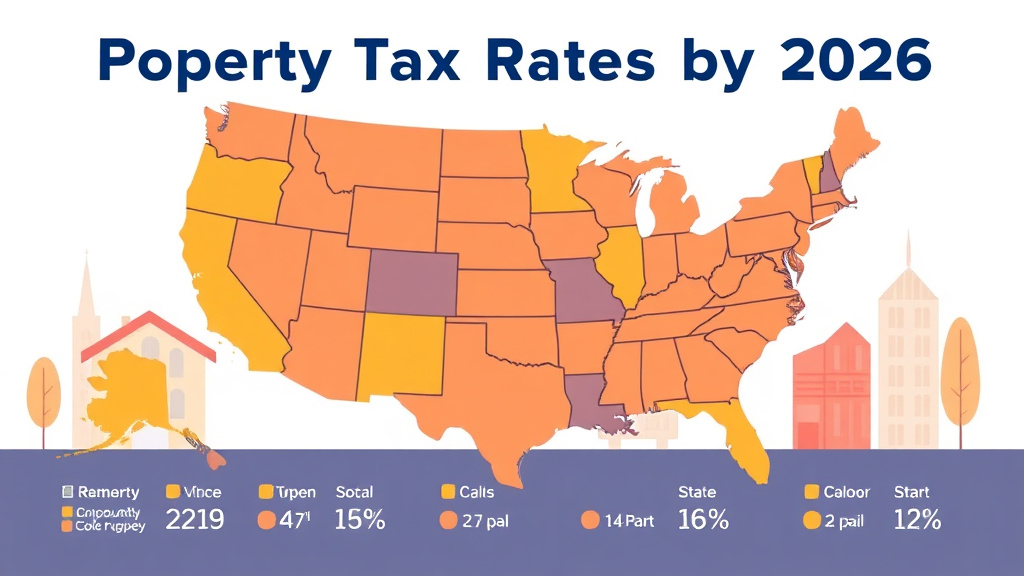
All 50 States Ranked by Effective Property Tax Rate
Note: Rates are approximate based on the most recent Census Bureau data and state tax reports. All 50 States Ranked by Effective Property Tax Rate affects real decisions, so accuracy counts. This guide covers the details.
| Rank | State | Effective Rate | Median Home Value | Median Annual Tax |
|---|---|---|---|---|
| 1 | New Jersey | 2.23% | $401,400 | $8,951 |
| 2 | Illinois | 2.08% | $239,100 | $4,973 |
| 3 | Connecticut | 2.00% | $313,600 | $6,272 |
| 4 | New Hampshire | 1.86% | $349,900 | $6,508 |
| 5 | Vermont | 1.83% | $278,700 | $5,100 |
| 6 | Wisconsin | 1.61% | $241,600 | $3,890 |
| 7 | Texas | 1.60% | $272,800 | $4,365 |
| 8 | Nebraska | 1.54% | $210,200 | $3,237 |
| 9 | New York | 1.40% | $384,100 | $5,377 |
| 10 | Ohio | 1.36% | $183,300 | $2,493 |
| 11 | Pennsylvania | 1.35% | $232,800 | $3,143 |
| 12 | Iowa | 1.29% | $184,400 | $2,379 |
| 13 | Kansas | 1.28% | $192,900 | $2,469 |
| 14 | Michigan | 1.25% | $201,100 | $2,514 |
| 15 | Rhode Island | 1.20% | $361,300 | $4,336 |
| 16 | South Dakota | 1.14% | $220,400 | $2,513 |
| 17 | Maine | 1.09% | $270,500 | $2,949 |
| 18 | Minnesota | 1.05% | $285,400 | $2,997 |
| 19 | Massachusetts | 1.04% | $481,700 | $5,010 |
| 20 | Alaska | 1.04% | $302,200 | $3,143 |
| 21 | North Dakota | 0.99% | $224,900 | $2,227 |
| 22 | Indiana | 0.95% | $194,500 | $1,848 |
| 23 | Missouri | 0.93% | $207,800 | $1,933 |
| 24 | Maryland | 0.92% | $383,600 | $3,529 |
| 25 | Washington | 0.87% | $465,900 | $4,053 |
| 26 | Florida | 0.86% | $321,500 | $2,765 |
| 27 | Oregon | 0.82% | $410,200 | $3,364 |
| 28 | Georgia | 0.81% | $256,800 | $2,080 |
| 29 | Virginia | 0.80% | $371,600 | $2,973 |
| 30 | Montana | 0.78% | $342,200 | $2,669 |
| 31 | North Carolina | 0.77% | $249,500 | $1,921 |
| 32 | Oklahoma | 0.76% | $176,500 | $1,341 |
| 33 | Kentucky | 0.75% | $177,900 | $1,334 |
| 34 | New Mexico | 0.72% | $239,500 | $1,724 |
| 35 | California | 0.71% | $659,300 | $4,681 |
| 36 | Idaho | 0.69% | $361,100 | $2,491 |
| 37 | Mississippi | 0.67% | $140,800 | $943 |
| 38 | Tennessee | 0.66% | $245,000 | $1,617 |
| 39 | Arizona | 0.63% | $339,800 | $2,141 |
| 40 | Arkansas | 0.60% | $162,400 | $974 |
| 41 | Nevada | 0.58% | $376,100 | $2,181 |
| 42 | Utah | 0.57% | $424,700 | $2,421 |
| 43 | Delaware | 0.57% | $305,200 | $1,740 |
| 44 | Wyoming | 0.56% | $282,500 | $1,582 |
| 45 | West Virginia | 0.55% | $128,800 | $708 |
| 46 | South Carolina | 0.53% | $218,500 | $1,158 |
| 47 | Colorado | 0.51% | $468,700 | $2,390 |
| 48 | Louisiana | 0.51% | $192,800 | $983 |
| 49 | Alabama | 0.37% | $179,200 | $663 |
| 50 | Hawaii | 0.27% | $722,500 | $1,951 |
Note: Rates are approximate based on the most recent Census Bureau data and state tax reports. Actual rates vary significantly within each state by county, city, and school district.
Understanding Effective vs. Nominal Tax Rates
Don't confuse the effective tax rate with the mill rate or nominal tax rate listed on your bill. The nominal rate is applied to your assessed value. The effective rate is what you actually pay as a percentage of your home's market value.
Example: Ohio has nominal rates of 60-100 mills, which sounds extremely high. But Ohio assesses at 35% of market value, so the effective rate is much lower (about 1.36%).
Effective rates are the only fair way to compare across states because they account for assessment ratios and exemptions.
What Drives State-to-State Differences
Revenue Structure
States that don't have an income tax (Texas, New Hampshire, Florida, Washington, Wyoming, Nevada, Tennessee, South Dakota, Alaska) tend to rely more heavily on property taxes or sales taxes. Texas and New Hampshire have high property taxes. Florida and Nevada rely more on sales and tourism taxes.
Education Funding
States where local property taxes fund the majority of school budgets (New Jersey, Illinois, Connecticut) tend to have higher rates. States where the state government picks up a larger share of education costs (Hawaii, Vermont through state income tax) have lower local property tax rates.
Assessment Practices
Assessment caps (California, Florida, Michigan) reduce the effective rate for longtime homeowners. Frequent reassessments keep assessed values closer to market values, which tends to distribute the burden more evenly.
Exemptions and Relief Programs
Generous homestead exemptions (Texas, Florida, Louisiana) lower the effective rate for owner-occupants. States with limited exemptions (New Jersey, Connecticut) have higher effective rates.
High-Rate vs. Low-Rate: What It Means for You
Living in a high property tax state doesn't necessarily mean you pay more total tax. And living in a low property tax state doesn't mean your overall tax burden is light. The key is looking at the full picture: property tax, income tax, and sales tax combined.
| Category | Examples | Overall Tax Burden |
|---|---|---|
| High property, no income tax | Texas, New Hampshire | Moderate to high |
| High property, high income tax | New Jersey, Connecticut, Illinois | High |
| Low property, high income tax | Hawaii, California (for long-term owners) | High for earners, low for retirees |
| Low property, no income tax | Wyoming, Nevada, Alaska | Low |
| Moderate all around | Virginia, Georgia, North Carolina | Moderate |
The Cost of Living in Different Property Tax Tiers
To make these numbers real, here's what a $350,000 home costs in annual property taxes across different rate tiers:
| Rate Tier | Effective Rate | Annual Tax on $350,000 Home | Monthly Impact |
|---|---|---|---|
| Very high (NJ, IL, CT) | 2.0-2.2% | $7,000-$7,700 | $583-$642 |
| High (TX, NH, WI) | 1.5-1.9% | $5,250-$6,650 | $438-$554 |
| Above average (PA, OH, NY) | 1.3-1.4% | $4,550-$4,900 | $379-$408 |
| Average (FL, WA, MN) | 0.85-1.05% | $2,975-$3,675 | $248-$306 |
| Below average (AZ, TN, NC) | 0.60-0.80% | $2,100-$2,800 | $175-$233 |
| Low (CO, SC, LA) | 0.50-0.55% | $1,750-$1,925 | $146-$160 |
| Very low (AL, HI) | 0.27-0.37% | $945-$1,295 | $79-$108 |
The monthly impact column shows what gets added to your escrow payment. A difference of $400 per month between a very high and a very low tax state is $4,800 per year. Over a 30-year mortgage, that's $144,000 in additional taxes.
States Where Property Taxes Are Changing
Several states have made significant changes to their property tax systems in recent years:
- Texas: Increased the school district homestead exemption to $100,000 in 2023, providing major relief for homeowners. Rate compression from state funding has also helped reduce school tax rates.
- Colorado: Adjusted residential assessment ratios downward multiple times (currently around 6.7%) to offset rapidly rising home values in markets like Denver, Boulder, and Colorado Springs.
- Idaho: Passed property tax relief measures in 2024 in response to skyrocketing home values that were driving tax bills up 20-30% per year in some areas.
- Kansas: Expanded property tax transparency requirements, making it easier for homeowners to see exactly how their bill is calculated.
- Georgia: Some counties expanded senior exemptions and floating homestead provisions to help longtime residents stay in their homes.
Keep an eye on your state legislature. Property tax reform is an active issue in many states, and new relief programs or rate changes can directly affect your bottom line.
How to Use This Data
- Check your state's rate. Find your state in the table and note the effective rate.
- Calculate your expected tax. Multiply your home's market value by the effective rate. This gives you a rough benchmark. Use our calculator guide for a more precise estimate.
- Compare to your actual bill. If you're paying significantly more than the state average would suggest, you may be overassessed or missing exemptions.
- Look at your county specifically. Rates within a state can vary 50% or more. Your county may be well above or below the state average.
Try our free tools
Frequently Asked Questions
Why does the effective rate differ from the rate on my tax bill?
Your tax bill shows the nominal rate applied to your assessed value. The effective rate is your total tax as a percentage of market value. In states with assessment ratios below 100%, the nominal rate is higher than the effective rate. For example, Ohio's nominal rates are 6-10%, but the effective rate is about 1.36% because the assessment ratio is 35%.
Do property tax rates change every year?
Yes, rates can change annually based on local government budgets, voter-approved levies, and changes in total assessed values. However, the changes are usually modest (a few percent up or down). Major changes happen when new levies pass or when a reassessment significantly shifts total property values.
Are these rates for all property or just residential?
The effective rates shown are for residential properties. Commercial, industrial, and agricultural properties often have different assessment ratios and tax rates. Some states tax commercial property at a higher rate than residential.
How does my state compare to the national average?
The national average effective rate is about 0.90%. If your state's rate is above that, you're in a higher-than-average tax state. If below, you're in a lower-than-average state. But remember, state averages mask huge local variation.
Can I lower my rate by moving to a different county?
Yes, but you're not changing the "rate" per se. You're changing which taxing authorities cover your property. Different school districts, cities, and special districts have different mill rates. Moving across a county or school district line can significantly change your total rate. Research specific addresses before you move.
Why is California's rate so low if homes are so expensive?
Proposition 13 caps the base tax rate at 1% of assessed value and limits annual assessment increases to 2%. For long-term homeowners, the assessed value is far below market value, producing a very low effective rate. New buyers pay higher effective rates because their assessment starts at the purchase price.
Do any states have no property tax at all?
No. Every state levies property taxes. However, some individuals can qualify for full exemptions (disabled veterans, qualifying seniors, etc.) that bring their personal liability to zero. But the tax itself exists in all 50 states.
How often do state rankings change?
The rankings are relatively stable from year to year. New Jersey has been #1 for decades. Hawaii has been near the bottom for decades. Modest shifts happen when states change tax laws, exemptions, or assessment practices, but a state rarely jumps more than a few positions in a single year.
Is the effective rate different for new buyers vs. long-term owners?
In states with assessment caps like California, Florida, and Michigan, yes. New buyers pay an effective rate based on the purchase price, while long-term owners benefit from capped assessed values well below market. In California, a new buyer might pay an effective rate of 1.1% while a neighbor who bought 20 years ago pays 0.3% on the same valued home. In states without caps, the effective rate is more uniform.
What's the best state for property taxes overall?
It depends on your situation. If you only look at property taxes, Hawaii and Alabama are cheapest. But if you're a high earner, Hawaii's 11% income tax erases the property tax savings. Wyoming and Nevada combine low property taxes with no income tax. The "best" state depends on your income, home value, and what services you value. See our low-tax state analysis.
Is Your Tax Bill in Line With Your State?
Knowing where your state ranks is a starting point. But the real question is whether your specific assessment is fair. TaxFightBack compares your assessed value to actual market data and helps you determine if you're paying more than your fair share. If you are, we help you fight for a correction.