Disabled Veteran Property Tax Exemption by State: 2026 Guide
If you're a disabled veteran, you could be sitting on one of the most valuable property tax breaks available. Every state offers some form of property tax relief for veterans with service-connected disabilities, and the savings can be massive. We're talking anywhere from a few hundred dollars to a complete elimination of your property tax bill.
The problem? Every state has different rules, different disability thresholds, and different application processes. This guide breaks it all down for 2026.
TL;DR
- All 50 states offer some property tax relief for disabled veterans
- Veterans with 100% disability ratings often pay zero property tax
- Partial exemptions are available in most states for ratings of 10-90%
- Surviving spouses typically retain the exemption after the veteran's death
- You must apply with your county assessor and provide your VA disability rating letter
How Disabled Veteran Property Tax Exemptions Work
These exemptions reduce or eliminate property taxes for veterans with service-connected disabilities as rated by the Department of Veterans Affairs. The VA assigns disability ratings in 10% increments from 10% to 100%. The higher your rating, the bigger the tax break.
Most states structure their exemptions in one of three ways:
- Full exemption at 100% disability: Your entire property is exempt from taxes. States like Texas, Florida, and Virginia do this.
- Sliding scale based on disability percentage: A 50% disability rating might get you a $5,000 exemption, while 70% gets $10,000. States like California and Colorado use this approach.
- Flat exemption regardless of percentage: Any qualifying disability rating gets you the same exemption amount. Less common but used in a few states.
State-by-State Exemptions: 2026
States Offering 100% Property Tax Exemption for Fully Disabled Veterans
| State | Disability Threshold | Exemption | Surviving Spouse |
|---|---|---|---|
| Texas | 100% | Full exemption on homestead | Yes, if not remarried |
| Florida | Total and permanent | Full exemption on homestead | Yes, until remarriage or sale |
| Virginia | 100% P&T | Full exemption, no value cap | Yes, if not remarried |
| Michigan | 100% | Full exemption on homestead | Yes |
| New Jersey | 100% or unemployable | Full exemption | Yes, if not remarried |
| Oklahoma | 100% | Full exemption up to $200,000 value | Yes |
| Alabama | 100% | Full exemption on homestead | Yes |
| Arkansas | 100% | Full exemption on homestead | Yes |
| Illinois | 70%+ | Full exemption at 70%+ | Yes, with conditions |
For a deeper look at 100% disability exemptions, see our dedicated guide on 100% disabled veteran property tax exemptions.
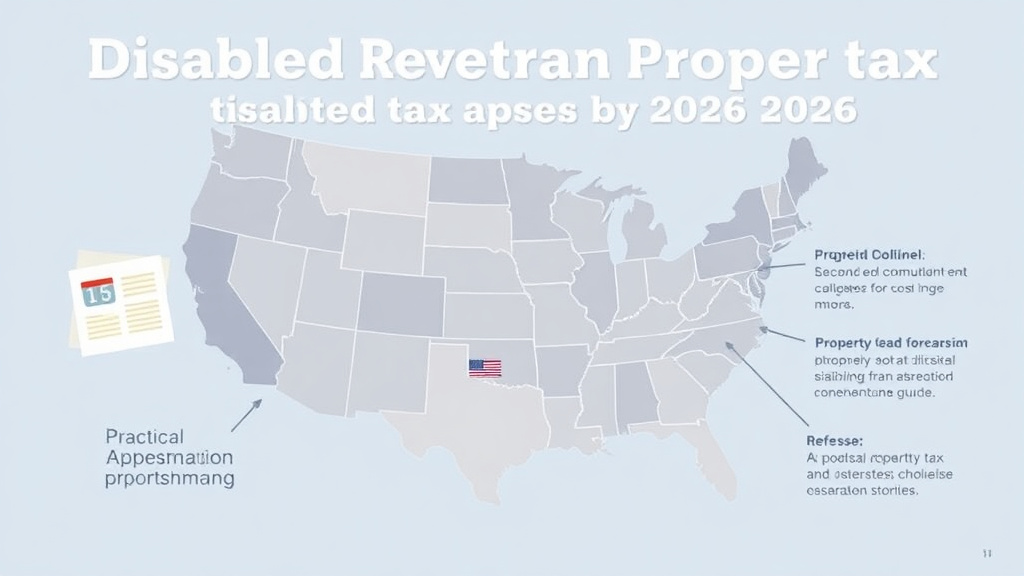
States With Partial Exemptions (Sliding Scale)
| State | Minimum Rating | Exemption Range | Notes |
|---|---|---|---|
| California | Any rating | $100,000-$150,000 off assessed value | Higher amount for income under $72,335 |
| Colorado | 5%+ | 50% of first $200,000 in value | Must be rated as permanent disability |
| Georgia | Any rating | $32,500-$109,986 depending on rating | Loss of use of limbs adds more |
| Minnesota | 70%+ | $150,000-$300,000 off market value | 100% rating gets $300,000 exemption |
| North Carolina | 100% | First $45,000 of assessed value | Lower ratings not covered |
| Ohio | Any rating | $25,000-$50,000 off assessed value | Based on disability percentage |
| Pennsylvania | Any rating | Varies by county | Counties set their own amounts |
States With Notable Programs
Texas stands out because it offers both a full exemption for 100% disabled veterans and a partial exemption ranging from $5,000 to $12,000 off assessed value for ratings between 10% and 99%. The surviving spouse benefit is also one of the strongest in the country.
Florida provides a full exemption for total and permanent disability, plus an additional $5,000 exemption for any veteran with a disability rating of 10% or more. Combat-disabled veterans 65 and older get an extra discount.
Illinois is unusually generous. At 70% disability or higher, you get a full exemption. Veterans with 50-69% disability get $5,000 off assessed value, and 30-49% gets $2,500.
What You Need to Apply
Regardless of your state, you'll need these documents when applying:
- VA Disability Rating Letter: This is the official letter from the VA showing your disability percentage and whether it's service-connected. You can download it from eBenefits or VA.gov.
- DD-214: Your discharge papers proving honorable or general discharge. Most states require honorable discharge to qualify.
- Proof of Homestead: Driver's license showing the property address, utility bills, or voter registration.
- Property Tax Statement: Your most recent tax bill showing the property's assessed value and your name as owner.
Application Deadlines
Deadlines vary by state but typically fall between January and April. Some states accept applications year-round and prorate the exemption. If you miss the deadline, you usually have to wait until the next tax year.
- Texas: April 30 (but late applications accepted up to 2 years after deadline)
- Florida: March 1
- California: February 15
- Virginia: Application filed any time; takes effect the following year
- Illinois: Varies by county, typically January-February
Individual Unemployability (IU) and Property Taxes
Here's something many veterans don't know: if you have an Individual Unemployability (IU) rating, you may qualify for the same property tax exemptions as a 100% rated veteran. IU means the VA considers you unable to work due to service-connected disabilities, even though your combined rating may be less than 100%.
States that treat IU the same as 100% disability include Texas, Florida, Virginia, and New Jersey. Others may not. Always check with your county assessor and bring your IU award letter.
Surviving Spouse Benefits
In most states, the surviving spouse of a disabled veteran can continue receiving the property tax exemption after the veteran's death. The rules typically include:
- The spouse must not have remarried
- The spouse must continue living in the home
- The veteran must have been receiving the exemption at the time of death (in some states)
- Some states allow the spouse to transfer the exemption to a new home
Texas is particularly generous here. The surviving spouse of a 100% disabled veteran keeps the full exemption as long as they don't remarry and continue to use the home as their primary residence. If they move, they can transfer the exemption to a new home of equal or lesser value.
Combining With Other Exemptions
Disabled veteran exemptions can often be stacked with other property tax savings programs:
- Homestead exemption: In most states, you can claim both. See our homestead exemption guide for details.
- Senior exemption: If you're 65+ and a disabled veteran, you can often take the larger of the two exemptions. Some states let you claim both. More details in our senior property tax exemption guide.
- Property tax appeal: Lowering your assessed value through an appeal multiplies the impact of your exemption. Even with a full exemption, an appeal matters for any taxes not covered (like special assessments).
Common Mistakes to Avoid
- Not applying at all: About 30% of eligible veterans never file for their exemption. It won't happen automatically.
- Using the wrong disability letter: Some veterans submit old letters with outdated ratings. Use your most current VA rating decision letter.
- Missing the deadline: Mark it on your calendar for the year you become eligible.
- Not reapplying after a rating increase: If your disability rating goes up, file a new application for the higher exemption.
- Assuming your state has no exemption: Every state has something. The amount varies, but the program exists.
Try our free tools
Frequently Asked Questions
What disability rating do I need for a property tax exemption?
It varies by state. Many states offer partial exemptions starting at any disability rating (even 10%). For a full exemption, most states require a 100% disability rating or total and permanent disability designation. Illinois stands out by offering full exemption at 70%.
Can I get a property tax exemption with a 50% VA disability rating?
Yes, in many states. States like California, Georgia, Ohio, and Texas all offer partial exemptions for veterans with ratings below 100%. The exemption amount is usually proportional to your disability percentage or falls within a set range.
Does the exemption apply to all property taxes or just some?
In most states, a full exemption covers all property taxes including county, city, and school district taxes. Some states only exempt certain portions, and special assessments (for things like sidewalks or sewers) are often excluded regardless of your exemption status.
Can I transfer my veteran property tax exemption to a new home?
Most states allow this. When you sell one home and buy another, you apply for the exemption at your new property. Some states like Texas even let surviving spouses transfer the exemption to a new home. The key is filing a new application promptly after your move.
What if I'm a veteran with a non-service-connected disability?
Most veteran property tax exemptions require a service-connected disability rated by the VA. Non-service-connected disabilities typically don't qualify for veteran-specific programs. However, you might still qualify for general disability exemptions or circuit breaker programs based on income and disability status.
Do I need to reapply for the exemption every year?
Some states require annual renewal, while others are one-time applications. Texas and Florida are one-time, meaning you apply once and the exemption stays until you sell or move. Illinois and some other states require yearly renewal with updated documentation.
Can I get the exemption retroactively if I didn't know about it?
A few states allow retroactive claims, typically going back one to five years. Texas allows late applications up to two years after the deadline. Check with your county assessor about back-filing options in your state.
Is my property tax exemption affected if I rent out part of my home?
It depends on the state and how much of the home you rent. Most states require the property to be your primary residence. Renting out a room usually doesn't disqualify you, but converting the property to a full rental probably will. Some states prorate the exemption based on the percentage you occupy.
What happens to the exemption if the veteran moves to a nursing home?
Many states allow the exemption to continue if the veteran intends to return home. Some states also let the surviving spouse keep the exemption while the veteran is in long-term care. Rules vary significantly, so check with your county assessor.
Can a veteran's property tax exemption be applied to a manufactured home?
Yes, in most states, as long as the manufactured home is your primary residence. Some states require the home to be on a permanent foundation or on land you own. Manufactured homes on leased land may qualify in some states but not others.
Don't Leave Money on the Table
Your disabled veteran property tax exemption is a benefit you earned through service. But even with the exemption, your underlying assessment might be too high. If your county has your home valued above what it's actually worth, you're paying more than necessary on any taxes not covered by your exemption.
TaxFightBack helps veterans identify overassessments and fight for fair property valuations. Combine a successful appeal with your veteran exemption for maximum savings on your property tax bill.