How to Apply for Senior Property Tax Exemption: Step-by-Step
You've turned 65 (or whatever age your state requires). You've heard about senior property tax exemptions. Now you need to actually apply. The good news: it's not complicated. The bad news: nobody's going to do it for you, and missing the deadline means waiting another full year.
Here's the exact process, from finding your form to confirming your exemption is applied.
TL;DR
- Applications are filed with your county assessor's office
- Most deadlines fall between January and April
- You'll need proof of age, ownership, residency, and sometimes income
- Many counties now accept online applications
- Some states require annual renewal; others are one-time filings
- The whole process typically takes 15-30 minutes
Before You Start: Check Your Eligibility
Before filling out any paperwork, confirm you actually qualify. Every state's program is slightly different, but the typical requirements are:
- Age: Most states require you to be 65 as of January 1 of the tax year. Some states start at 60 or 62.
- Ownership: You must own the home. Your name needs to be on the deed.
- Primary residence: You must live in the home full-time. Second homes and rentals don't count.
- Income limit: About two-thirds of states cap income eligibility, typically between $30,000 and $75,000 annually.
Not sure about your state's specific rules? Our complete guide to senior property tax exemptions by state has the details.
Step 1: Find Your County Assessor's Office
Property tax exemptions are handled at the county level, not the state level. You need to work with the assessor's office in the county where your home is located.
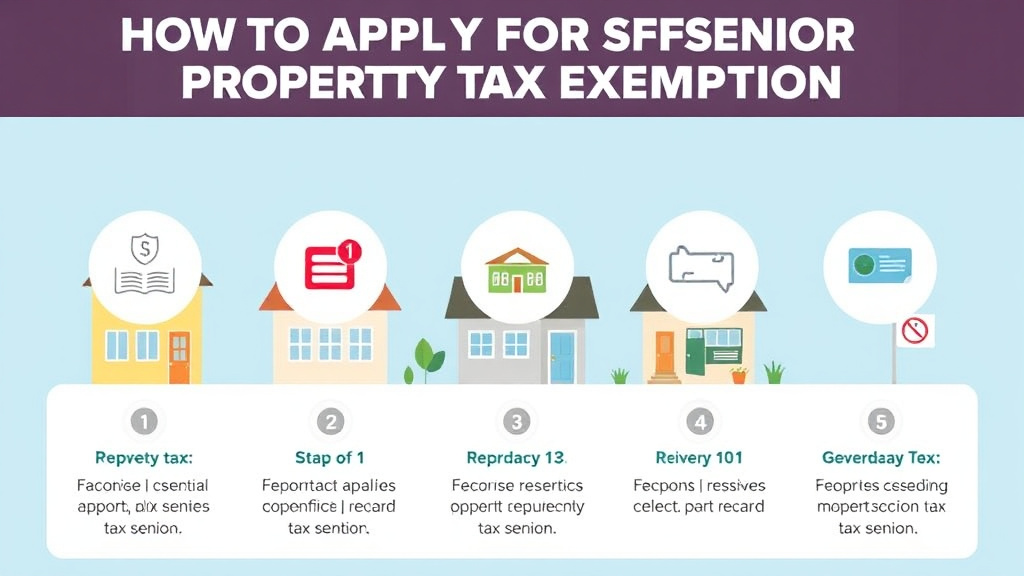
How to find them:
- Search "[your county name] property appraiser" or "[your county name] tax assessor"
- Check your most recent property tax bill. It will have the assessor's contact information.
- Call your county's main phone number and ask to be transferred
Most county assessor offices have websites with application forms, deadlines, and instructions specific to your area.
Step 2: Get the Application Form
There are usually three ways to get the form:
- Download from the website: Most county assessor websites have PDF forms you can download, print, and fill out.
- Apply online: An increasing number of counties let you complete and submit the entire application online. This is the fastest option.
- Pick up in person: Visit the assessor's office and they'll hand you the form. Some offices will help you fill it out on the spot.
The form is usually 1-2 pages. It asks for basic information about you and your property.
Step 3: Gather Your Documents
Before you sit down to fill out the application, collect these documents:
Required in Almost Every State
- Proof of age: Driver's license, state ID, birth certificate, or passport
- Proof of ownership: Recorded deed, closing statement, or your property tax bill showing you as the owner
- Proof of residency: Driver's license showing the property address, voter registration card, or utility bills
Required If Your State Has Income Limits
- Federal tax return: Most recent Form 1040 showing your adjusted gross income
- Social Security statement: Form SSA-1099 showing your annual benefit amount
- Pension statements: Any 1099-R forms for retirement distributions
- Other income documentation: Interest statements, rental income records, or any other income sources
Pro tip: Make copies of everything before you submit. Keep a folder with all your property tax exemption documents. You'll need them if the assessor has questions or if your state requires annual renewal.
Step 4: Fill Out the Application
The application form itself is straightforward. Here's what you'll typically be asked:
- Your full legal name and date of birth
- Property address and parcel/folio number (find the parcel number on your tax bill)
- Date you purchased or acquired the property
- Whether it's your primary residence
- Your Social Security number (some states require this for verification)
- Household income (if income-limited)
- Whether you receive any other exemptions on the property
Read the fine print. Some forms include a sworn statement that the information is accurate. Providing false information on a property tax exemption application is a misdemeanor in most states.
Step 5: Submit the Application
You have three options for submission:
Online Submission
The fastest and most convenient option. Upload your documents and submit the form electronically. You'll usually get a confirmation number or email immediately.
Mail Submission
Send the completed form and copies of your documents to the assessor's office. Use certified mail with return receipt requested so you have proof of timely filing. Address it to the attention of the exemptions department.
In-Person Submission
Visit the assessor's office during business hours. Bring originals of all documents (they may want to see them) plus copies to leave with your application. Ask for a receipt or confirmation of filing.
Step 6: Know Your Deadline
This is the step where people mess up. Miss the deadline and you lose the exemption for the entire year. Common deadlines by state:
| State | Filing Deadline | Late Filing Allowed? |
|---|---|---|
| Texas | April 30 | Yes, up to 2 years late |
| Florida | March 1 | Yes, late applications accepted through September with penalties |
| California | February 15 | Partial credit available through December 10 |
| Illinois | Varies by county | Check with your county assessor |
| New York | March 1 (most municipalities) | Limited late filing options |
| Georgia | April 1 | No |
| South Carolina | Varies by county | Check with county auditor |
Set a calendar reminder for one month before the deadline. Give yourself time to gather documents and deal with any issues.
Step 7: Follow Up and Verify
Don't assume everything went through. Two to four weeks after filing:
- Call the assessor's office and ask if your application was received and processed
- Ask if any additional documentation is needed
- Ask when the exemption will appear on your property records
When you get your next property tax bill, check that the exemption is listed. The bill should show a reduced assessed value or a line item for the senior exemption. If it's not there, contact the assessor's office immediately.
Step 8: Understand Renewal Requirements
This catches a lot of people off guard. Some states require you to renew your exemption every year.
One-Time Application States
In states like Texas and Florida, you file once and the exemption stays in effect until you move or sell. No annual paperwork.
Annual Renewal States
In states like Illinois (for the Senior Citizens Assessment Freeze) and some New York municipalities, you must reapply every year. This often includes submitting updated income documentation. Fail to renew and you lose the exemption for that year.
Ask your assessor's office which type your state uses, and put renewal dates on your calendar.
What If You're Denied?
Denial isn't the end. Common reasons for denial and how to fix them:
- Income too high: If you're slightly over the limit, check if your state excludes certain income sources (like Social Security). You may have included income that shouldn't count.
- Not the primary residence: If you split time between two homes, make sure your driver's license, voter registration, and mail all show the exemption property as your address.
- Missing documentation: Submit the missing documents and ask if the application can be reconsidered without refiling.
- Ownership issue: If the deed doesn't match your current legal name (maiden name, for example), you may need to provide a marriage certificate or legal name change documentation.
Most counties have a formal appeals process for exemption denials. Ask about the timeline and process.
Maximizing Your Savings Beyond the Senior Exemption
The senior exemption is just one piece of the puzzle. Other programs you should look into:
- Homestead exemption: Available to all homeowners, not just seniors. Stack it with your senior exemption for double savings. Learn more in our homestead exemption guide.
- Property tax deferral: Some states let seniors postpone property tax payments until they sell the home. Check our property tax deferral guide.
- Circuit breaker programs: Income-based credits that reduce your tax burden further. Details in our circuit breaker guide.
- Property tax appeal: If your assessment is too high, an appeal can reduce your taxable value on top of any exemptions. Read about savings from a successful appeal.
Try our free tools
Frequently Asked Questions
How long does the application process take?
Filling out the form takes 15-30 minutes. Processing time varies by county but usually takes 2-6 weeks. You'll see the exemption reflected on your next property tax bill, which could be several months away depending on when you file.
Can I apply if I turn 65 later in the year?
Most states require you to be 65 as of January 1 of the tax year. If you turn 65 in June 2026, you'd apply for the 2027 tax year. A few states are more flexible, so check your specific state's rules.
What if I own the home with my spouse who isn't 65 yet?
In most states, only one owner needs to meet the age requirement. If you're 65 and your spouse is 62, you should still qualify. The application typically goes in the name of the qualifying spouse.
Can I apply by phone?
Generally no. Property tax exemption applications require a signed form and documentation. However, some assessor offices will mail you the form if you call and request it. A few counties have started accepting electronic signatures on online applications.
Is there a fee to apply?
No. Applying for a senior property tax exemption is free. If anyone tries to charge you to file your exemption application, it's likely a scam. Be cautious of companies offering to file on your behalf for a fee.
What if I live in a mobile home?
Mobile homes and manufactured homes qualify for senior exemptions in most states, as long as you own the home and it's your primary residence. If you own the home but lease the land, check with your assessor about eligibility.
Can I get the exemption if my home is in a trust?
Usually yes, if it's a revocable living trust and you're the beneficiary living in the home. Irrevocable trusts may disqualify you in some states. Bring your trust documents when you apply so the assessor can review them.
What happens to my senior exemption if I go into assisted living?
This depends on your state. Some states allow the exemption to continue for a period of time (often 2-3 years) if you intend to return home. Others remove the exemption once the home is no longer your primary residence. A surviving spouse who remains in the home typically keeps the exemption.
Can I get both a senior exemption and a veteran exemption?
In many states, you can receive both if you qualify. Some states require you to choose the more beneficial of the two. Check with your assessor about stacking rules in your state.
Will applying for a senior exemption trigger a reassessment of my home?
No. Filing for a senior exemption does not trigger a reassessment. The assessor applies the exemption to your existing assessed value. Your next scheduled reassessment will happen on its normal cycle regardless of whether you apply for an exemption.
Take the First Step Today
The application takes less than half an hour, and the savings start immediately. If you're eligible and haven't applied, you're giving the county money you don't owe.
And if you suspect your property's assessed value is too high on top of everything else, TaxFightBack can help you determine whether a property tax appeal could save you even more. Combine a lower assessment with your senior exemption for the biggest possible reduction in your property tax bill.