Senior Property Tax Exemption: Every State's Rules in 2026
Property taxes hit harder when you're living on a fixed income. That's why most states offer some form of senior property tax exemption, but the rules vary wildly. Some states slash your bill by thousands. Others give you a token break that barely covers a month's groceries.
Here's what every state offers in 2026, how to qualify, and how to stack these exemptions with other savings programs.
TL;DR
- Most states offer property tax exemptions or credits for seniors, typically starting at age 65
- Savings range from a few hundred dollars to complete elimination of your property tax bill
- Income limits apply in many states, usually between $30,000 and $75,000
- You must apply. These exemptions don't happen automatically
- Many seniors miss out by not knowing their state's specific program exists
How Senior Property Tax Exemptions Work
A senior property tax exemption reduces the taxable value of your home. If your home is assessed at $300,000 and you qualify for a $50,000 exemption, you only pay taxes on $250,000. At a 1.5% tax rate, that's $750 in annual savings.
Some states use a different approach. Instead of reducing assessed value, they freeze your assessment at its current level, cap annual increases, or provide a direct credit against your tax bill.
The key thing to understand: these exemptions don't happen on their own. You have to file an application with your county assessor's office. Miss the deadline, and you wait another year.
Age and Eligibility Requirements
The most common qualifying age is 65, but it's not universal. Here's how the age requirements break down:
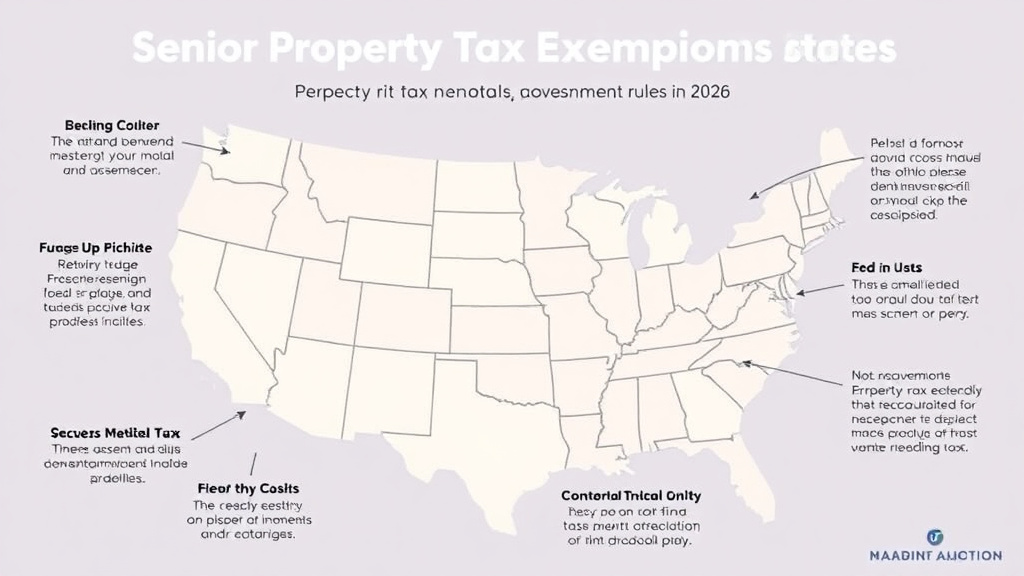
- Age 60: A handful of states, including Washington and Vermont, set the bar at 60 for certain programs
- Age 62: Georgia and several other states use 62 as the cutoff
- Age 65: The majority of states, including Texas, Florida, Illinois, and New York
- Age 70: Some enhanced exemptions kick in at 70, like South Carolina's additional break
Beyond age, most states require you to own and occupy the home as your primary residence. A few states also require you to have lived in the state for a minimum number of years.
State-by-State Senior Property Tax Exemptions in 2026
States With the Most Generous Programs
| State | Age Requirement | Exemption Amount | Income Limit |
|---|---|---|---|
| Texas | 65 | $10,000 off school taxes + local options up to $30,000 | None |
| Florida | 65 | Additional $50,000 homestead exemption | $36,614 (adjusted annually) |
| Georgia | 62 | $10,000-$66,000 depending on county | $10,000-$40,000 depending on county |
| South Carolina | 65 | First $50,000 of fair market value exempt from school taxes | None |
| Illinois | 65 | $8,000 off assessed value + assessment freeze | $65,000 for freeze |
| New Jersey | 65 | $250 annual deduction or freeze (if income qualifies) | Varies by program |
| New York | 65 | 50% off assessed value (up to local caps) | $29,000-$58,400 depending on locality |
| California | 62 | Prop 19 portability + $7,000 homeowners' exemption | $40,000 for postponement |
States With Assessment Freezes
Some of the best senior tax programs aren't traditional exemptions. They're assessment freezes that lock your home's taxable value at a specific point. This means even as property values skyrocket around you, your taxes stay flat.
- Illinois: The Senior Citizens Assessment Freeze locks your assessed value if your household income is under $65,000
- Texas: Mandatory tax ceiling for school taxes once you turn 65. Your school tax bill can never go above what it was the year you qualified
- Oklahoma: Valuation freeze for homeowners 65+ with income under $85,600
- Indiana: Over-65 property tax deduction plus circuit breaker credits
States With No Senior-Specific Exemption
A few states don't offer a dedicated senior property tax exemption. That doesn't mean there's no relief. States like New Hampshire and Wisconsin rely on circuit breaker programs that provide tax credits based on income regardless of age. Check out our guide to property tax circuit breaker programs for details.
Income Limits: The Fine Print That Matters
About two-thirds of state senior exemptions come with income limits. These limits determine whether you qualify, and in some states, how much of an exemption you get.
Common income thresholds in 2026:
- Under $25,000: Full exemption in many states
- $25,000-$50,000: Partial exemption or reduced benefit
- $50,000-$75,000: Some states still offer benefits at this level
- Over $75,000: Most income-limited programs phase out here
What counts as "income" varies too. Some states count only your adjusted gross income from your tax return. Others include Social Security benefits, pension income, or even the income of everyone living in your household.
How to Apply for a Senior Property Tax Exemption
The process is straightforward but has deadlines you can't miss. Here's the typical application process:
- Check your state's deadline. Most states require applications between January 1 and March 1, though some extend to April or later.
- Get the application form. Available from your county assessor's office or website. Some states also make forms available through the state department of revenue.
- Gather your documents. You'll usually need proof of age (driver's license or birth certificate), proof of ownership (deed or tax bill), proof of residency (utility bills), and income documentation (tax return or Social Security statement).
- Submit the application. Most counties accept applications in person, by mail, or online.
- Check if you need to renew. Some states require annual renewal. Others are one-time applications that stay in effect until you sell or move.
For a more detailed walkthrough, see our step-by-step guide to applying for senior property tax exemptions.
Stacking Multiple Exemptions
In many states, you can combine a senior exemption with other tax breaks for even bigger savings. Common combinations include:
- Senior exemption + homestead exemption: In Texas, you can stack the $40,000 general homestead exemption with the $10,000 over-65 exemption on school taxes
- Senior exemption + disabled veteran exemption: If you're both a senior and a disabled veteran, many states let you claim whichever exemption is larger, and a few let you claim both
- Senior exemption + circuit breaker credit: Some states allow you to claim the exemption on your property tax bill and a circuit breaker credit on your state income tax return
Check out our article on property tax exemptions you might be missing for other credits you could combine.
What If Your Property Taxes Are Still Too High?
Exemptions help, but they only reduce the taxable value. If the underlying assessment is inflated, you're still overpaying. An assessment of $400,000 with a $10,000 exemption still leaves $390,000 on the books. If your home is really worth $350,000, you should be paying taxes on $340,000.
That's where a property tax appeal comes in. Successful appeals can reduce your assessed value by 10-30%, saving you hundreds or even thousands per year. And unlike exemptions, a lower assessment compounds with any exemptions you already have.
Learn more about how much you can save after a property tax appeal.
Try our free tools
Frequently Asked Questions
What age do you have to be for a senior property tax exemption?
Most states set the qualifying age at 65, but it varies. Some states like Georgia start at 62, and a few programs are available at 60. Check your specific state and county requirements since age thresholds can differ even within the same state for different programs.
Do I have to apply every year for a senior property tax exemption?
It depends on your state. Some states like Texas require a one-time application that stays in effect permanently. Others, like Illinois (for the assessment freeze), require annual renewal with updated income documentation. Your county assessor's office can tell you which type your state uses.
Can I get a senior property tax exemption on a second home?
Almost never. Senior property tax exemptions apply to your primary residence only. If you own multiple properties, the exemption goes on the home where you live full-time. Vacation homes, rental properties, and investment properties don't qualify.
What happens to the senior exemption when I sell my house?
The exemption stays with you, not the house. When you sell, the new owner loses your senior exemption unless they independently qualify. If you buy another home, you'll need to apply for the exemption at your new address. In a few states like California, you can transfer your tax basis to a new home under Prop 19.
Does my spouse's age matter for the senior exemption?
In most states, only one spouse needs to meet the age requirement. If you're 65 and your spouse is 60, you typically qualify. Some states also allow a surviving spouse to keep the exemption after the qualifying spouse passes away, even if the survivor hasn't reached the qualifying age.
Do Social Security benefits count toward the income limit?
This varies by state. Some states exclude Social Security income entirely when calculating whether you meet the income threshold. Others count it as part of your gross income. Check your state's specific rules, because this one detail can determine whether you qualify or not.
Can I apply retroactively for a senior exemption I missed?
A few states allow retroactive applications, typically going back one to three years. Texas, for example, lets you file a late application up to two years after the deadline. But most states don't, so it's worth applying as soon as you're eligible to avoid leaving money on the table.
Is a senior property tax exemption the same as a homestead exemption?
No. A homestead exemption is available to all homeowners regardless of age. A senior exemption is an additional benefit on top of the homestead exemption. In many states, you can claim both. The homestead exemption is typically the larger of the two, but the senior exemption adds extra savings.
What if I live in a state with no senior property tax exemption?
Even states without a specific senior exemption usually offer alternative relief. Look into circuit breaker programs, property tax deferral options, or general homestead exemptions. You might also qualify for a property tax deferral program that lets you postpone payment until you sell your home.
Can renters benefit from senior property tax programs?
In some states, yes. Programs in states like Minnesota, Michigan, and Vermont provide property tax refunds or credits to renters, recognizing that landlords pass property tax costs through to rent. These are usually income-based and available to seniors and non-seniors alike.
How much can a senior exemption actually save me?
It depends on your state and local tax rates. A $50,000 exemption in a county with a 2% tax rate saves you $1,000 per year. In Texas, the school district tax ceiling alone can save seniors $1,500-$3,000 annually as values rise. Combined with a homestead exemption, total savings can reach $2,000-$5,000 in high-tax areas.
Does a senior exemption protect me from rising property taxes?
A standard exemption reduces your taxable value by a fixed amount but doesn't prevent the remaining value from going up. Assessment freezes, available in states like Texas and Illinois, are what truly protect you from rising assessments. If your state offers a freeze, that's the program you want.
Stop Overpaying on Property Taxes
Claiming your senior exemption is a great first step, but it's not the only way to cut your property tax bill. If your home's assessed value is higher than its actual market value, you could be paying hundreds or thousands more than you should.
TaxFightBack helps homeowners identify overassessments and build strong appeal cases. Whether you're a senior looking to stack savings or just want to make sure you're not overpaying, we can help you figure out if an appeal makes sense for your situation.