Special Assessment vs Property Tax: Understanding the Difference
You look at your property tax bill and see a line item you don't recognize. It might say "special assessment," "improvement district," or "benefit assessment." This isn't your regular property tax. It's a separate charge that works differently, follows different rules, and in some cases can be challenged on different grounds.
Here's how special assessments work, how they're different from property taxes, and what you can do about them.
TL;DR
- Property taxes are based on your home's value; special assessments are based on the benefit you receive from a specific improvement
- Special assessments pay for things like new sidewalks, sewer lines, street paving, and flood control
- Homestead and other exemptions usually don't reduce special assessments
- Special assessments can sometimes be challenged, but the process is different from a property tax appeal
- Some special assessments can be paid in installments over 5-20 years
What Is a Property Tax?
A property tax (also called an ad valorem tax) is based on the assessed value of your property. The revenue goes into the county, city, or school district's general fund to pay for public services like schools, police, fire departments, and parks.
Key characteristics of property taxes:
- Based on assessed value
- Applied to all properties in the taxing jurisdiction
- Pays for general government services
- Can be reduced by exemptions (homestead, senior, veteran, etc.)
- Can be appealed based on assessment accuracy
- Recurs annually
What Is a Special Assessment?
A special assessment is a charge levied on properties that benefit from a specific public improvement. If the city installs new sidewalks on your street, only the properties on that street get assessed for the cost, not the whole city.
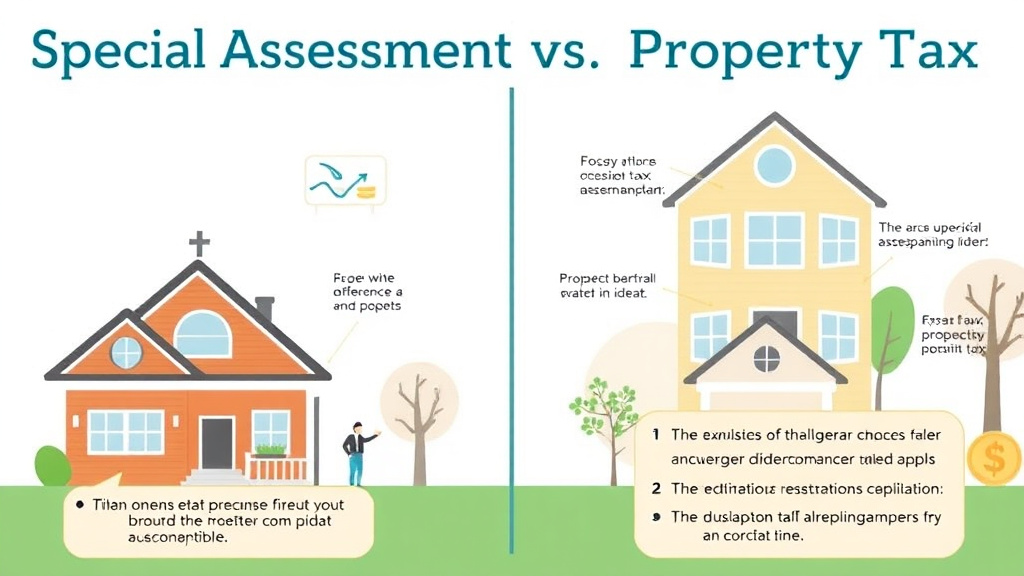
Key characteristics of special assessments:
- Based on the benefit received, not property value (though some are calculated per front foot, per acre, or per parcel)
- Applied only to properties that benefit from the improvement
- Pays for a specific infrastructure project
- Usually NOT reduced by homestead or other exemptions
- Can sometimes be challenged, but on different grounds than property taxes
- Often a one-time charge (may be spread over multiple years)
Common Types of Special Assessments
| Type | What It Pays For | Typical Cost Range |
|---|---|---|
| Sidewalk assessment | New or replaced sidewalks | $2,000-$8,000 per property |
| Sewer assessment | New sewer lines or upgrades | $5,000-$20,000 per property |
| Street paving | Road construction or repaving | $3,000-$15,000 per property |
| Water main | New or replaced water lines | $3,000-$12,000 per property |
| Stormwater/drainage | Flood control and drainage improvements | $1,000-$10,000 per property |
| Lighting district | Street lighting installation and maintenance | $100-$500 per year |
| Improvement district | Area-wide improvements (landscaping, parking) | $200-$2,000 per year |
Why Exemptions Don't Help
Your homestead exemption reduces your ad valorem property taxes. It doesn't touch special assessments. The same goes for senior exemptions, veteran exemptions, and most other tax breaks.
This catches people off guard. A 100% disabled veteran with a full property tax exemption still owes special assessments. A senior with a tax freeze still sees their bill go up when a special assessment is added.
A few states make exceptions. Some will waive special assessments for low-income seniors or disabled veterans, but this is uncommon. Check your state and local rules.
How Special Assessments Are Calculated
The method varies by jurisdiction, but common approaches include:
- Front footage: The assessment is based on how many linear feet of your property face the improved street. More frontage = higher assessment.
- Per parcel: Each property in the improvement area pays an equal share.
- Per acre: Larger lots pay more.
- Benefit-based: The assessment is proportional to the estimated increase in property value from the improvement.
- Zone-based: Properties closer to the improvement pay more; those farther away pay less.
Can You Challenge a Special Assessment?
Yes, but the grounds are different from a property tax appeal. You can't argue that your home is over-assessed. Instead, you can challenge:
1. The Benefit You Actually Received
The legal principle behind special assessments is that you're paying for a benefit to your property. If the improvement doesn't benefit your property (or the benefit is less than the assessment), you have grounds to challenge it.
Example: If a new sidewalk was installed on the opposite side of the street and your property already has a sidewalk, the benefit to your property is questionable.
2. The Calculation Method
If the assessment was calculated unfairly (your property was charged more than similar properties receiving the same benefit), you can challenge the method.
3. Procedural Issues
Local governments must follow specific procedures when levying special assessments: public notice, public hearings, and proper authorization. If they skipped a step, the assessment may be invalid.
4. The Total Cost
If the total project cost seems inflated (and therefore your share is too high), you may be able to challenge the reasonableness of the expenditure.
Payment Options
Many jurisdictions allow you to pay special assessments in installments:
- Lump sum: Pay the full amount upfront. Some jurisdictions offer a discount for early payment.
- Installment plan: Spread the payment over 5-20 years. Interest is added to the balance (typically 4-8% annually).
- Added to tax bill: Some assessments are added as a line item on your annual property tax bill until paid off.
If you're buying a home, check for outstanding special assessments. They run with the property, not the person. If the seller hasn't paid off a special assessment, you inherit the remaining balance.
Special Assessments When Buying or Selling
This is a major point for homebuyers. Special assessments must be disclosed by the seller, and they're typically addressed at closing. Common approaches:
- Seller pays off the remaining balance at closing
- Buyer assumes the remaining payments
- The cost is negotiated as part of the purchase price
Always ask about pending or existing special assessments before purchasing. A $10,000 sewer assessment that's been levied but not yet billed can be an unwelcome surprise after closing.
Pending Assessments: The Hidden Risk
Local governments sometimes plan improvements years before they levy the assessment. If your neighborhood is slated for new sewer lines or road reconstruction, the assessment might not show up until the project begins. Keep an eye on city council meeting agendas and public hearing notices for planned improvement districts in your area.
Try our free tools
Frequently Asked Questions
Are special assessments tax deductible?
Generally no. Special assessments for improvements (new sidewalks, sewer lines) are not deductible on your federal tax return because they increase your property's value. However, assessments for maintenance of existing infrastructure may be deductible. The IRS distinguishes between assessments that improve property (not deductible) and those that maintain existing services (deductible).
Can a special assessment be added to my mortgage?
Usually not directly. However, if your mortgage has an escrow account, the annual installment payments for special assessments might be included in your escrow. Check with your lender. Some jurisdictions also allow you to add large special assessments to your property tax lien, which your lender may then collect through escrow.
What happens if I don't pay a special assessment?
Unpaid special assessments become a lien on your property, similar to unpaid property taxes. Eventually, the municipality can foreclose or sell the property at a tax sale. Penalties and interest accrue on unpaid amounts. If you're struggling to pay, contact your local government about installment options.
Can I vote against a special assessment?
In many jurisdictions, yes. Special assessment districts often require a public hearing and sometimes a vote of affected property owners before the assessment can be levied. Attend public hearings and participate in the process. In some areas, a majority of property owners can block a proposed assessment.
Do special assessments affect my home's value?
Indirectly. The improvement itself (new sewer, paved road) may increase your home's value. But the outstanding assessment balance is a liability that reduces what a buyer is willing to pay. Once the assessment is paid off, you benefit from the improved infrastructure without the ongoing cost.
How do I find out if there are special assessments on a property?
Check the property tax bill for line items beyond the standard ad valorem tax. You can also check with the county tax collector's office or search for liens on the property through the county recorder's office. When buying, your title search should reveal any existing assessments.
Can special assessments increase over time?
One-time project assessments are fixed once levied (though installment interest may vary). Ongoing assessments for things like lighting districts or improvement districts can change if the governing body adjusts the rate. Some ongoing assessments have built-in annual increase caps.
Are there exemptions for special assessments for seniors or disabled?
In most jurisdictions, no. Special assessments apply regardless of age, disability status, or other characteristics that qualify for property tax exemptions. However, a few localities offer hardship provisions or payment deferrals for seniors and disabled homeowners. Check with your local government.
Know What You're Paying For
Special assessments and property taxes may appear on the same bill, but they're fundamentally different charges with different rules. Understanding the distinction helps you know which charges you can fight and which programs (exemptions, appeals) apply to which portions of your bill.
TaxFightBack helps homeowners understand every line item on their property tax bill and identify opportunities to reduce what they owe. If your ad valorem taxes are too high, we can help you build an appeal.